
Project Management Software for AI SEO Pipelines
Project management software for SEO: Mayla's autonomous AI pipeline researches, writes, audits, publishes. See the cost math. Start today.
Summary
Project management software for SEO: Mayla's autonomous AI pipeline researches, writes, audits, publishes. See the cost math. Start today.
Project Management Software for AI SEO Pipelines
Project management software for AI SEO is a multi-agent system that runs the entire organic growth engine autonomously — research, write, audit, publish, and learn. It replaces the manual agency workflow with a continuous pipeline that researches competitors, identifies content gaps, writes in your brand voice, and publishes without human intervention. Mayla Labs built exactly this: an autonomous AI SEO employee that scores 95%+ on SEO before publishing and costs $15/month on the yearly plan. That's not a tool. That's a system that compounds.
But here's the problem. Most teams searching for project management software for SEO end up with a Kanban board and a content calendar. That's not strategy. That's noise. A Trello board doesn't research your competitors. A Notion template doesn't audit keyword coverage. And a Monday.com dashboard absolutely does not learn from Google Search Console data and rewrite your keyword strategy while you sleep.
This article breaks down what project management software actually means when applied to autonomous AI SEO — the architecture, the cost math, the quality gates, and the specific systems that produce measurable organic growth. If you want to know what is project management software for SEO in 2026, this is the definitive answer.
What Is Project Management Software for SEO — and Why Most Tools Fail
Traditional project management software manages tasks. Autonomous AI SEO project management software manages outcomes. That's the entire distinction, and it's why 90% of SEO teams are stuck in a manual loop that doesn't scale.
Here's the failure mode. A growth lead signs up for Asana. They create a content board. They assign articles to writers. They wait three weeks for drafts. They pay $400 per article. They publish. Then they check rankings 60 days later and discover half the articles target keywords their competitors already own. That's not a workflow. That's a lottery ticket with extra steps.
The core problem is that manual project management software for SEO has no intelligence layer. It tracks what humans decide to do. It doesn't decide what to do. It doesn't know that your top competitor just published 14 articles targeting long-tail keywords you're missing. It doesn't know that your brand voice has drifted across the last 20 posts. It doesn't know that Google moved you from position 8 to position 4 on a keyword that's now worth doubling down on.
If your SEO project management involves a human manually assigning keywords to writers, you're not running a pipeline. You're running a bottleneck. The average agency content cycle takes 21-45 days from brief to publish. An autonomous pipeline does it in under 30 minutes.
The Five Stages of an Autonomous SEO Pipeline
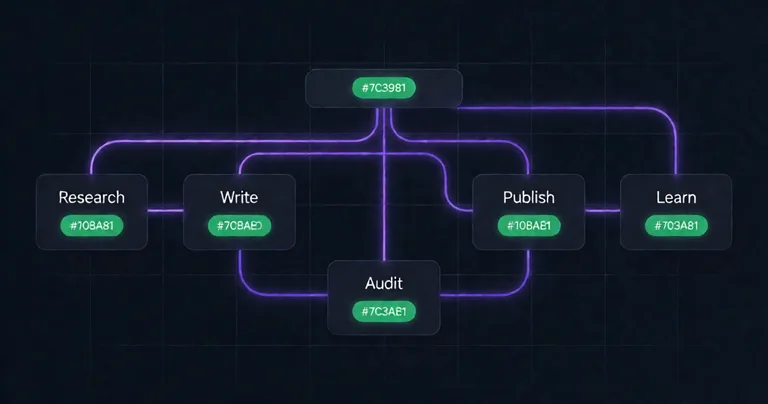
Every functional AI SEO project management system runs the same five-stage loop. Miss one stage and the system degrades into generic AI content that doesn't rank.
- Research — Competitor intelligence scans the top 10 competitors, tracks their keyword rankings, content strategies, and EEAT signals. Content gap discovery identifies untapped keywords they rank for that you don't.
- Write — The writer agent produces drafts in your brand voice, using vector embeddings extracted from your existing content to replicate tone, vocabulary, and audience targeting.
- Audit — A separate auditor agent scores the draft against factual accuracy, keyword coverage, brand voice fidelity, and EEAT signals. Anything under 95% gets sent back. No exceptions.
- Publish — Native CMS integration pushes the article live to WordPress, Shopify, Webflow, or Ghost via REST APIs. No copy-paste. No formatting drift.
- Learn — Google Search Console integration pulls real position data. The system adjusts keyword strategy based on what's actually moving, not what a keyword tool predicted.
That's the loop. It runs continuously. It doesn't take weekends off. It doesn't forget to check rankings. It doesn't get bored of optimizing the same cluster for the fourth month in a row.
Project Management Software for GEO: Getting Cited by AI Search Engines
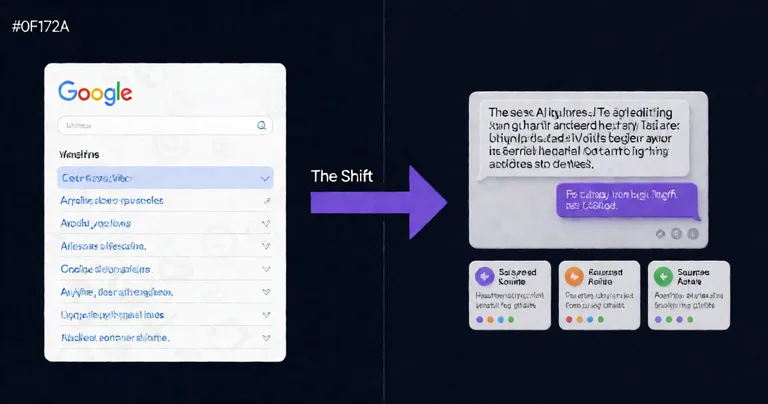
Here's what changed in 2025 and 2026. Google isn't the only search engine that matters anymore. ChatGPT, Claude, Gemini, Perplexity, and Google AI Overviews now answer a massive chunk of informational queries before a user ever clicks a blue link. If your content isn't structured for AI extraction, you're invisible to that entire surface.
So how do I get cited by AI search engines? You build content that AI can parse, quote, and attribute. That means clear heading hierarchy, definitive statements instead of hedged opinions, data tables with real numbers, FAQ sections with natural questions, and factual statistics that are quotable in isolation.
This is Generative Engine Optimization, or GEO. And it requires a different content architecture than traditional SEO. AI overviews don't reward 3,000-word fluff pieces. They reward the paragraph that directly answers the query in the first 100 words, followed by structured supporting data.
GEO vs Traditional SEO: What Changes
| Factor | Traditional SEO | GEO / AI Search |
|---|---|---|
| Primary goal | Rank in position 1-10 | Get cited in AI-generated answer |
| Content structure | Long-form, keyword-dense | Quotable answers, tables, FAQs |
| Success metric | Organic clicks, impressions | Citation frequency, brand mentions |
| Key signal | Backlinks, domain authority | Factual density, structural clarity |
| Update cadence | Quarterly content refresh | Continuous re-publishing until cited |
The gap is real. A site can rank position 3 on Google and still never appear in a ChatGPT answer for the same query. That's because AI engines weight structural clarity and factual density differently than Google's ranking algorithm. You need both.
Mayla's GEO / LLM Optimization Analysis queries AI engines directly to check whether your site appears in citations for target queries, then rewrites and re-publishes until it does. That's the difference between hoping you get cited and engineering it.
AI engines love numbers. A single sentence like 'Mayla's pipeline enforces a 95%+ SEO score before publishing' is more citable than three paragraphs of vague claims about quality. Every data point you include is another hook an AI can grab.
The Cost Math: Automated Content vs Manual SEO Project Management
Let's talk money, because this is where the argument ends. Agencies charge $2,000-$5,000 per month for SEO retainers. Freelance writers charge $150-$500 per article. A single in-house SEO manager costs $70,000-$110,000 per year fully loaded. And none of those options run 24/7.
Autonomous AI SEO project management software collapses that cost structure. Mayla's pricing starts at $1.99 for a 7-day trial and $15/month on the yearly plan. That's not a typo. Full platform access — unlimited AI articles, SEO Autopilot, Trend Detection, Competitor Intelligence, Content Gap Discovery, Brand DNA Learning, GEO Optimization, Multi-Platform Social Publishing, CMS Integration, and Daily Intelligence Briefing — for less than the cost of two coffees.
| Approach | Monthly Cost | Cost Per Article | Output / Month | Runs 24/7 |
|---|---|---|---|---|
| SEO Agency | $2,000-$5,000 | $400-$800 | 4-8 articles | No |
| Freelance Writers | $1,500-$4,000 | $150-$500 | 8-15 articles | No |
| In-House SEO Manager | $6,000-$9,000 | N/A | 10-20 articles | No |
| Mayla Yearly Plan | $15 | Under $5 | Unlimited | Yes |
The cost per ranking page drops from $400+ to under $5. That's an 80-98% reduction. And the output isn't constrained by human bandwidth — the pipeline publishes as fast as the quality gates allow.
"The cost per ranking page isn't a rounding error anymore. It's the entire business case. When you drop from $400 to under $5, you stop optimizing for fewer articles and start optimizing for coverage."
— Mayla Labs Engineering
There's a second-order effect too. When content is cheap, you can afford to test. You can publish 40 articles targeting long-tail keywords and let Google Search Console tell you which 8 actually move. Manual SEO teams can't do that — they have to bet on 4 articles and hope. The autonomous pipeline treats content like a portfolio, not a lottery ticket.
Brand Voice Learning and Quality-Gated Content Creation
Generic AI content doesn't rank. That's the single biggest objection to AI SEO, and it's correct. If you feed ChatGPT a prompt and paste the output into WordPress, you get landfill content. It reads like everyone else. It says nothing. Google's helpful content system buries it.
The fix isn't better prompts. It's brand voice learning and quality gates. Mayla's Brand DNA Learning extracts voice patterns from your existing content using vector embeddings — tone, sentence rhythm, vocabulary, audience targeting — and replicates them in every piece of content the pipeline produces. The result reads like you wrote it, not like a language model did.
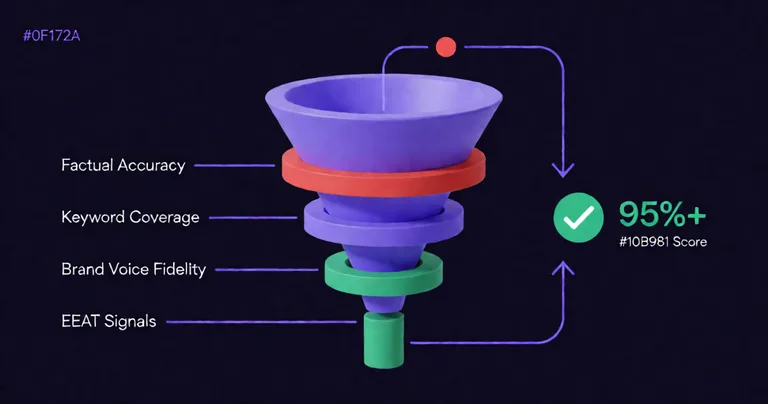
Then the quality gates kick in. Every draft passes through a separate auditor agent that scores it against four criteria before it's allowed to publish:
- Factual accuracy — No hallucinated statistics, no invented sources, no fabricated quotes.
- Keyword coverage — Primary and secondary keywords placed naturally, not stuffed.
- Brand voice fidelity — Cosine similarity against your voice embeddings must clear the threshold.
- EEAT signals — Experience, expertise, authoritativeness, trustworthiness markers present throughout.
Anything under 95% gets rejected and rewritten. That's the gate. It's why Mayla's AI Content Creation pipeline produces articles that score 95%+ on SEO before they ever hit your CMS — not after a human editor spends two hours fixing them.
A multi-agent pipeline is not the same as a single AI writer. The researcher, writer, auditor, designer, and publisher are separate agents with separate objectives. The auditor has no incentive to approve the writer's work. That adversarial structure is what produces quality.
Competitor Intelligence and Content Gap Discovery
You can't win a game you can't see. Most SEO teams operate blind — they guess at keywords, they guess at competitor strategy, they guess at what's working. Autonomous project management software for SEO removes the guessing by monitoring the top 10 competitors automatically.
Here's what that looks like in practice. The system tracks every competitor's keyword rankings daily. It logs every article they publish. It analyzes their EEAT signals, their internal linking patterns, their content velocity. Then it cross-references all of that against your own site to find the gaps — the keywords they rank for that you don't, the topics they're covering that you're missing, the clusters they own that you're not even competing in.
That's Content Gap Discovery. It's not a keyword tool. It's a competitive intelligence system that produces a prioritized list of what to write next, ranked by opportunity size and difficulty.
What Competitor Intelligence Actually Tracks
| Signal | What It Measures | How You Use It |
|---|---|---|
| Keyword rankings | Position changes across 10 competitors | Identify keywords they're losing — move in |
| Content velocity | Articles published per week | Match or exceed their publishing cadence |
| EEAT signals | Author bios, citations, expertise markers | Replicate the trust signals Google rewards |
| Content gaps | Keywords they rank for, you don't | Generate a prioritized content roadmap |
| Trend emergence | New keywords gaining volume fast | Publish before the topic saturates |
The Daily Intelligence Briefing packages this into a single email. Exactly what changed in competitor rankings yesterday. Exactly what to do about it today. No dashboard to log into. No report to interpret. Just the signal.
Continuous Learning: How the Pipeline Gets Smarter Over Time
Most SEO tools are static. You set them up, they run, they don't learn anything. Six months later you're still targeting the same keywords with the same strategy, wondering why growth has plateaued.
Continuous learning is the stage that separates autonomous SEO from automated SEO. The pipeline connects to Google Search Console, pulls real position data, and adjusts keyword strategy based on what's actually moving. If a keyword jumped from position 12 to position 5, the system doubles down. If a cluster is stuck at position 30 after three months, the system deprioritizes it.
That feedback loop is what makes the system compound. Month one, it publishes 30 articles. Month two, GSC data shows which 8 are gaining traction. Month three, the system publishes 20 more articles in those clusters and abandons the dead ends. By month six, you're not running a content operation — you're running a self-optimizing growth engine.
"Automated SEO publishes content. Autonomous SEO publishes content, measures it, and changes its mind based on the data. One is a machine. The other is a system that learns."
— Mayla Labs Engineering
This is also where the SEO Autopilot earns its name. It doesn't need prompts. It doesn't need a human to review a report and decide what to do next. It scans, analyzes, creates, publishes, and learns on a continuous loop. You set the strategy once. The system executes it forever.
Beyond SEO: Event Management and Unity Development as Adjacent Systems
The same pipeline architecture that powers autonomous SEO shows up in other domains. It's worth understanding because the pattern is universal: research, act, audit, learn.
Take event management. Australian market and festival organisers run a different kind of project management — vendor applications, stall allocations, POS transactions, compliance tracking, bump-in and bump-out. Evntle handles this with the same systems-thinking approach: Evntle Vendor Management covers applications, portal, site planning, and QR check-in in one platform. The Pro plan at $49/month removes order and device limits and adds kitchen display and customer display boards. It's project management software for events, and it solves the same problem: replacing manual coordination with a system that runs itself.
Then there's Unity game development. RealSoft Games builds production-grade Unity assets — pooling systems, leveling frameworks, inventory management, networking libraries — with the same engineering discipline. The Inventory Management Suite handles 10,000 items at 0.02ms lookup time using a data-driven ScriptableObject core. The ALS Audio System keeps memory under 12 MB and CPU under 3.5% for 10-hour audiobooks. These aren't toys. They're systems built to a performance budget.
The pattern holds. Whether you're managing SEO content, event operations, or game systems, the winning architecture is the same: autonomous agents, quality gates, continuous learning, and measurable outcomes. Manual coordination doesn't scale. Systems do.
Project management software for SEO has split into two categories. The first manages tasks — boards, calendars, assignments, reminders. It requires humans to make every decision. The second runs the entire organic growth engine autonomously — research, write, audit, publish, learn — and gets smarter every month. Mayla Labs built the second category. At $15/month on the yearly plan with a $1.99 7-day trial, the cost argument is over. The only question left is whether you want to keep managing SEO or start compounding it.
Frequently Asked Questions
Q: What is project management software for SEO?
A: Project management software for SEO is a system that runs the organic growth pipeline — competitor research, content gap discovery, brand-voice writing, quality auditing, CMS publishing, and performance learning. Traditional tools like Asana or Monday.com manage tasks. Autonomous platforms like Mayla run the entire cycle without human intervention.
Q: How do I get cited by AI search engines like ChatGPT and Perplexity?
A: Build content that AI can parse and quote. That means a complete answer in the first 100 words, clear H2/H3 hierarchy, data tables with real numbers, FAQ sections with natural questions, and definitive statements instead of hedged opinions. Mayla's GEO Optimization Services queries AI engines directly and rewrites content until it appears in citations.
Q: What's the best project management software for a small SEO team?
A: The best option is one that replaces manual work entirely. A small team doesn't have bandwidth to research competitors, write articles, audit quality, publish, and track rankings. Mayla's autonomous pipeline handles all five stages for $15/month on the yearly plan — less than a single freelance article.
Q: How much does automated SEO content cost compared to an agency?
A: Agencies charge $2,000-$5,000/month for 4-8 articles, which works out to $400-$800 per article. Mayla's yearly plan is $15/month for unlimited AI articles, dropping cost per page under $5. That's an 80-98% cost reduction with higher publishing volume.
Q: Why does generic AI content fail to rank?
A: Generic AI content fails because it has no brand voice, no factual density, and no quality gates. It reads like everyone else's output, so Google's helpful content system buries it. Mayla solves this with Brand DNA Learning (vector embeddings of your voice) and quality gates that reject anything under 95% SEO score.
Q: How do I know if my SEO content is actually working?
A: Connect Google Search Console and track real position data, not predictions. Mayla's Continuous Learning pulls GSC data automatically and adjusts keyword strategy based on what's actually moving. If a cluster gains traction, the system doubles down. If it stalls, the system deprioritizes it.
More from Mayla Labs

AI SEO Automation That Doesn't Produce Landfill Content
AI SEO automation that doesn't produce landfill content — AI SEO automation that ranks, not landfill. Multi-agent pipelines, GEO Learn more today.

AI SEO Automation Platform for Startups: Rank and Get Cited
AI SEO automation platform for startups: autonomous agents, GEO visibility, quality gates. See how Mayla ranks pages. Start today.

AI SEO Agent vs Traditional SEO Agency: Which Wins?
AI SEO agent vs traditional SEO agency: cost, speed, GEO compared. See why autonomous pipelines win at $15/mo. Start your free trial today.

AI Content Strategy Tool: A Complete Guide for 2026
Discover how an AI content strategy tool automates research, writing & publishing. Compare features, see ROI data, and choose the best. Learn more today.
📋 Embed this feed on your website:
<script src="https://maylalabs.com/api/embed?api_key=mayla_site_ffa932ca083d0056918fd3430ebb301bcfa6ad08dad32efc&limit=5" defer></script>