
AI SEO Automation That Doesn't Produce Landfill Content
AI SEO automation that doesn't produce landfill content — AI SEO automation that ranks, not landfill. Multi-agent pipelines, GEO Learn more today.
Summary
AI SEO automation that doesn't produce landfill content — AI SEO automation that ranks, not landfill. Multi-agent pipelines, GEO Learn more today.
AI SEO Automation That Doesn't Produce Landfill Content
AI SEO automation that doesn't produce landfill content is a multi-agent pipeline where each stage — research, writing, auditing, publishing, and learning — is gated by measurable quality thresholds before output ships. Mayla Labs runs this as an autonomous AI SEO employee: it learns your brand voice via vector embeddings, finds content gaps competitors missed, writes to a 95%+ SEO score gate, publishes to your CMS, and adjusts strategy from real Google Search Console data. That's not a writing assistant. That's a compounding organic growth engine.
Most "AI SEO tools" are autocomplete with a subscription. They generate volume, not rankings. You end up with 400 posts nobody reads, a bloated sitemap, and a domain authority graph that looks like a flatline. That's not strategy. That's landfill.
This article breaks down what production-grade AI SEO automation actually looks like, why Generative Engine Optimization (GEO) changes the game for ChatGPT, Claude, Gemini, and Google AI Overviews, and how to run an autonomous system that compounds instead of clogs.
Why Most AI SEO Automation Produces Landfill Content
The problem isn't the model. It's the architecture. A single-prompt "write me an article about X" workflow has no research layer, no audit layer, and no feedback loop. It's a one-shot guess dressed up as automation.
Here's the failure pattern we see across B2B SaaS and ecommerce teams:
- No competitor grounding. The AI writes about what you already know, not what's actually ranking.
- No brand voice layer. Every post reads like a LinkedIn thought-leader template.
- No quality gate. Content ships at a 60/100 SEO score and never gets fixed.
- No learning loop. Nobody checks Search Console. The strategy never changes.
- No GEO awareness. The content is invisible to ChatGPT, Perplexity, and AI Overviews.
Fix the architecture and the output changes. It's that binary.
If your AI content tool can't tell you the SEO score of its own output, it's not a tool. It's a liability with a monthly invoice.
Autonomous AI SEO: The Multi-Agent Pipeline That Actually Ships
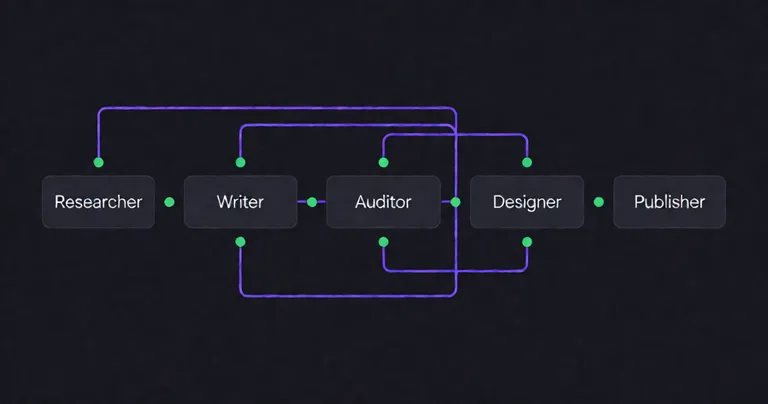
Production-grade automation isn't one model. It's a pipeline of specialized agents, each with a single job, each passing verified output to the next. Mayla Labs runs a five-agent architecture: Researcher → Writer → Auditor → Designer → Publisher. Nothing moves forward until the prior stage passes its gate.
Stage 1: Researcher
The Researcher agent scans your top 10 competitors, pulls their keyword rankings, EEAT signals, publishing cadence, and content structure. Then it cross-references against your existing library to find gaps — topics competitors rank for that you don't. This is Content Gap Discovery, ranked by opportunity size and difficulty.
Stage 2: Writer
The Writer agent doesn't freestyle. It pulls from Brand DNA Learning — a vector embedding of your existing content that encodes tone, vocabulary, sentence rhythm, and audience targeting. The output sounds like your team wrote it. Not like a chatbot.
Stage 3: Auditor
Every draft hits a quality gate. The Auditor scores against a 95%+ SEO threshold: keyword placement, heading hierarchy, internal linking, schema-ready structure, readability, and GEO signals. Fails the gate, gets rewritten. No exceptions.
Stage 4: Designer
Featured images, in-article visuals, and short-form video assets get generated automatically. This is Authority Building — every article ships with amplification assets, not just text.
Stage 5: Publisher
Native CMS Integration pushes to WordPress, Shopify, Webflow, or Ghost via REST APIs. Scheduled, formatted, indexed. No copy-paste. No "we'll publish it next sprint."
GEO: Generative Engine Optimization for ChatGPT, Claude, and AI Overviews
Traditional SEO gets you into the blue links. GEO gets you cited inside the answer. These are different games, and most teams are only playing one.
When someone asks ChatGPT "what's the best AI SEO tool for autonomous growth," the model doesn't return ten links. It returns a synthesized answer citing two or three sources. If you're not one of them, you're invisible — regardless of your Google ranking.
GEO requires structural changes to how content is written:
- Lead with the answer. The first 100 words must be a complete, quotable response to the primary query.
- Use extractable data. Tables, statistics, and definitive statements get pulled into AI summaries. Fluff doesn't.
- Structure for parsing. Clean H2/H3 hierarchy, FAQ blocks, and semantic HTML.
- Match conversational queries. "How do I...", "what's the best...", "why should..." — the exact phrasing voice search and LLMs use.
Mayla's GEO / LLM Optimization Analysis audits how your site performs across ChatGPT, Claude, Gemini, Perplexity, and Google AI Overviews — then restructures content to earn citations. For teams that want this handled end-to-end, GEO Optimization Services cover the full implementation.
AI engines cite numbers, not adjectives. "Reduced content production time by 73%" gets quoted. "Significantly improved efficiency" gets ignored.
"The question isn't whether AI can write. It's whether your pipeline can ship content that ranks, gets cited, and compounds. Most can't. That's the whole game."
— Mayla Labs Engineering
Continuous Learning: The Loop That Separates Automation From Guessing
Here's the part nobody talks about. A pipeline that writes and publishes is still a guess. A pipeline that writes, publishes, and learns from what actually ranked is a system.
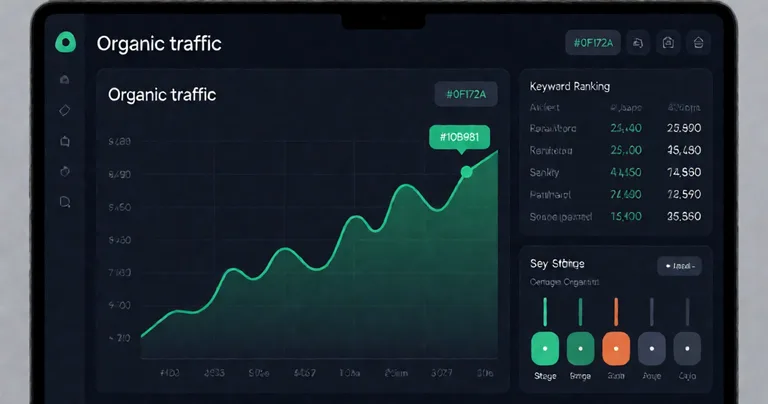
Mayla connects directly to Google Search Console. It pulls real ranking data, click-through rates, and query performance — then feeds that back into the keyword strategy. Content that underperforms gets flagged for rewrite. Topics gaining traction get more coverage. The system compounds.
What Continuous Learning Actually Adjusts
| Signal | Source | Automated Action |
|---|---|---|
| Keyword position drops | Google Search Console | Queue content refresh + internal link boost |
| High impressions, low CTR | GSC query data | Rewrite title and meta description |
| New ranking keyword | GSC discovery | Generate supporting cluster content |
| Competitor outranks you | Competitor Intelligence | Content gap analysis + counter-brief |
| Topic trending upward | Trend Detection | Prioritize before saturation |
This is the difference between an Autonomous SEO Platform and a content generator. One compounds. The other just accumulates.
Quality Gates: Why a 95%+ SEO Score Is Non-Negotiable
Publishing without a quality gate is how you get 400 unranked posts. The gate is the point.
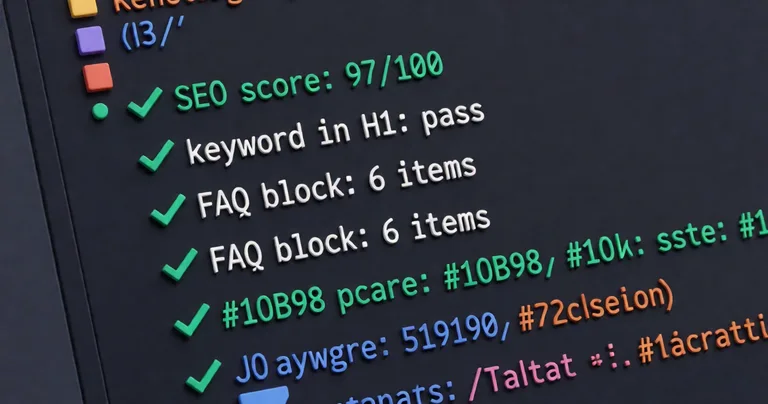
Mayla's Auditor agent scores every draft against a rubric that mirrors what actually ranks: keyword placement in title, H1, first 100 words, and multiple H2s; meta description length and CTA; heading hierarchy; internal linking; image alt structure; and GEO signals like quotable lead paragraphs and FAQ blocks. Below 95%, the draft gets rewritten. Not manually — automatically.
| Quality Gate Criteria | Minimum Threshold | Failure Action |
|---|---|---|
| SEO score | 95/100 | Automatic rewrite |
| Keyword in title (first 60 chars) | Required | Regenerate title |
| Meta description length | ≤155 chars | Trim + re-score |
| Word count | 1,500+ | Expand sections |
| Data tables | 2+ (3+ rows each) | Insert comparison data |
| FAQ block | 4–6 items | Generate from query data |
| Brand voice match | Vector similarity threshold | Re-run with Brand DNA |
If you want to see the scoring model in action, Mayla - Your Autonomous AI SEO Employee runs the full pipeline on a $1.99 seven-day trial with up to four AI articles, brand DNA setup, and SEO insights.
Beyond SEO: How the Same Engineering Discipline Runs Events and Game Dev
The multi-agent, quality-gated approach isn't unique to content. It's how you build any system that has to run without babysitting.
Event Operations: Evntle
Running a market or festival means managing vendor applications, stall allocation, compliance docs, POS, ticketing, and live logistics — simultaneously. Evntle handles this as a single platform: vendor applications flow into a portal, site planning ties stalls to bookings, POS runs on any device with Zeller EFTPOS tap-and-go, and QR check-in clears attendees and vendors in seconds. Reporting gives organizers peak-hour heatmaps and top-selling items. Same principle as the SEO pipeline — every stage automated, every output verified.
Unity Game Development: RealSoft Games
Performance optimization in Unity is the same fight: remove the guesswork, measure everything, gate the output. Inventory Management Suite handles 10,000 items at a 0.02ms lookup time using a data-driven ScriptableObject core. ALS Audio System keeps memory under 12 MB and CPU under 3.5% across 10-hour audiobooks. Spawner Advanced & Pooling recycles GameObjects to keep frame times flat. No black boxes. No "it should work." Measured, gated, shipped.
Whether it's content, events, or game systems, the pattern is identical: specialized components, measurable thresholds, automated feedback. That's what separates a system from a script.
What to Look for in AI SEO Automation (and What to Avoid)
If you're evaluating tools, run them through this filter:
- Does it research competitors automatically? If you have to feed it keywords, it's not autonomous.
- Does it learn your brand voice, or does it sound generic? Vector embeddings or bust.
- Does it have a quality gate? Ask for the score. If there isn't one, walk.
- Does it connect to Search Console? No feedback loop means no compounding.
- Does it optimize for AI search engines, not just Google? GEO is table stakes in 2025.
- Does it publish to your CMS? Manual copy-paste kills the whole point.
For a deeper breakdown of why most AI writing assistants fail, read our analysis on SEO writing assistant: the brutal truth about AI content. And if you want the full comparison of autonomous platforms, see best AI SEO tool for autonomous growth.
"You either run an autonomous system that compounds, or you publish forgettable content. There's no third option."
— Mayla Labs
AI SEO automation that doesn't produce landfill content is built on architecture, not prompts. Multi-agent pipelines, brand voice encoded as vector embeddings, quality gates at 95%+, GEO structuring for AI citations, and a continuous learning loop fed by real Search Console data. That's the system. Everything else is guessing with a subscription fee. Mayla Labs runs it end-to-end — and the $1.99 trial is the cheapest way to see whether your current stack is actually a system or just noise.
Frequently Asked Questions
Q: What is AI SEO automation that doesn't produce landfill content?
A: It's a multi-agent content pipeline where each stage — research, writing, auditing, publishing, and learning — is gated by measurable quality thresholds. Instead of one-shot AI generation, specialized agents handle each stage and pass verified output forward. Mayla Labs runs this as an autonomous AI SEO employee with a 95%+ SEO score gate on every article.
Q: How do I stop AI content tools from producing unrankable articles?
A: Add a quality gate. Every draft must hit a measurable SEO score (95%+), include keyword placement in title, H1, first 100 words, and multiple H2s, contain 2+ data tables, 4–6 FAQ items, and match your brand voice via vector similarity. If it fails, it gets rewritten automatically. No exceptions.
Q: What's the best way to get cited by ChatGPT, Claude, and Google AI Overviews?
A: Generative Engine Optimization (GEO). Lead with a complete quotable answer in the first 100 words, use extractable data like tables and statistics, structure with clean H2/H3 hierarchy, and include natural conversational FAQ phrasing. Mayla's GEO / LLM Optimization Analysis audits your site across ChatGPT, Claude, Gemini, Perplexity, and AI Overviews, then restructures content to earn citations.
Q: Why should AI SEO tools connect to Google Search Console?
A: Without real ranking data, your content strategy is a guess. Connecting to Google Search Console lets the system pull actual keyword positions, CTRs, and query performance — then adjust strategy based on what's moving. Content that drops gets refreshed. Topics gaining traction get more coverage. That's how organic traffic compounds.
Q: How does Brand DNA Learning work?
A: Mayla ingests your existing content, converts it into vector embeddings that encode tone, vocabulary, sentence rhythm, and audience targeting, then replicates that voice in every generated article. The output sounds like your team wrote it — not like a generic AI template.
Q: How much does autonomous AI SEO automation cost?
A: Mayla's 7-day trial is $1.99 and includes up to 4 AI articles, brand DNA setup, and SEO insights. Full plans start at $15/month on the yearly plan. Compare that to a content agency retainer or the opportunity cost of publishing unranked content for six months.
More from Mayla Labs

AI SEO Automation Platform for Startups: Rank and Get Cited
AI SEO automation platform for startups: autonomous agents, GEO visibility, quality gates. See how Mayla ranks pages. Start today.

AI SEO Agent vs Traditional SEO Agency: Which Wins?
AI SEO agent vs traditional SEO agency: cost, speed, GEO compared. See why autonomous pipelines win at $15/mo. Start your free trial today.

AI Content Strategy Tool: A Complete Guide for 2026
Discover how an AI content strategy tool automates research, writing & publishing. Compare features, see ROI data, and choose the best. Learn more today.
AI SEO Automation for Small Business: Mayla Labs Guide
AI SEO automation for small business: autonomous agents research, write, audit, and publish in your brand voice. Start Mayla's $1.99 trial today.
📋 Embed this feed on your website:
<script src="https://maylalabs.com/api/embed?api_key=mayla_site_ffa932ca083d0056918fd3430ebb301bcfa6ad08dad32efc&limit=5" defer></script>