
AI SEO Agent vs Traditional SEO Agency: Which Wins?
AI SEO agent vs traditional SEO agency: cost, speed, GEO compared. See why autonomous pipelines win at $15/mo. Start your free trial today.
Summary
AI SEO agent vs traditional SEO agency: cost, speed, GEO compared. See why autonomous pipelines win at $15/mo. Start your free trial today.
AI SEO Agent vs Traditional SEO Agency: Which Wins?
An AI SEO agent is autonomous software that researches competitors, finds content gaps, writes in your brand voice, audits quality, and publishes on a continuous loop for around $15/month. A traditional SEO agency is a human team that charges $2,000–$10,000/month for strategy, content, and link building. The AI SEO agent wins on cost per ranking page, publishing velocity, and Generative Engine Optimization (GEO) coverage. The agency wins on high-stakes brand strategy and relationship-driven link acquisition. For most SaaS, e-commerce, real estate, and service businesses, the answer is an autonomous pipeline — not a retainer.
That's not a hot take. That's math. Let's break down exactly where each model wins, where it fails, and how to decide without wasting six months and $30,000 finding out the hard way.
What Is an AI SEO Agent and How Does It Differ From an Agency?
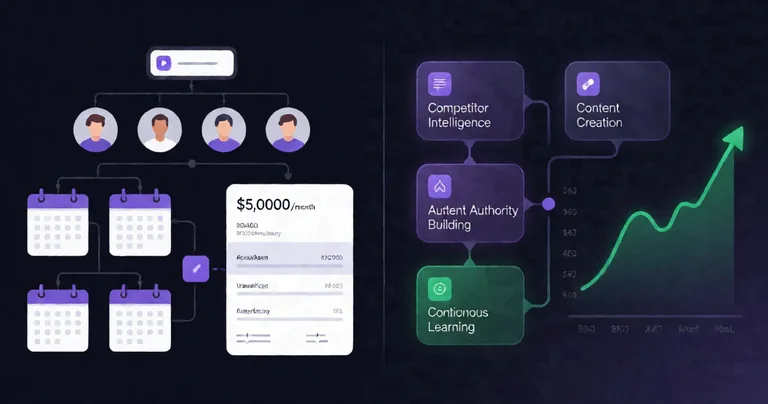
An AI SEO agent is a multi-agent pipeline that runs the entire content lifecycle without human intervention. It scans your top 10 competitors, discovers keywords they rank for that you don't, writes articles in your learned brand voice, runs them through quality gates, publishes to your CMS, and then tracks ranking outcomes to adjust the next cycle.
A traditional SEO agency is a service business. You pay a retainer. You get a strategist, a writer or two, and maybe a link builder. Output depends on how many hours your account gets. Communication runs through email and monthly reports. The feedback loop between publishing and strategy is measured in weeks, not hours.
The core difference isn't AI versus human. It's loop speed. An autonomous agent closes the research-to-ranking loop continuously. An agency closes it once a month, if you're lucky.
The Four Phases of an Autonomous AI SEO System
- Competitor Intelligence — Monitors your top 10 competitors automatically, tracking keyword rankings, content strategies, and EEAT signals.
- AI Content Creation — A quality-gated pipeline that goes Research → Write → Audit → Final, requiring a 95%+ SEO score before publishing.
- Authority Building — Amplifies every article with AI-generated featured images, short-form videos, and automated social distribution.
- Continuous Learning — Tracks ranking outcomes against real Google position data and adjusts keyword strategy based on what actually moved.
That four-phase cycle is what Mayla runs on autopilot. It's not a content generator with a keyword tool bolted on. It's an autonomous employee that learns your brand and compounds output.
An AI SEO agent is autonomous software that performs the full SEO content lifecycle — research, writing, auditing, publishing, and optimization — without human intervention. A traditional SEO agency performs the same tasks manually, billed hourly or on retainer.
AI SEO Agent vs Traditional SEO Agency: Cost and Output Compared
Let's put numbers on the table. Vague claims are useless. Here's what each model actually costs and produces.
| Factor | AI SEO Agent | Traditional SEO Agency |
|---|---|---|
| Monthly cost | $15–$29 | $2,000–$10,000 |
| Cost per article | Under $5 | $150–$500 |
| Articles per month | Unlimited (150+ on monthly plan) | 4–12 |
| Publishing velocity | Daily | Weekly to monthly |
| Feedback loop | Continuous (GSC data) | Monthly report |
| GEO / LLM optimization | Built-in | Rarely offered |
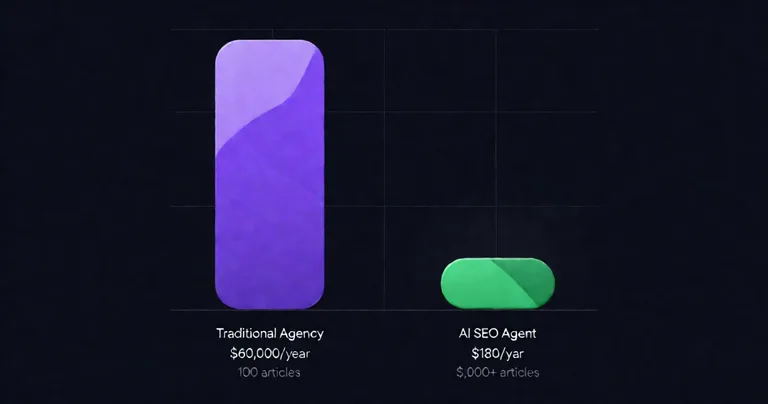
Run the math on a single year. An agency at $5,000/month costs $60,000 and produces maybe 100 articles. An AI SEO agent at $15/month costs $180 and produces 1,000+ articles. That's a 333x cost difference per ranking page.
"You're not paying an agency for content. You're paying for their calendar. And their calendar doesn't scale."
— Mayla Labs engineering team
Now, how much does an AI SEO agent cost in practice? Mayla starts at a $1.99 7-day trial and $15/month on the yearly plan. That's less than a single agency blog post. The Mayla 7-Day Trial gives you up to 4 AI articles, brand DNA setup, and SEO insights so you can verify output quality before committing.
Why Generative Engine Optimization (GEO) Changes the Equation
GEO is the practice of optimizing content to be cited by AI search engines — ChatGPT, Claude, Gemini, Perplexity, and Google AI Overviews. It's the fastest-growing channel in search, and most agencies don't offer it.
Here's why it matters. When someone asks ChatGPT "what's the best CRM for real estate," the model doesn't return ten blue links. It returns a synthesized answer citing two or three sources. If your content isn't structured for extraction — clear headings, data tables, definitive statements, FAQ blocks — you don't get cited. You don't exist.
Traditional agencies optimize for Google's crawler. AI SEO agents optimize for both Google and LLM retrieval. That's a structural advantage, not a feature.
Want to know how your site performs across AI search engines right now? Run a GEO / LLM Optimization Analysis before you spend another dollar on traditional SEO. The gap is usually bigger than you think.
What GEO Requires That Agencies Rarely Deliver
- Quotable first paragraphs — the first 100 words must answer the query completely.
- Data tables — AI models extract structured comparisons faster than prose.
- FAQ blocks — natural question phrasing matches voice search and LLM prompts.
- Definitive statements — hedging language gets ignored by AI overviews.
- Consistent publishing velocity — LLMs favor sources that update frequently.
An autonomous pipeline bakes all five into every article by default. A human agency has to be trained on GEO, and most haven't been. If you want to see what AI search engine optimization looks like in practice, AI Search Engine Optimization breaks down the full playbook.
Brand Voice, Quality Gates, and the Content Landfill Problem
Let's address the obvious objection. "AI content is landfill." True — most of it. Generic AI tools produce generic output because they have no brand context and no quality gate.
An autonomous AI SEO agent solves this with two mechanisms: Brand DNA Learning and quality gates.
Brand DNA Learning ingests your existing content, tone, vocabulary, and audience targeting. It builds a voice profile. Every article it writes replicates that profile — not a generic "professional and engaging" template.
Quality gates are the second mechanism. Mayla's AI Content Creation Pipeline runs five agents: Researcher, Writer, Auditor, Designer, Publisher. The Auditor agent requires a 95%+ SEO score before anything publishes. Failing content gets rewritten, not shipped.
| Pipeline Stage | Agent Role | Output |
|---|---|---|
| 1. Research | Researcher | Competitor gaps, keyword clusters, SERP analysis |
| 2. Write | Writer | Draft in learned brand voice |
| 3. Audit | Auditor | 95%+ SEO score gate, GEO checks |
| 4. Design | Designer | Featured images, social assets |
| 5. Publish | Publisher | CMS push, social distribution |
That's the difference between a content generator and an autonomous SEO employee. One produces drafts. The other produces ranking pages.
"If your AI content pipeline doesn't have a quality gate, you're not running a pipeline. You're running a landfill."
— Mayla Labs engineering team
How Zero-Allocation Architecture Makes Autonomous SEO Fast
Performance matters even in SEO. An autonomous agent that takes 40 minutes to generate an article is a bottleneck. Mayla's pipeline is built on zero-allocation, high-performance architecture — the same engineering discipline we apply to Unity game systems.
Zero-allocation means no garbage collection spikes during processing. No memory churn. Predictable frame budgets. The same principles that keep a VR action RPG running at 90fps keep a content pipeline processing competitor data in real time.
This isn't theoretical. Our Unity tools like Spawner Advanced & Pooling recycle GameObjects to eliminate GC spikes, and our Interactable System handles 200+ objects with zero allocations at 0.6ms frame cost. We apply identical discipline to the SEO platform. Same architecture, different domain.
Why does this matter to a marketing lead? Because speed compounds. A pipeline that researches, writes, and publishes in minutes can run daily. A pipeline that takes hours runs weekly. Over a year, that's 365 articles versus 52. Velocity wins.
Don't confuse "fast" with "careless." Speed without quality gates produces landfill at scale. The pipeline must audit before it publishes — every single time.
When a Traditional SEO Agency Still Makes Sense
We're not going to pretend agencies are useless. They're not. There are three scenarios where a human agency beats an autonomous agent.
1. High-Stakes Brand Strategy
If you're repositioning a category-defining brand, you need human judgment. An AI agent executes a strategy. It doesn't invent one from scratch.
2. Relationship-Driven Link Acquisition
Digital PR and podcast placements require human relationships. An AI agent can do outreach at scale, but it can't close a partnership over coffee.
3. Regulated Industries With Nuance
Healthcare, finance, and legal content sometimes needs subject-matter review. An AI agent can draft and audit, but a human expert should sign off.
For everything else — SaaS blog content, e-commerce category pages, real estate listings, service business location pages — the autonomous agent wins on every metric that matters.
If you're in real estate, for example, Homes for Sale SEO shows how an autonomous pipeline handles listing content at scale. If you're in fashion, Women's Fashion AI SEO covers the same approach for product-led content. The pattern holds across verticals.
How to Decide: A Practical Framework
Ask yourself three questions.
- How many articles do you need per month? Under 4? Agency might work. Over 10? Autonomous agent wins.
- Do you need GEO coverage? If AI search engines matter to your traffic, you need a pipeline built for it.
- What's your cost ceiling per ranking page? If it's under $50, an agency can't compete.
If you answered "10+", "yes", and "under $50" — you already know the answer. The Mayla Autonomous SEO Platform was built for exactly that profile.
The best move is to run both in parallel for 30 days. Keep your agency. Deploy an autonomous agent. Compare cost per ranking page, publishing velocity, and GEO citation rate. The data will make the decision for you.
Frequently Asked Questions
Q: What is an AI SEO agent?
A: An AI SEO agent is autonomous software that performs the full SEO content lifecycle — competitor research, content gap discovery, writing, quality auditing, publishing, and continuous optimization — without human intervention. It runs on a continuous loop and learns from ranking outcomes.
Q: How much does an AI SEO agent cost?
A: Mayla starts at $1.99 for a 7-day trial and $15/month on the yearly plan. That's under $5 per article at typical output volumes. Traditional SEO agencies charge $2,000–$10,000/month for 4–12 articles.
Q: Can an AI SEO agent replace my traditional SEO agency?
A: For content-driven SEO — blog posts, category pages, location pages, listing content — yes. For high-stakes brand strategy, digital PR, and relationship-driven link acquisition, a human agency still adds value. Most businesses should run both for 30 days and compare cost per ranking page.
Q: What is GEO and why does it matter for AI SEO?
A: GEO stands for Generative Engine Optimization. It's the practice of optimizing content to be cited by AI search engines like ChatGPT, Claude, Gemini, Perplexity, and Google AI Overviews. It matters because AI search is replacing traditional search for informational queries, and most traditional agencies don't offer GEO.
Q: How do I know if AI-generated SEO content will match my brand voice?
A: Look for Brand DNA Learning. Mayla ingests your existing content, tone, vocabulary, and audience targeting to build a voice profile, then replicates it in every article. Combined with a 95%+ quality gate, output matches your brand without manual editing.
Q: What's the best AI SEO tool for autonomous growth?
A: The best tool runs the full four-phase cycle — Competitor Intelligence, AI Content Creation, Authority Building, and Continuous Learning — with quality gates and GEO built in. Mayla is purpose-built for autonomous growth with CMS integration, Google Search Console data, and unlimited articles on the yearly plan.
The AI SEO agent vs traditional SEO agency debate isn't about AI replacing humans. It's about loop speed, cost per ranking page, and GEO coverage. Agencies sell calendars. Autonomous pipelines sell compounding output. For most businesses, the math is not close. Start with a $1.99 trial, run both models for 30 days, and let the ranking data decide. That's not strategy. That's just reading the numbers.
More from Mayla Labs

AI SEO Automation That Doesn't Produce Landfill Content
AI SEO automation that doesn't produce landfill content — AI SEO automation that ranks, not landfill. Multi-agent pipelines, GEO Learn more today.

AI SEO Automation Platform for Startups: Rank and Get Cited
AI SEO automation platform for startups: autonomous agents, GEO visibility, quality gates. See how Mayla ranks pages. Start today.

AI Content Strategy Tool: A Complete Guide for 2026
Discover how an AI content strategy tool automates research, writing & publishing. Compare features, see ROI data, and choose the best. Learn more today.
AI SEO Automation for Small Business: Mayla Labs Guide
AI SEO automation for small business: autonomous agents research, write, audit, and publish in your brand voice. Start Mayla's $1.99 trial today.
📋 Embed this feed on your website:
<script src="https://maylalabs.com/api/embed?api_key=mayla_site_ffa932ca083d0056918fd3430ebb301bcfa6ad08dad32efc&limit=5" defer></script>