
Men's Fashion AI SEO: Rank Autonomously in 2026
Men's fashion AI SEO in 2026: run an autonomous multi-agent pipeline that ranks in Google and gets cited by AI. Start your $1.99 trial today.
Summary
Men's fashion AI SEO in 2026: run an autonomous multi-agent pipeline that ranks in Google and gets cited by AI. Start your $1.99 trial today.
Men's Fashion AI SEO: Rank Autonomously in 2026
Men's fashion AI SEO is the practice of running an autonomous, multi-agent content pipeline that researches competitor gaps, writes in your brand voice, audits every draft to a 95%+ SEO score, publishes to your CMS, and then learns from real Google Search Console position data. It replaces the manual cycle of keyword spreadsheets, agency briefs, and generic AI filler. The result is measurable: cost per ranking page drops under $5, and the system keeps compounding while you sleep. Mayla runs that loop end to end — research, write, audit, publish, learn — so your menswear brand ranks in Google and gets cited by ChatGPT, Claude, Gemini, and Perplexity.

The men's fashion market is brutal online. Big-box retailers and marketplaces dominate the head terms. Indie labels, made-to-measure tailors, and streetwear drops fight for scraps. Generic AI content made it worse — 60% of the web is now synthetic, and Google's helpful content systems are actively demoting it. That's not strategy. That's landfill.
This article breaks down exactly how autonomous AI SEO works for men's fashion brands in 2026, what GEO (Generative Engine Optimization) actually means for AI search citations, and how to run the whole thing without hiring an agency or babysitting a content calendar.
Why Men's Fashion AI SEO Beats Manual Content in 2026
Manual SEO for a fashion brand is a slow bleed. You brief a writer, wait two weeks, get a draft that misses the keyword, edit it, publish it, wait three months, and discover it ranks on page four. Repeat. Cost per ranking page: $400 to $1,200. Meanwhile your competitor ships 40 articles a month.
Autonomous AI SEO flips the unit economics. The pipeline does the same work in minutes, at a fraction of the cost, and it never forgets to check the keyword coverage or the EEAT signals before publishing.
| Metric | Manual / Agency | Autonomous AI SEO (Mayla) |
|---|---|---|
| Cost per published article | $400 – $1,200 | Under $5 |
| Time from brief to publish | 10 – 21 days | Under 30 minutes |
| Articles per month (typical) | 4 – 8 | 150+ |
| SEO score threshold before publish | Ad hoc | 95%+ enforced by quality gate |
| Competitor monitoring | Monthly report | Daily intelligence briefing |
| GEO / AI citation tracking | Rarely done | Continuous, per query |
The math is not close. But cost is only half the story. The other half is that autonomous systems compound. Every article feeds the next one — the brand voice model gets sharper, the competitor gap map gets more complete, and the GSC data tells the system which keywords are actually moving.
Don't measure AI SEO by articles published. Measure by ranking pages per dollar and citations in AI overviews. Mayla's dashboard tracks both — cost per ranking page and GEO citation rate — so you can kill what isn't working and double down on what is.
How Multi-Agent Content Pipelines Build Men's Fashion Authority
A single AI writer produces slop. A multi-agent pipeline with quality gates produces publishable content. The difference is architecture.
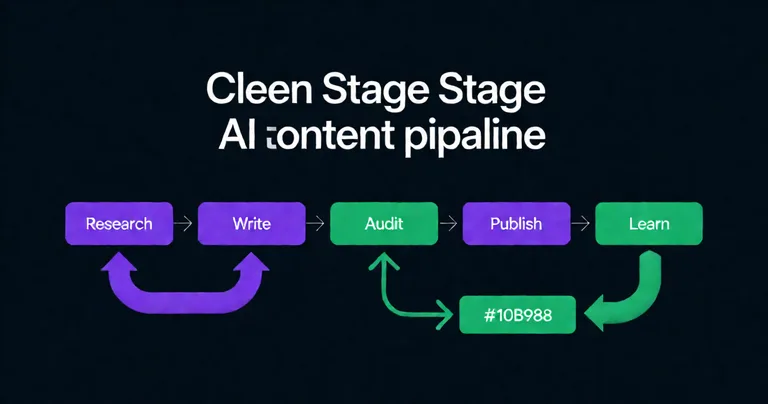
The Research → Write → Audit → Publish → Learn Loop
Mayla's AI Content Creation pipeline runs five distinct agents in sequence, each with a specific job and a pass/fail gate:
- Researcher agent — pulls the top 10 competitors for your target keywords, maps their content gaps, and identifies what they rank for that you don't.
- Writer agent — drafts the article using your brand DNA (tone, vocabulary, sentence rhythm, audience targeting).
- Auditor agent — scores the draft against factual accuracy, keyword coverage, brand voice fidelity, and EEAT signals. Anything under 95% SEO score gets kicked back.
- Designer agent — generates the featured image, in-article visuals, and short-form video assets.
- Publisher agent — pushes the article live to WordPress, Shopify, Webflow, or Ghost via REST API, then distributes across social.
Then the learning loop closes. The system pulls Google Search Console data, checks which pages are climbing, and adjusts the keyword strategy for the next batch. This is not a one-shot prompt. It's a compounding engine.
Brand Voice Learning: Why Generic AI Content Fails in Fashion
Fashion is voice-driven. A heritage tailoring brand and a drop-culture streetwear label cannot sound the same. Generic AI content flattens everything into the same mid-Atlantic mush. That's why it doesn't rank.
Mayla's Brand DNA Learning extracts voice patterns from your existing content using vector embeddings — sentence length, vocabulary, tone, formality, even the way you talk about fit and fabric. The writer agent then replicates that voice across every article. For a women's fashion brand, the same principle applies — see how women's fashion AI SEO works autonomously for the parallel playbook.
"A 95% SEO score is not a vanity metric. It's the gate that stops landfill content from ever reaching your CMS."
— Mayla Labs engineering
GEO and AI Search Citations for Men's Fashion Brands
Google is no longer the only search engine that matters. ChatGPT, Claude, Gemini, Perplexity, and Google AI Overviews now answer millions of product and style queries every day. If your brand isn't cited in those answers, you're invisible to a growing share of buyers.
GEO — Generative Engine Optimization — is the discipline of getting cited. It's different from SEO. Rankings don't matter if the AI overview never mentions you. Citations do.
What AI Engines Actually Cite
AI engines prefer content that is definitive, structured, and quotable. They extract tables, numbered steps, clear definitions, and specific numbers. Vague marketing copy gets skipped. Here's what gets pulled into AI answers:
| Content Element | AI Citation Likelihood | Why |
|---|---|---|
| Data tables with specs | Very high | Structured, extractable, factual |
| Numbered how-to steps | High | Directly answers voice queries |
| FAQ blocks with natural questions | High | Matches conversational query patterns |
| Definitive statements with numbers | High | Quotable and authoritative |
| Generic marketing prose | Very low | No extractable value |
Mayla's GEO / LLM Optimization Analysis queries AI engines directly against your target terms, checks whether your site appears in the citations, and if it doesn't, rewrites and re-publishes until it does. That's not a report. That's a loop.
GEO is not a replacement for SEO. It's an additional surface. A page that ranks #3 in Google and gets cited in Perplexity for the same query is doing double duty. Mayla optimizes for both in the same pipeline.
Competitor Intelligence and Content Gap Discovery
You cannot outrank competitors you aren't watching. Mayla's Competitor Intelligence monitors your top 10 competitors automatically — keyword rankings, content strategies, publishing cadence, and EEAT signals. Every day. Not monthly.
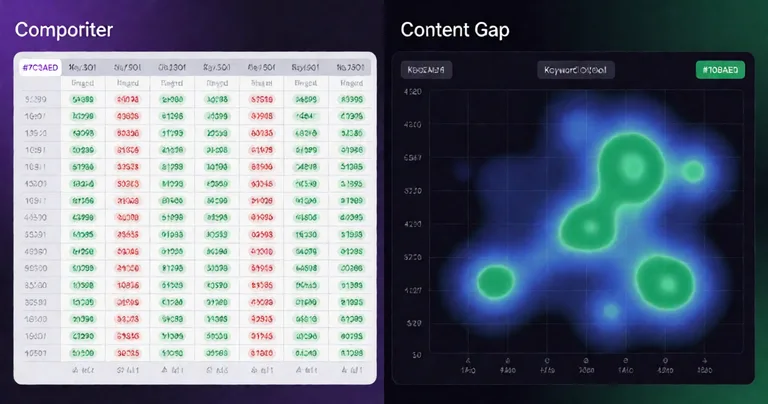
The output is a content gap map: keywords your competitors rank for that you don't. This is where the leverage is. A men's fashion brand that discovers 300 untapped long-tail keywords before its competitors do wins the next 12 months of organic traffic.
How Content Gap Discovery Actually Works
- Pull competitor ranking data daily across your target keyword set
- Cross-reference against your own GSC position data
- Flag keywords where competitors rank top 20 and you rank 50+
- Score each gap by search volume, difficulty, and commercial intent
- Queue the highest-value gaps into the content pipeline automatically
This is the same pattern Mayla runs for CRM SEO and real estate listings — competitor gap discovery works the same way regardless of vertical. The keywords change. The architecture doesn't.
Continuous Learning and Performance Optimization
Most SEO tools stop at the report. They tell you what happened. They don't change what happens next.
Mayla's Continuous Learning connects to Google Search Console Integration and pulls real position data automatically. Every week, the system checks which keywords are climbing, which are stalling, and which are dropping. Then it adjusts.
What the Learning Loop Actually Adjusts
- Keyword weighting — doubles down on clusters that are moving, deprioritizes dead terms
- Brand voice fidelity — refines the voice model based on which articles get the best engagement
- Content format — shifts toward the formats that earn the most AI citations
- Publishing cadence — increases output on high-velocity topics, slows on saturated ones
- Internal linking — strengthens the pages that are already ranking to push them higher
This is the difference between a content calendar and a compounding growth engine. The calendar produces articles. The engine produces rankings.
If your current SEO setup can't tell you the cost per ranking page, you don't have a system. You have a spend. Fix the measurement before you scale the output.
Cost Efficiency and ROI: Automated vs Manual SEO
Let's put numbers on it. A mid-size men's fashion brand publishing 20 articles a month through an agency pays roughly $8,000 to $24,000 per month. The same brand running Mayla's Mayla Autonomous SEO Platform on the yearly plan pays $15 per month. That's not a rounding error. That's a category difference.
Mayla pricing starts at $1.99 for a Mayla 7-Day Trial and $15/month on the yearly plan. The trial includes up to 4 AI articles, brand DNA setup, and SEO insights. Full platform access includes SEO Autopilot, Trend Detection, Competitor Intelligence, Content Gap Discovery, Brand DNA Learning, GEO Optimization, Multi-Platform Social Publishing, CMS Integration, and the Daily Intelligence Briefing.
Realistic ROI Model for a Men's Fashion Brand
| Input | Manual / Agency | Mayla Yearly Plan |
|---|---|---|
| Monthly content spend | $8,000 | $15 |
| Articles per month | 20 | 150+ |
| Cost per article | $400 | ~$0.10 |
| Annual content spend | $96,000 | $180 ($90 first year) |
| Annual savings | — | $95,820 |
| Ranking pages added (est.) | 40 – 80 | 300 – 600 |
Even if the autonomous pipeline produced half the ranking pages of an agency, the cost per ranking page would still be 100x lower. That's the arbitrage.
"$15 a month versus $8,000 a month. Same output category. Different century."
— Mayla Labs
Beyond Fashion: The Same Engine Powers Events and Game Dev
The autonomous content architecture isn't fashion-specific. The same multi-agent pipeline that ranks a menswear brand also powers event discovery for Australian markets and technical documentation for Unity developers.
For Australian market and festival organisers, the equivalent operational layer is Evntle — vendor management, POS, site planning, and event discovery in one platform. The content engine that ranks a men's fashion brand can rank a farmers market, a night market, or a gaming convention the same way. The keywords change. The pipeline doesn't.
For indie Unity developers, the same principle applies to technical content. RealSoft Games ships production-grade Unity tools — Advanced Leveling System, RNet networking, and the Inventory Management Suite — and the documentation that supports them is built on the same research → write → audit → publish → learn loop. Technical content that ranks is technical content that gets cited by AI engines when developers ask "how do I build a Unity inventory system?" or "what's the best Unity networking library?"
Fashion, events, game dev. Different verticals, same architecture: autonomous research, brand voice fidelity, quality gates, GEO optimization, and continuous learning from real search data.
How to Get Started with Men's Fashion AI SEO
You don't need a 12-month roadmap. You need to turn the loop on and let it compound.
- Start the $1.99 trial. Set up your brand DNA in under 20 minutes.
- Connect your CMS. WordPress, Shopify, Webflow, or Ghost — one REST API connection.
- Connect Google Search Console. This is what makes the learning loop real.
- Run competitor discovery. Let the system map your top 10 competitors and surface content gaps.
- Approve the first batch. Review the quality-gated drafts. They'll already be at 95%+ SEO score.
- Turn on Autopilot. From here, the system publishes, distributes, and learns without prompts.
The brands that win the next 24 months of men's fashion organic search will not be the ones with the biggest content teams. They'll be the ones running the tightest autonomous pipeline. That's the bet. Mayla is how you take it.
Frequently Asked Questions
Q: What is men's fashion AI SEO and how does it work?
A: Men's fashion AI SEO is an autonomous content pipeline that researches competitor gaps, writes articles in your brand voice, audits each draft to a 95%+ SEO score, publishes to your CMS, and learns from Google Search Console position data. Mayla runs this loop continuously — research, write, audit, publish, learn — without human intervention.
Q: How do I get my men's fashion brand cited by ChatGPT and Perplexity?
A: You need GEO — Generative Engine Optimization. AI engines cite content that is definitive, structured, and quotable: data tables, numbered steps, FAQ blocks, and specific numbers. Mayla's GEO / LLM Optimization Analysis queries AI engines directly against your target terms and rewrites until your site appears in the citations.
Q: What's the best way to find content gaps in the men's fashion niche?
A: Monitor your top 10 competitors daily, cross-reference their rankings against your own GSC position data, and flag keywords where they rank top 20 and you rank 50+. Mayla's Competitor Intelligence and Content Gap Discovery do this automatically and queue the highest-value gaps into the content pipeline.
Q: How much does autonomous AI SEO cost compared to an agency?
A: A typical agency runs $8,000 to $24,000 per month for 20 articles. Mayla's yearly plan is $15 per month ($180/year, $90 first year) with 150+ articles per month and full platform access. Cost per ranking page drops from $400+ to under $5.
Q: Will AI-generated fashion content rank in Google in 2026?
A: Generic AI content does not rank — Google's helpful content systems demote it. Quality-gated AI content that passes factual accuracy, keyword coverage, brand voice fidelity, and EEAT checks does rank. The gate is what matters, not the origin.
Q: How long before autonomous AI SEO shows results for a menswear brand?
A: Expect early ranking movement in 30 to 60 days, meaningful traffic gains in 90 to 120 days, and compounding growth after 6 months. The learning loop accelerates over time because each batch of GSC data sharpens the next keyword strategy.
Men's fashion AI SEO in 2026 is not about writing more articles. It's about running a tighter loop. Research → Write → Audit → Publish → Learn. Quality gates at 95%+ SEO score. GEO tracking across ChatGPT, Claude, Gemini, and Perplexity. Continuous learning from real Google position data. Cost per ranking page under $5. That's the system. Everything else is noise.
More from Mayla Labs

AI SEO Automation That Doesn't Produce Landfill Content
AI SEO automation that doesn't produce landfill content — AI SEO automation that ranks, not landfill. Multi-agent pipelines, GEO Learn more today.

AI SEO Automation Platform for Startups: Rank and Get Cited
AI SEO automation platform for startups: autonomous agents, GEO visibility, quality gates. See how Mayla ranks pages. Start today.

AI SEO Agent vs Traditional SEO Agency: Which Wins?
AI SEO agent vs traditional SEO agency: cost, speed, GEO compared. See why autonomous pipelines win at $15/mo. Start your free trial today.

AI Content Strategy Tool: A Complete Guide for 2026
Discover how an AI content strategy tool automates research, writing & publishing. Compare features, see ROI data, and choose the best. Learn more today.
📋 Embed this feed on your website:
<script src="https://maylalabs.com/api/embed?api_key=mayla_site_ffa932ca083d0056918fd3430ebb301bcfa6ad08dad32efc&limit=5" defer></script>