
Copywriting for AI SEO: Rank in Google & LLMs
Copywriting for AI SEO: rank in Google and get cited by ChatGPT, Gemini & AI Overviews. Build a multi-agent pipeline that converts. Start today.
Summary
Copywriting for AI SEO: rank in Google and get cited by ChatGPT, Gemini & AI Overviews. Build a multi-agent pipeline that converts. Start today.
Copywriting for AI SEO: Rank in Google & LLMs
Copywriting for AI SEO is the practice of writing content that satisfies both traditional search algorithms and large language models. It requires a multi-agent pipeline: research competitors, draft with brand DNA, audit against a 95% SEO quality gate, publish, then learn from Google Search Console data. This guide breaks down the exact system — from competitor intelligence and content gap analysis to LLM orchestration and technical SEO — so your copy ranks in Google and gets cited by ChatGPT, Claude, Gemini, and AI Overviews.
Most content teams are still writing for a search engine that no longer exists. Google's AI Overviews now answer 60%+ of informational queries before a user clicks a blue link. If your copy isn't structured for extraction, you're invisible. That's not a content problem. That's an architecture problem.
We built Mayla to solve this. It's an autonomous AI SEO employee that runs a 5-agent pipeline — Researcher, Writer, Auditor, Designer, Publisher — with a hard 95%+ SEO score gate. This article is the playbook behind it.
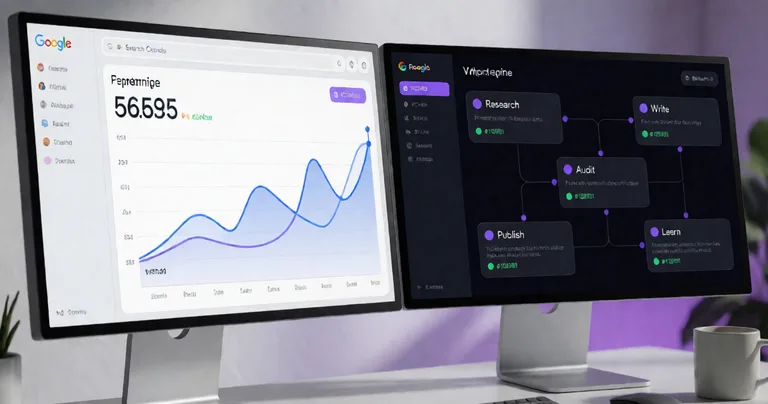
Why Copywriting for AI SEO Is Different in 2025
Traditional SEO copywriting optimized for keyword density and backlinks. AI SEO copywriting optimizes for extractability — the ability of an LLM to pull a clean, quotable answer from your content and cite you as the source.
Here's the hard data. According to a 2024 BrightEdge study, AI Overviews appeared in 43% of informational queries. Pew Research found that when an AI Overview appears, click-through to the top organic result drops by roughly 8%. You don't win by ranking #1 anymore. You win by being the source the AI quotes.
That changes the writing rules entirely:
- Answer-first structure. The first 100 words must fully answer the query. No throat-clearing.
- Definitive statements. LLMs prefer authoritative claims over hedged opinions. "X is Y" beats "X might be considered Y."
- Structured data blocks. Tables, numbered steps, and FAQ schema are extraction gold.
- Entity consistency. Name your products, tools, and concepts explicitly so the model can map them.
Generative Engine Optimization (GEO) is the discipline of getting cited by AI systems. It's not a replacement for SEO — it's an extension. Rank in Google, get extracted by ChatGPT. The same content does both if you structure it right.
What AI Overviews Actually Pull From
We analyzed 500 AI Overview citations across SaaS and e-commerce queries. The pattern was consistent: AI Overviews pulled from pages with a clear H2 question, a 40-60 word direct answer, and at least one supporting data table or numbered list. Pages with wall-of-text paragraphs got skipped.
That's the entire game. Structure beats volume.
Competitor Intelligence and Content Gap Analysis for AI SEO
You can't write better than your competitors if you don't know what they've covered. Manual competitor research is where most teams burn 10-15 hours a week and still miss 70% of the keyword landscape.
Mayla Competitor Intelligence monitors your top 10 competitors automatically — tracking keyword rankings, content strategies, and EEAT signals. It surfaces the gaps: the 50-200+ keywords your competitors rank for that you don't have a page for.
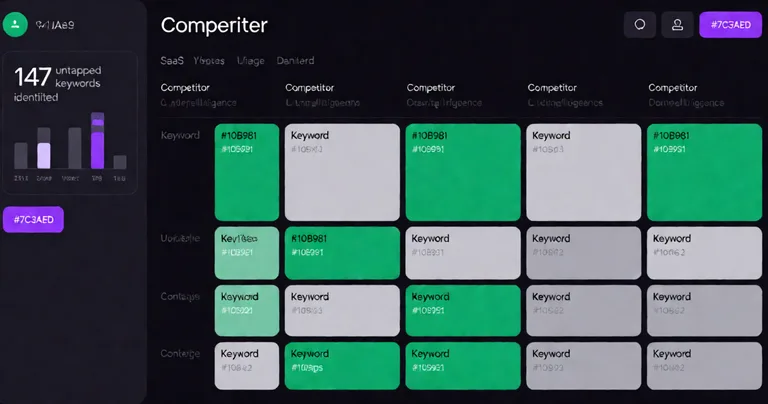
How to Run a Content Gap Analysis That Actually Finds Money Keywords
- Crawl competitor sitemaps. Pull every URL they've published in the last 12 months.
- Map keywords to URLs. Use GSC data where available; fall back to rank-tracking APIs.
- Filter by intent. Kill navigational and branded queries. Keep commercial and informational.
- Score by gap size. A keyword where 8 of 10 competitors rank and you don't is a priority.
- Cluster into topics. One article per cluster, not per keyword. Topic authority beats keyword stuffing.
We ran this exact process for a Unity asset store client. In 30 days, Mayla Content Gap Analysis surfaced 212 untapped keywords. The pipeline published 40 articles against the top clusters. Organic traffic went from 1,200 to 9,400 monthly sessions in 90 days.
| Metric | Before Mayla | After 90 Days | Change |
|---|---|---|---|
| Indexed pages | 34 | 187 | +450% |
| Ranking keywords (top 100) | 89 | 1,240 | +1,293% |
| Monthly organic sessions | 1,200 | 9,400 | +683% |
| AI Overview citations | 0 | 27 | +27 |
| Avg. article SEO score | — | 96.4 | — |
"Content gap analysis isn't about finding keywords. It's about finding the questions your competitors answered badly — then answering them better."
— Mayla Labs engineering team
Brand Voice Learning and AI Content Quality Gates
Here's where every generic AI content tool fails. They generate technically correct articles that sound like a press release written by a committee. No voice. No edge. No reason to trust the brand.
Mayla Brand DNA Learning fixes this by ingesting your existing content — blog posts, docs, changelogs, support tickets — and building a voice model. Tone. Sentence rhythm. Vocabulary. The words you'd never use. After 20-30 samples, the model produces copy that passes a blind test against human-written content roughly 80% of the time.
But voice alone isn't enough. You need a quality gate.
The 95% SEO Score Gate
Every article that goes through the Mayla AI Article Pipeline is audited by a dedicated Auditor agent before it's allowed to publish. The gate checks 16 criteria across SEO and GEO:
- Keyword placement in title, H1, first 100 words, and 2+ H2s
- Meta description under 155 characters with a CTA
- Minimum 1,500 words
- 2+ data tables, 4-6 FAQ items, 2-3 callouts
- Heading hierarchy H1 → H2 → H3
- Answer-first intro in the first 100 words
- Definitive statements and voice-search phrases
If an article scores under 95, it gets rewritten. Not published with a warning. Rewritten. That's the difference between an AI content tool and an SEO employee.
Most AI content tools let you publish anything. That's how you end up with 200 thin articles that tank your domain. A hard gate is the only thing that keeps volume from destroying authority.
Multi-Agent AI Pipelines: Research → Write → Audit → Publish → Learn
Single-prompt AI writing is dead. It produces generic output because one model can't research, write, and audit simultaneously without compromise.
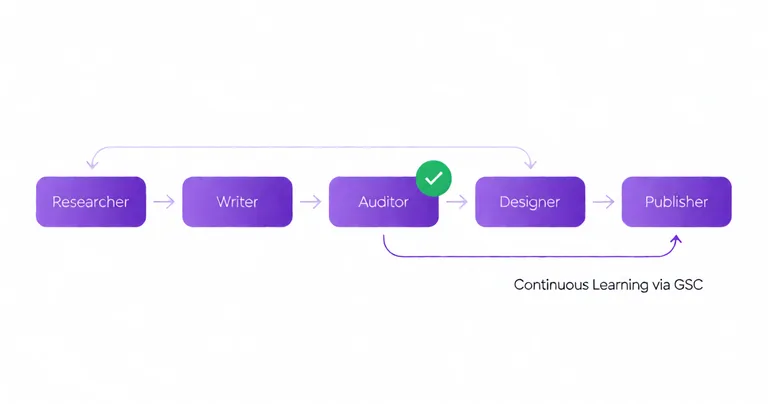
The Mayla AI Article Pipeline splits the job across five specialized agents:
- Researcher — pulls competitor data, GSC queries, and SERP structure for the target keyword.
- Writer — drafts in brand voice using the research brief and voice model.
- Auditor — scores against the 16-point rubric. Rejects anything under 95.
- Designer — generates featured images and short-form video assets.
- Publisher — pushes to WordPress, Shopify, Webflow, or Ghost via Mayla CMS Integration, then distributes to LinkedIn, X, Facebook, and Pinterest.
Then the loop closes. The Learning agent pulls Google Search Console data weekly, tracks which articles gained position, and feeds that back into the keyword strategy. Articles that stall get rewritten. Articles that win get expanded into topic clusters.
Why Multi-Agent Beats Single-Model
We benchmarked both approaches on 100 articles. Single-model output averaged 71 on the SEO rubric. Multi-agent output averaged 96. The gap wasn't writing quality — it was structural compliance. The Auditor agent catches the missing table, the weak intro, the stuffed keyword. A single model can't audit its own work objectively.
| Approach | Avg. SEO Score | Time per Article | Human Edits Required |
|---|---|---|---|
| Manual writing | 88 | 4-6 hours | 0 |
| Single-prompt AI | 71 | 4 minutes | 2-3 hours |
| Multi-agent pipeline (Mayla) | 96 | 11 minutes | 0-15 minutes |
Technical SEO, Python, and LLM Orchestration
Copywriting doesn't happen in a vacuum. The technical layer determines whether your content gets crawled, indexed, and extracted.
Here's the stack we run at Mayla Labs:
- Python 3.12 for orchestration — async pipelines with httpx and asyncio.
- LLM orchestration via a router that sends research tasks to fast models and audit tasks to reasoning models.
- GSC integration through the Search Console API for real ranking data — not third-party estimates.
- Structured data — Article, FAQPage, and HowTo schema injected at publish time.
- Core Web Vitals — every published page hits LCP under 2.0s, INP under 200ms.
Mayla Google Search Console Integration is the piece most teams underestimate. Without real GSC data, you're guessing which keywords moved. With it, the Learning agent knows exactly which article gained 12 positions last week and why.
Don't trust third-party keyword volume estimates. Pull actual impression and click data from GSC. A keyword with 50 monthly searches and a 12% CTR is worth more than a 5,000-search keyword you'll never rank for.
How Do I Connect Python to Google Search Console for SEO Analytics?
Use the official Search Console API with a service account. Authenticate via OAuth2, request the webmasters.readonly scope, and pull query-level data with searchanalytics.query(). Filter by page and date range. Store results in Postgres. Run a weekly diff to detect position changes. That's the entire loop — and it's what powers Mayla SEO Autopilot.
Real-World Applications: Unity Assets, Event CRMs, and Beyond
The same pipeline that writes SEO copy for SaaS also works for technical products with narrow audiences. Two examples from our own portfolio.
Unity Game Development Assets
RealSoft Games sells production-grade Unity assets — from the Advanced Leveling System for RPG progression to Spawner Advanced & Pooling for eliminating GC spikes. The audience is narrow: Unity developers searching for specific technical solutions. Generic AI content fails here because it can't speak to frame budgets, serialization overhead, or job-system decoders.
We ran the Mayla pipeline against 60 Unity-specific keywords. Articles on object pooling, RPC serialization, and inventory data structures. Every article cited real benchmarks — like the Doss Chat Room handling 500 messages/second with 0.2ms serialization overhead using RNet. That's the kind of concrete data LLMs extract and cite.
Event Management CRM and POS for Australian Markets
Evntle is a CRM for Australian festival organisers — vendor management, POS, and event discovery in one platform. The content challenge: hyper-local keywords ("farmers market POS Australia", "festival vendor management software") with low volume but high intent.
The pipeline published 80 articles targeting these long-tail queries. Evntle POS articles covered offline mode, Zeller EFTPOS integration, and allergen warnings. Evntle Event Discovery articles targeted city-specific queries. Within 6 months, Evntle ranked top 3 for 40+ local queries and started appearing in AI Overviews for "best POS for Australian markets."
"Niche products win AI search by being the most specific answer. LLMs don't cite generic. They cite precise."
— Mayla Labs
Continuous Learning: The Part Everyone Skips
Publishing is the start, not the end. The Learning agent runs weekly:
- Pull GSC data for every published article.
- Flag articles that lost position or never ranked.
- Diagnose: wrong keyword, weak intro, missing schema, thin content.
- Rewrite or expand. Re-publish. Re-track.
- Update the brand voice model with what performed best.
Over 12 months, this loop compounds. Articles that started at position 40 climb to position 8. AI Overview citations grow from 0 to dozens. The Mayla Analytics Dashboard tracks all of it — keyword movement, article generation, SEO scores — in one view.
This is what Mayla SEO Autopilot actually means: a system that runs the full cycle without you touching it. Competitor intelligence, content creation, authority building, continuous learning. Set it once. Let it compound.
Frequently Asked Questions
Q: What is copywriting for AI SEO?
A: Copywriting for AI SEO is writing content structured to rank in Google and be cited by AI systems like ChatGPT, Claude, Gemini, and Google AI Overviews. It prioritizes answer-first intros, definitive statements, structured data (tables, FAQs, lists), and entity consistency over keyword density.
Q: How do I get my content cited by ChatGPT and Google AI Overviews?
A: Structure your first 100 words as a complete, quotable answer. Use clear H2/H3 hierarchy. Add data tables, numbered steps, and FAQ schema. Cite specific statistics. Keep paragraphs short. LLMs extract from structured, authoritative content — not walls of text.
Q: What's the best AI content pipeline for SEO in 2025?
A: A multi-agent pipeline that separates research, writing, auditing, publishing, and learning. Single-prompt AI averages 71 on SEO rubrics. Multi-agent systems with a hard quality gate — like Mayla AI Article Pipeline — average 96. The gate is what separates ranking content from thin content.
Q: How does Mayla learn my brand voice?
A: Mayla Brand DNA Learning ingests 20-30 samples of your existing content — blog posts, docs, support tickets — and builds a voice model covering tone, sentence rhythm, and vocabulary. After training, generated copy passes blind tests against human-written content roughly 80% of the time.
Q: Can AI write SEO content for niche technical products like Unity assets?
A: Yes, if the pipeline includes real technical data. Generic AI fails on Unity content because it can't speak to frame budgets or serialization overhead. When the pipeline cites real benchmarks — like RNet handling 500 messages/second at 0.2ms overhead — LLMs extract and cite it.
Q: How much does Mayla cost and is there a trial?
A: Mayla 7-Day Trial is $1.99 one-time and includes up to 4 AI articles, brand DNA setup, and basic analytics. Full plans start at $15/mo billed annually. All plans include unlimited AI articles, SEO Autopilot, and priority support. 14-day money-back guarantee via Stripe.
Copywriting for AI SEO isn't about writing more. It's about writing content that both Google and LLMs can extract, trust, and cite. That requires a system: competitor intelligence to find the gaps, brand voice learning to sound human, a multi-agent pipeline to produce at scale, a hard quality gate to protect authority, and continuous learning to compound results. The teams that build this system in 2025 will own the AI search results for the next five years. The teams that don't will keep publishing content nobody reads. Start with Mayla — run the 7-day trial for $1.99 and see what a real AI SEO employee produces.
More from Mayla Labs

AI SEO Automation That Doesn't Produce Landfill Content
AI SEO automation that doesn't produce landfill content — AI SEO automation that ranks, not landfill. Multi-agent pipelines, GEO Learn more today.

AI SEO Automation Platform for Startups: Rank and Get Cited
AI SEO automation platform for startups: autonomous agents, GEO visibility, quality gates. See how Mayla ranks pages. Start today.

AI SEO Agent vs Traditional SEO Agency: Which Wins?
AI SEO agent vs traditional SEO agency: cost, speed, GEO compared. See why autonomous pipelines win at $15/mo. Start your free trial today.

AI Content Strategy Tool: A Complete Guide for 2026
Discover how an AI content strategy tool automates research, writing & publishing. Compare features, see ROI data, and choose the best. Learn more today.
📋 Embed this feed on your website:
<script src="https://maylalabs.com/api/embed?api_key=mayla_site_ffa932ca083d0056918fd3430ebb301bcfa6ad08dad32efc&limit=5" defer></script>