
AI SEO Automation Software With Quality Gates
AI SEO automation software with quality gates: 5-agent pipeline, 95% audit threshold, GEO optimization. See how autonomous SEO ranks Learn more today.
Summary
AI SEO automation software with quality gates: 5-agent pipeline, 95% audit threshold, GEO optimization. See how autonomous SEO ranks Learn more today.
AI SEO Automation Software With Quality Gates
AI SEO automation software with quality gates is an autonomous system that researches competitors, discovers content gaps, writes in your brand voice, audits every draft against a 95%+ SEO/GEO score, and only then publishes. The quality gate is the difference between content that ranks and content that rots. Mayla runs a five-agent pipeline — Researcher, Writer, Auditor, Designer, Publisher — where nothing ships unless it passes the gate. That is how you get AI search visibility without dumping 400 mediocre posts into the index.
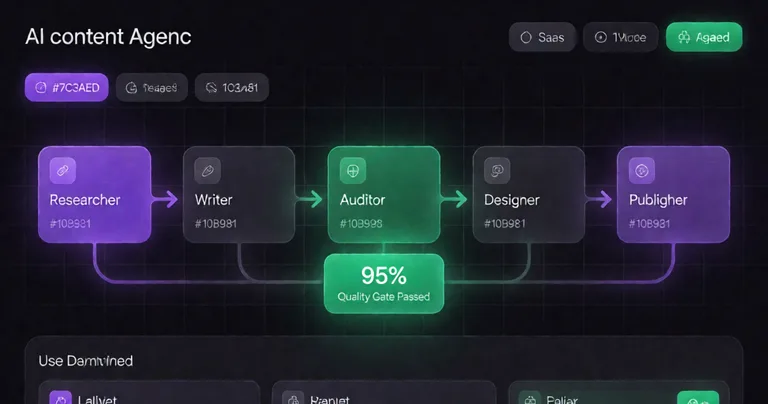
Most "AI SEO tools" are content generators with a publish button. They optimize for volume, not rankings. The result is predictable: thin pages, duplicate angles, and a site Google quietly buries while competitors get cited in AI Overviews. If you want the full teardown of why that happens, read the brutal truth about AI content.
This article breaks down how quality-gated AI SEO automation actually works, what the multi-agent pipeline looks like under the hood, how GEO (Generative Engine Optimization) changes the rules, and why autonomous SEO now costs under $5 per ranking page instead of $500.
What Is AI SEO Automation Software With Quality Gates?
AI SEO automation software with quality gates is a system that runs the entire SEO workflow autonomously — competitor intelligence, keyword research, content gap discovery, drafting, auditing, publishing, and continuous optimization — with a hard scoring threshold that blocks weak content from going live.
A quality gate is not a spellchecker. It's a multi-dimensional audit that scores every draft against technical SEO, content depth, entity coverage, EEAT signals, brand voice fidelity, and GEO extractability. If the draft scores below the threshold, it goes back to the Writer agent. No human override. No "it's good enough."
This is the structural difference between an AI content creation tool that works like an employee and a chatbot with a WordPress plugin.
The Three Layers Every Quality Gate Must Audit
- Technical layer — heading hierarchy, schema markup, internal links, meta tags, image alt text, page speed implications.
- Content layer — keyword coverage, entity density, answer completeness, readability, factual claims, source diversity.
- Authority layer — EEAT signals, author attribution, citation-worthy statistics, brand voice match, topical cluster fit.
A quality gate that only checks word count and keyword density is theater. The gate must score against the same criteria Google and AI engines use to decide whether to rank or cite you.
Why Autonomous AI SEO Beats Manual Content Pipelines
Manual content pipelines have three failure modes: speed, consistency, and cost. A human writer produces 2–4 quality articles per week. An autonomous pipeline produces the same volume per hour, at a fraction of the cost, with zero variance in brand voice.
Here's the math that matters to any founder or marketing manager:
| Approach | Cost Per Article | Output / Week | Brand Voice Consistency | GEO Optimization |
|---|---|---|---|---|
| Freelance writer | $150–$400 | 2–4 | Variable | Rarely |
| SEO agency retainer | $500–$1,200 | 4–8 | Depends on account manager | Sometimes |
| Generic AI writer | $5–$20 | 100+ | Poor without tuning | No |
| Quality-gated AI SEO automation | Under $5 | 150+ | High (vector-embedded brand DNA) | Built-in |
The bottom row is not hypothetical. It's the architecture behind Mayla's autonomous SEO platform, where the Auditor agent enforces a 95%+ score before the Publisher agent touches your CMS.
"Volume without a gate is just landfill with a publish date. The gate is what turns AI output into an asset."
— Mayla Labs engineering principle
How the Five-Agent Content Pipeline Works
Multi-agent pipelines beat single-model generation because each agent has one job and one scoring rubric. Specialization produces better output than a generalist prompt trying to do everything at once.
Agent 1: Researcher
Pulls competitor rankings, SERP features, entity maps, and content gaps. Outputs a structured brief with target keywords, entities to cover, questions to answer, and internal link targets. This agent runs daily, not on demand.
Agent 2: Writer
Drafts against the brief using vector-embedded brand DNA — tone, vocabulary, sentence rhythm, audience targeting. The Writer never sees a blank page. It sees a structured brief plus 20 examples of how your brand actually sounds.
Agent 3: Auditor
This is the quality gate. Scores the draft across technical, content, and authority layers. Anything below 95% goes back to the Writer with specific fix instructions. This agent is the reason the pipeline produces rankings instead of noise.
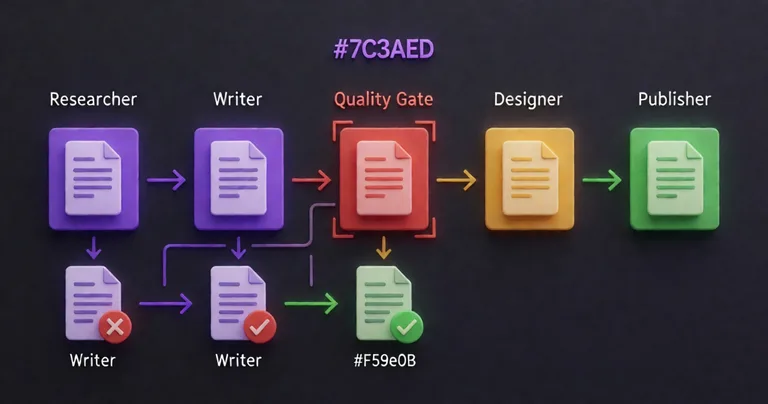
Agent 4: Designer
Generates featured images, inline visual assets, and short-form video snippets for TikTok, Reels, and Shorts. Authority signals now include multimedia, not just text.
Agent 5: Publisher
Pushes to WordPress, Shopify, Webflow, or Ghost via REST API, then distributes to LinkedIn, X, Facebook, and Pinterest. No human touches the publish button.
If your current AI tool has one agent and one prompt, you don't have a pipeline. You have a lottery ticket. The Auditor is what separates the two.
Generative Engine Optimization (GEO) and AI Search Visibility
GEO is the practice of structuring content so AI engines — ChatGPT, Claude, Gemini, Perplexity, and Google AI Overviews — cite you as a source. It's a different game from traditional SEO. Ranking position matters less than extractability.
AI engines extract content that: answers a question in the first 100 words, uses clear H2/H3 hierarchy, includes data tables and statistics, states definitive claims, and provides FAQ sections with natural language questions.
What AI Engines Actually Extract
| Content Element | Traditional SEO Weight | GEO / AI Citation Weight |
|---|---|---|
| Keyword density | High | Low |
| Direct answer in first 100 words | Medium | Critical |
| Data tables with statistics | Medium | Very High |
| FAQ with conversational questions | Low | Very High |
| Definitive authoritative statements | Medium | High |
| Clear H2/H3 hierarchy | High | High |
This is why a quality gate must score GEO separately from SEO. A page can rank #3 on Google and still never get mentioned in an AI Overview. Mayla's GEO / LLM optimization analysis audits both layers independently.
"Ranking on Google gets you traffic. Getting cited by AI gets you traffic you'll never see in Search Console — because the click never happens."
— Mayla Labs GEO research
Competitor Intelligence and Content Gap Discovery
Autonomous SEO only works if it knows what your competitors are doing. Mayla monitors top competitors' keyword rankings, content strategies, and EEAT signals daily. When a competitor publishes a page that starts ranking for a term you don't own, the gap gets surfaced within 24 hours.
Content gap discovery is not just keyword subtraction. It's prioritization by opportunity: search volume velocity, competitive difficulty, topical fit, and conversion proximity.
What Daily Competitor Intelligence Surfaces
- New keywords competitors started ranking for in the last 7 days
- Pages losing position (rewrite candidates)
- New backlink sources and EEAT signals
- Content formats competitors are winning with (comparison tables, case studies, tools)
- Emerging topics before they saturate
This intelligence feeds the Researcher agent automatically. No human brief required. For a deeper look at how this plays out in a specific vertical, see CRM SEO: how autonomous AI gets CRM brands cited by AI.
Continuous Learning: The Feedback Loop Most Tools Skip
Publishing is not the end of the pipeline. It's the start of the learning loop. Mayla pulls real ranking data from Google Search Console daily, correlates ranking movements to specific content changes, and adjusts keyword strategy automatically.
Pages that lose position get flagged for rewrite. Pages that gain get analyzed for patterns. The system gets smarter every week without human intervention.
A quality gate that doesn't close the loop on real ranking data is guessing. The loop is what makes "autonomous" mean something.
Beyond SEO: Event Tech and Unity Systems Built on the Same Principles
Quality gates and zero-allocation architecture share the same DNA: nothing ships until it passes a hard performance threshold. That principle runs across everything we build.
On the event side, Evntle runs Australian markets and festivals with the same philosophy — vendor management, POS, cashless payments via Zeller EFTPOS, compliance tracking, and site planning in one system, with no spreadsheet duct tape. Event organisers running vendor-heavy markets at Geelong Central Market and Barwon Monday Market use it to replace paper sign-in sheets, manual stall allocation, and end-of-day reconciliation guesswork.
On the game dev side, RealSoft Games builds production-ready Unity assets — object pooling, leveling systems, inventory architecture, RPC networking — with zero-allocation performance budgets. The same discipline that blocks a sub-95% article from publishing blocks a GC spike from shipping in a game build.

Why Most AI SEO Tools Fail the Quality Gate Test
Most AI SEO tools optimize for output volume because volume is easy to sell. "Generate 100 articles a month" sounds impressive until you check the indexation rate, the ranking trajectory, and the brand voice drift.
Three structural failures:
- No auditor agent. Content goes from draft to publish with no scoring threshold.
- No brand DNA learning. Every article sounds like generic AI — same rhythm, same vocabulary, same hollow authority.
- No GEO layer. Content is optimized for 2018 Google, not 2026 AI engines.
The fix is architectural, not a prompt tweak. You need a pipeline with specialized agents, a hard quality gate, vector-embedded brand voice, and a continuous learning loop tied to real ranking data.
Frequently Asked Questions
Q: What is AI SEO automation software with quality gates?
A: It's an autonomous system that runs the full SEO workflow — research, writing, auditing, publishing, and optimization — with a hard scoring threshold that blocks any draft below 95% from going live. The quality gate is the audit layer that enforces technical, content, and authority standards before publishing.
Q: How do I get my brand cited by ChatGPT and Google AI Overviews?
A: Structure content for extraction. Answer the primary question in the first 100 words, use clear H2/H3 hierarchy, include data tables and statistics, write definitive statements, and add FAQ sections with natural language questions. GEO is a separate optimization layer from traditional SEO.
Q: What's the best AI SEO tool for autonomous growth?
A: The best tool runs a multi-agent pipeline with a dedicated Auditor agent, learns brand voice via vector embeddings, integrates with Google Search Console for continuous learning, and publishes directly to your CMS. Single-prompt AI writers fail at scale because they have no quality gate.
Q: How much does autonomous AI SEO cost compared to an agency?
A: Traditional SEO agencies charge $500–$1,200 per article. Quality-gated autonomous pipelines cut that to under $5 per ranking page. Mayla's plans start at $29/month for up to 150 AI articles with the full pipeline.
Q: Why should I care about GEO if I already rank on Google?
A: Because AI engines increasingly answer queries without sending clicks. If ChatGPT, Perplexity, or Google AI Overviews cite your competitor instead of you, you lose the traffic before it ever reaches Search Console. GEO is how you stay visible in that shift.
Q: Can autonomous AI SEO replace a human SEO team?
A: For content production, competitor intelligence, content gap discovery, and continuous optimization — yes. A human still sets strategy, approves brand positioning, and handles edge cases. But the day-to-day pipeline runs without intervention.
AI SEO automation software with quality gates is not a content generator with a nicer UI. It's an autonomous system where every draft earns its way into the index. The five-agent pipeline — Researcher, Writer, Auditor, Designer, Publisher — only works because the Auditor enforces a hard threshold. Without that gate, you're just producing landfill faster. With it, you're producing rankings, AI citations, and compounding authority at under $5 per page. Start with Mayla's 7-day trial and watch the gate do its job.
More from Mayla Labs

AI SEO Automation Platform That Actually Ranks Content
AI SEO automation platform that actually ranks content. Autonomous multi-agent pipeline, GEO optimization, under $5 per page. Start your $1.99 trial today.

AI SEO Employee for Small Business: Autonomous Growth
AI SEO employee for small business: autonomous multi-agent pipeline that researches, writes, audits, and publishes. Start your $1.99 trial today.

AI SEO Automation That Doesn't Produce Landfill Content
AI SEO automation that doesn't produce landfill content — AI SEO automation that ranks, not landfill. Multi-agent pipelines, GEO Learn more today.

AI SEO Automation Platform for Startups: Rank and Get Cited
AI SEO automation platform for startups: autonomous agents, GEO visibility, quality gates. See how Mayla ranks pages. Start today.
📋 Embed this feed on your website:
<script src="https://maylalabs.com/api/embed?api_key=mayla_site_ffa932ca083d0056918fd3430ebb301bcfa6ad08dad32efc&limit=5" defer></script>