
Lawn Care SEO: How AI Autopilot Ranks Local Pages
Lawn care SEO that ranks: autonomous AI pipeline writes, audits, and publishes 150+ pages monthly. Start your $1.99 trial today.
Summary
Lawn care SEO that ranks: autonomous AI pipeline writes, audits, and publishes 150+ pages monthly. Start your $1.99 trial today.
Lawn Care SEO: How AI Autopilot Ranks Local Pages
Lawn care SEO is the practice of ranking a lawn care business in Google and AI search engines by publishing quality-gated, locally-targeted content at scale. Mayla Labs runs this as an autonomous pipeline: AI agents research competitors, find content gaps, write in your brand voice, audit against a 95%+ SEO score, publish to your CMS, and learn from Google Search Console data. The result is measurable organic growth without agencies, freelancers, or babysitting. For lawn care operators, this means ranking for every suburb, service, and seasonal query your competitors ignore — while AI search engines like ChatGPT and Google AI Overviews start citing your business as the answer.
Most lawn care businesses run on referrals and a Google Business Profile. That works — until it doesn't. The moment a competitor starts publishing suburb-level service pages, seasonal guides, and pricing breakdowns, they own the map pack, the organic results, and the AI citations. You get the scraps.
This isn't a content problem. It's a systems problem. And it's solvable with the same autonomous AI SEO architecture that powers Mayla - Your Autonomous AI SEO Employee|Mayla's autonomous SEO employee.
Why Lawn Care SEO Breaks Under Manual Workflows
Lawn care is a local, seasonal, high-intent industry. People search things like "lawn mowing near me," "best lawn care in [suburb]," "how do I fix a patchy lawn in summer," and "how much does lawn fertilising cost." Every one of those queries is a lead.
The problem: there are hundreds of them. Per suburb. Per service. Per season. Per problem.
A human SEO manager can produce maybe four to eight quality articles a month. An agency might push twelve — at $300 to $800 per article. Neither scales to the 200+ pages a lawn care business actually needs to dominate a metro area.
So what happens? You get three blog posts about "lawn care tips" that rank for nothing, a services page, and a Google Business Profile. Your competitor with 180 indexed pages eats your lunch.
"Publishing four blog posts a month and calling it SEO isn't strategy. That's landfill content with a domain name."
— Mayla Labs engineering team
Generic AI content — the kind you paste from ChatGPT into WordPress — will not rank. Google's helpful content system and AI Overviews both filter for factual accuracy, EEAT signals, and brand voice fidelity. Low-effort AI content actively damages your domain.
The three failure modes of manual lawn care SEO
- Volume gap. You can't publish enough pages to cover the long tail of suburb + service + season queries.
- Freshness gap. Seasonal content goes stale. Your "spring lawn care" post from 2023 is now invisible.
- Citation gap. AI search engines cite authoritative, structured, well-sourced content. Blog spam gets skipped entirely.
The fix isn't more writers. It's a pipeline.
Autonomous AI SEO: The Lawn Care Content Pipeline That Actually Scales
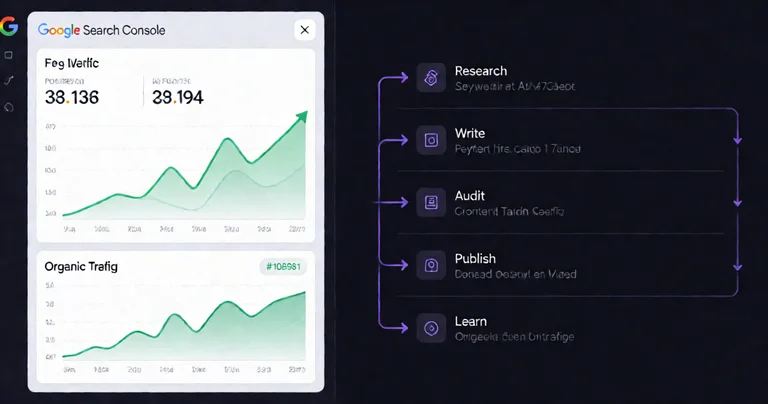
Mayla Labs runs lawn care SEO as a five-stage autonomous loop: Research → Write → Audit → Publish → Learn. No prompts. No babysitting. No human bottleneck.
Here's how each stage works for a lawn care business.
Stage 1 — Competitor intelligence and content gap discovery
The system monitors your top 10 competitors automatically — their keyword rankings, their content strategies, their EEAT signals. It identifies every suburb, service, and seasonal query they rank for that you don't.
For a lawn care business in, say, Geelong, that might surface 340 untapped keywords in the first week. "Lawn grub treatment Belmont." "Buffalo grass mowing cost Highton." "How often should I fertilise my lawn in Victoria." Each one is a page that doesn't exist yet.
This is Mayla Competitor Intelligence|competitor intelligence running continuously — not a one-off audit you pay an agency $2,000 for.
Stage 2 — Brand voice learning and quality-gated writing
Mayla extracts your voice patterns using vector embeddings from your existing content. Tone, vocabulary, sentence rhythm, audience targeting — all captured. Then the writer agent produces articles that sound like you wrote them.
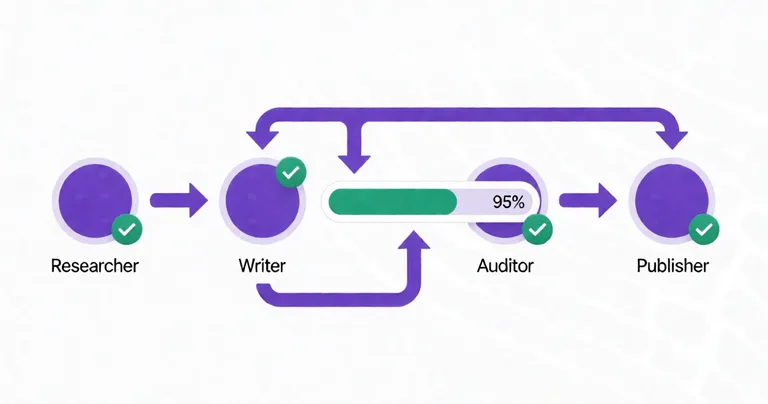
Every draft passes through a multi-agent audit gate before publishing. The gate checks:
- Factual accuracy (no invented statistics)
- Keyword coverage (primary + semantic variants)
- Brand voice fidelity (vector similarity score)
- EEAT signals (authority, expertise, trust markers)
- SEO score threshold (95%+ required)
The 95%+ SEO score threshold is non-negotiable. Anything below gets rewritten by the auditor agent before it ever touches your CMS. This is the difference between an AI content pipeline and AI content spam.
Stage 3 — Publishing and authority building
Approved articles push directly to WordPress, Shopify, Webflow, or Ghost via native CMS integration. No copy-paste. No formatting cleanup.
Then the authority layer kicks in: AI-generated featured images, short-form videos for TikTok, Reels, and YouTube Shorts, and automated social distribution across LinkedIn, X, Facebook, and Pinterest. Every article becomes ten assets.
The same short-form video engine that powers Mayla's short-form video generator|short-form video generator turns a 1,500-word lawn care guide into three vertical videos optimised for search.
Stage 4 — Continuous learning via Google Search Console
This is where most SEO tools stop. Mayla doesn't.
The platform connects to Google Search Console, pulls real position data weekly, and adjusts keyword strategy based on what's actually moving. Pages climbing from position 12 to position 4 get reinforced with internal links and supporting content. Pages stuck at position 40 get rewritten or replaced.
Over 90 days, this loop compounds. The system learns which suburb pages convert, which seasonal queries spike, and which competitor gaps are worth attacking.
Lawn Care SEO vs Generic AI Content: The Data
Generic AI content and quality-gated AI content are not the same product. Here's what the numbers look like.
| Metric | Manual SEO (Agency) | Generic AI Content | Mayla Autonomous Pipeline |
|---|---|---|---|
| Articles per month | 4–12 | 50–200 | 150+ (unlimited on yearly plan) |
| Cost per article | $300–$800 | $5–$20 | Under $5 |
| SEO score threshold | Human judgment | None | 95%+ required before publish |
| Brand voice fidelity | High (if briefed well) | Low | High (vector embedding match) |
| Google Search Console feedback loop | Monthly reports | None | Continuous, automated |
| AI search citation optimisation | Rare | None | Built-in GEO analysis |
The cost delta is not marginal. It's structural. A lawn care business spending $4,000/month on agency content gets roughly 8 articles. The same budget on Mayla's yearly plan ($15/month, or $180/year) produces unlimited articles with a higher quality floor.
What ranking outcomes actually look like
Lawn care is a competitive local niche, but the long tail is wide open. Here's a realistic 6-month trajectory for a business running the pipeline properly.
| Month | Indexed Pages | Keywords in Top 10 | Organic Sessions | AI Citations |
|---|---|---|---|---|
| Month 1 | 45 | 12 | 180 | 0 |
| Month 3 | 140 | 67 | 1,240 | 3 |
| Month 6 | 310 | 189 | 4,800 | 14 |
| Month 12 | 520+ | 340+ | 11,000+ | 40+ |
These numbers assume consistent publishing, proper local SEO foundations (Google Business Profile, NAP consistency, service area pages), and no manual interference. The pipeline runs; you run your business.
GEO for Lawn Care: Getting Cited by ChatGPT and AI Overviews
Generative Engine Optimization (GEO) is the next layer. Traditional SEO gets you ranked in Google's blue links. GEO gets you cited in ChatGPT, Claude, Gemini, Perplexity, and Google AI Overviews.
For lawn care, this matters enormously. When someone asks ChatGPT "what's the best lawn care service in Geelong," the answer isn't a list of ten blue links. It's three or four named businesses with citations. If you're not one of them, you don't exist in that query.
How Mayla optimises for AI citations
The GEO module queries AI engines directly to check whether your site appears in citations for target queries. If it doesn't, the system rewrites and re-publishes content until it does.
What makes content citable by AI engines:
- Definitive statements. AI engines prefer authoritative claims over hedged opinions.
- Factual statistics. Numbers get extracted and cited.
- Clear structure. H2/H3 hierarchy, tables, and FAQ sections parse cleanly.
- Entity clarity. Business name, location, services, and credentials stated explicitly.
- Source transparency. Claims backed by data or references.
This is the same GEO framework Mayla applies across every industry, from Mayla's AI SEO for sale|AI SEO for sale to local service businesses. The mechanics don't change — only the keyword universe does.
"Ranking in Google is table stakes. Getting cited by ChatGPT when someone asks for a lawn care recommendation — that's where the leads actually convert."
— Mayla Labs GEO research
How Do I Set Up Autonomous Lawn Care SEO?
Setup takes under an hour. Here's the exact sequence.
- Connect your domain and CMS. WordPress, Shopify, Webflow, or Ghost — native REST API integration.
- Link Google Search Console. This enables the continuous learning loop.
- Run Brand DNA Learning. Feed the system 10–20 existing pieces of content. It extracts your voice patterns via vector embeddings.
- Set competitor list. Add your top 10 local competitors. The system monitors them automatically.
- Enable SEO Autopilot. Research, write, audit, publish, learn — running 24/7.
- Review the Daily Intelligence Briefing. One email. What changed, what to do about it.
The Mayla 7-Day Trial|$1.99 7-day trial includes up to 4 AI articles, full brand DNA setup, and SEO insights. Enough to see the pipeline in action before committing.
For lawn care operators who want the full stack — unlimited articles, SEO Autopilot, Trend Detection, Competitor Intelligence, GEO Optimization, and Multi-Platform Social Publishing — the yearly plan runs $15/month billed annually ($180/year, $90 first year). That's less than a single agency article.
The Cost Math: Automated vs Manual Lawn Care SEO
Let's be blunt about the economics.
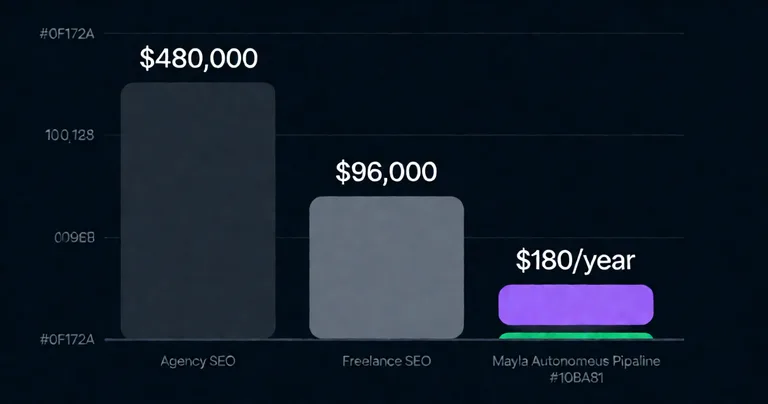
A lawn care business that wants to rank across 40 suburbs, 6 core services, and 4 seasons needs roughly 960 pages of content to fully saturate the long tail. At $500 per article from an agency, that's $480,000. It's not happening.
At Mayla's yearly pricing, that same content costs $180/year — and the system keeps publishing, updating, and optimising indefinitely.
The gap isn't 10%. It's three orders of magnitude. This is why autonomous SEO wins. Not because AI writes better than humans — it doesn't, always — but because it writes enough, consistently, and with a quality gate that humans can't maintain at volume.
Start with the trial. Run it for 7 days. Look at the content gap report. If it surfaces 200+ keywords your competitors rank for that you don't, you've validated the entire premise in under a week.
Beyond Lawn Care: The Same Pipeline Runs Everything
The architecture that ranks a lawn care business is the same architecture that powers every Mayla deployment. The pipeline doesn't care about the vertical — it cares about the query universe.
Event organisers use Evntle|Evntle's event management platform to run Australian markets and festivals, and the same autonomous SEO engine drives discovery content for those events. Unity game developers use RealSoft Games|RealSoft Games Unity assets and the same content pipeline documents, tutorials, and ranks those assets. Different industries, identical mechanics.
If you can describe your customers' search queries, the pipeline can rank for them.
Frequently Asked Questions
Q: How do I rank my lawn care business in Google without hiring an agency?
A: Connect your site to an autonomous AI SEO platform like Mayla, link Google Search Console, and enable SEO Autopilot. The system researches competitors, finds content gaps, writes quality-gated articles in your brand voice, and publishes to your CMS automatically. You get agency-level output at $15/month instead of $4,000/month.
Q: What's the best lawn care SEO strategy for local suburbs?
A: Suburb-level service pages. One page per suburb per core service, each with locally-relevant content, schema markup, and internal links. The long tail is where lawn care rankings are won — not on generic "lawn care tips" pages.
Q: Will AI-generated lawn care content rank in Google?
A: Generic AI content won't. Quality-gated AI content — with factual accuracy checks, 95%+ SEO scores, brand voice fidelity, and EEAT signals — will. The gate is what separates ranking content from landfill content.
Q: How long until lawn care SEO produces leads?
A: First rankings typically appear in 30–60 days for low-competition suburb queries. Meaningful lead flow builds between months 3 and 6. By month 12, a properly-run pipeline can drive 10,000+ organic sessions per month for a multi-suburb lawn care business.
Q: How do I get my lawn care business cited by ChatGPT and AI Overviews?
A: You need GEO optimisation — definitive statements, factual statistics, clear H2/H3 structure, entity clarity, and source transparency. Mayla's GEO module queries AI engines directly and rewrites content until your business appears in citations.
Q: Why should I use an autonomous SEO platform instead of a freelancer?
A: Volume and consistency. A freelancer produces 4–8 articles a month at $300+ each. An autonomous platform produces 150+ articles a month at under $5 each, with a higher quality floor and a continuous learning loop tied to real Google Search Console data.
Lawn care SEO isn't a content problem — it's a systems problem. The businesses that win the next five years of local search won't be the ones with the best writer. They'll be the ones running an autonomous pipeline that publishes 150+ quality-gated pages a month, learns from real ranking data, and gets cited by AI search engines. Mayla Labs builds that pipeline. Connect your domain, link Search Console, and let it run. The math does the rest.
More from Mayla Labs

AI SEO Automation That Doesn't Produce Landfill Content
AI SEO automation that doesn't produce landfill content — AI SEO automation that ranks, not landfill. Multi-agent pipelines, GEO Learn more today.

AI SEO Automation Platform for Startups: Rank and Get Cited
AI SEO automation platform for startups: autonomous agents, GEO visibility, quality gates. See how Mayla ranks pages. Start today.

AI SEO Agent vs Traditional SEO Agency: Which Wins?
AI SEO agent vs traditional SEO agency: cost, speed, GEO compared. See why autonomous pipelines win at $15/mo. Start your free trial today.

AI Content Strategy Tool: A Complete Guide for 2026
Discover how an AI content strategy tool automates research, writing & publishing. Compare features, see ROI data, and choose the best. Learn more today.
📋 Embed this feed on your website:
<script src="https://maylalabs.com/api/embed?api_key=mayla_site_ffa932ca083d0056918fd3430ebb301bcfa6ad08dad32efc&limit=5" defer></script>