
AI SEO Employee vs Agency: Autonomous AI SEO Wins
AI SEO employee vs agency: compare cost, speed, and GEO citation power. See why autonomous AI SEO wins and start your $1.99 trial today.
Summary
AI SEO employee vs agency: compare cost, speed, and GEO citation power. See why autonomous AI SEO wins and start your $1.99 trial today
An AI SEO employee vs agency beats a traditional agency on cost, speed, and compounding output. A multi-agent AI pipeline researches, writes, audits, and publishes GEO-optimized content 24/7 for a fraction of a retainer — roughly $15/month versus $2,000–$10,000/month — while learning your brand voice through vector embeddings. Agencies sell hours; autonomous AI SEO builds an asset that gets smarter with every article. That's the difference between renting strategy and owning a system.

Most founders don't have a content problem. They have a throughput problem. You know what to publish. You just can't publish enough of it, fast enough, in a voice that doesn't sound like a robot wrote it at 2am. So you hire an agency. Six months later you're paying $4,500 a month for eight blog posts, a monthly report you don't read, and a Slack channel where nobody answers on Fridays.
That's not strategy. That's noise.
Here's the blunt truth: the agency model was built for a world where content production was labor-bound. LLMs broke that constraint. The question is no longer can AI write — it's can an autonomous system write, audit, publish, and learn without you touching it. That's what an AI SEO employee actually is. And it's why the comparison isn't close.
What Is an AI SEO Employee vs an Agency?
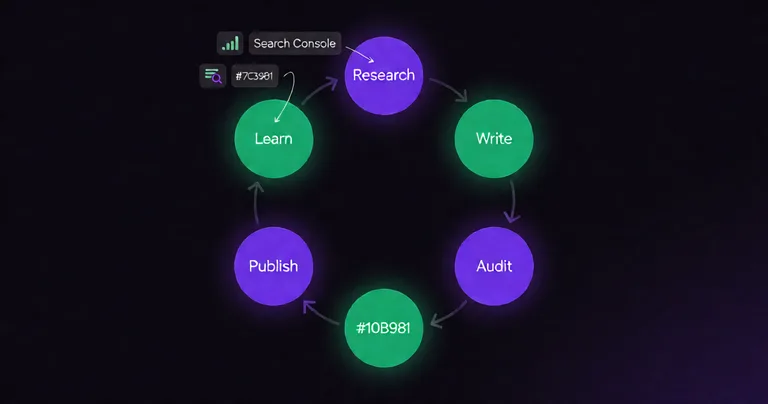
An AI SEO employee is an autonomous AI SEO system that runs a multi-agent pipeline — Research → Write → Audit → Publish → Learn — continuously, using Python, LLMs, vector embeddings, and Google Search Console data to compound organic traffic. An agency is a human team you retain monthly to execute a subset of that same work, usually at 10–100x the cost per published asset.
The distinction matters because the two models optimize for different things. Agencies optimize for billable hours and client retention. AI SEO employees optimize for published output and ranking outcomes. One is a service. The other is infrastructure.
The five agents inside an autonomous pipeline
Real autonomous SEO isn't "ChatGPT writes a blog post." It's a chain of specialized agents, each with a quality gate. At Mayla, the Mayla AI Article Pipeline runs five agents in sequence:
- Researcher — pulls SERP data, competitor rankings, and content gaps, then builds a brief with target keywords and entity coverage.
- Writer — drafts in your learned brand voice using vector-embedded style guides.
- Auditor — checks factual accuracy, keyword placement, heading hierarchy, and GEO extractability. Fails the draft if it doesn't pass.
- Designer — generates featured images and supporting visual assets.
- Publisher — pushes to WordPress, Shopify, Webflow, or Ghost via REST API and schedules social distribution.
Single-prompt AI content fails because there's no audit layer. A five-agent pipeline with quality gates produces content that passes human review — not content that needs a rewrite.
AI SEO Employee vs Agency: The Real Cost Comparison
Let's put numbers on it. The table below compares a typical mid-tier B2B SEO agency against the Mayla Autonomous SEO Platform on a 12-month horizon.
| Metric | Traditional Agency | AI SEO Employee (Mayla) |
|---|---|---|
| Monthly cost | $2,000 – $10,000 | $15 (annual plan) |
| Articles per month | 4 – 12 | Unlimited |
| Publishing cadence | Business hours, batch | 24/7 continuous |
| Brand voice consistency | Varies by writer | Vector-locked per brand |
| Competitor monitoring | Monthly snapshot | Daily intelligence |
| GEO / AI citation optimization | Rarely offered | Built into every article |
| Feedback loop | Manual, quarterly | Daily via Search Console |
| Time to first published post | 2 – 6 weeks | 24 – 72 hours |
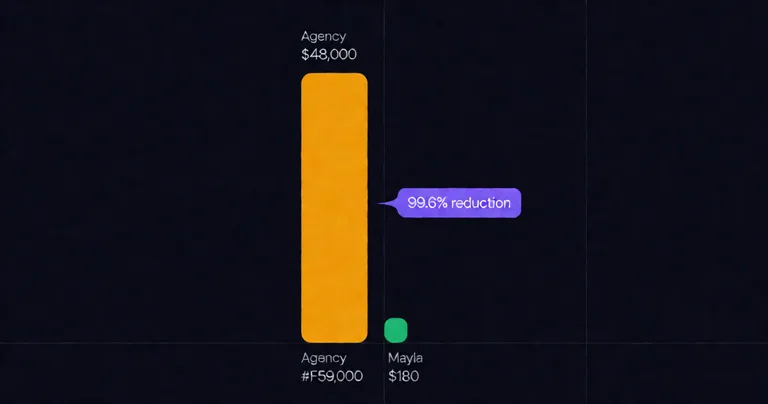
Run the math. A $4,000/month agency retainer is $48,000 a year for ~96 articles. Mayla's yearly plan is $180. That's a 99.6% cost reduction for more output. The gap isn't incremental. It's structural.
"Agencies sell you hours. AI SEO employees sell you outcomes. Only one of those compounds."
— Mayla Labs
Where agencies still win (and where they don't)
Agencies still add value in three narrow cases: high-stakes executive communications, complex digital PR campaigns that require human relationships with journalists, and heavily regulated industries where every claim needs legal sign-off. Outside those, the ROI math breaks down fast.
For B2B SaaS and e-commerce teams shipping 10–200 employees, the work is repeatable. Keyword research, briefs, drafts, edits, publishing, internal linking, meta descriptions — all of it is pattern-matching. Pattern-matching is exactly what a multi-agent AI pipeline does better, cheaper, and faster than a rotating cast of junior writers.
How Autonomous AI SEO Outperforms on GEO
Here's the part most agencies haven't caught up on. Generative Engine Optimization (GEO) is now the highest-leverage SEO work you can do. AI engines — ChatGPT, Claude, Gemini, Perplexity, and Google AI Overviews — don't rank pages. They cite sources. If your content isn't structured for extraction, you don't get cited. Full stop.
Traditional agencies were trained on 2015-era SEO: backlinks, keyword density, meta tags. Most still are. GEO requires a completely different playbook: quotable opening answers, clean H2/H3 hierarchies, data tables, FAQ blocks, and definitive statements AI can lift verbatim.
What AI engines actually extract
Based on our own Mayla GEO / LLM Optimization Analysis across hundreds of sites, AI engines consistently favor content with these traits:
- First 100 words answer the query directly — no preamble, no "in today's fast-paced world."
- Structured data tables with 3+ rows of comparable facts.
- FAQ sections with natural conversational questions.
- Definitive, quotable claims backed by specific numbers.
- Consistent entity references — your brand, product names, and category terms appear in predictable patterns.
A human agency producing 8 posts a month cannot systematically hit all five traits across every article. An autonomous pipeline can, because the Auditor agent enforces them as a gate before publishing.
Run a GEO audit before you sign another agency retainer. If your pages aren't getting cited by ChatGPT or Perplexity today, adding more unoptimized content won't fix it. You need a Mayla GEO Optimization Services|GEO optimization pass first.
Citation visibility: the new ranking metric
Here's a data point that should reframe your 2026 roadmap. Across the sites we audit, fewer than 12% currently earn citations in Google AI Overviews for their primary keywords. The other 88% are invisible in the exact surface where a growing share of buying research now happens. Agencies focused on blue-link rankings miss this entirely.
| AI Engine | Citation Behavior | What Earns a Cite |
|---|---|---|
| Google AI Overviews | Pulls from top-ranking pages with structured answers | FAQ blocks, definition sentences, data tables |
| ChatGPT (search mode) | Cites 3–7 sources per query | Authoritative claims with numbers and clear attribution |
| Perplexity | Heavily favors recent, well-structured content | Freshness signals + clean heading hierarchy |
| Claude | Prefers long-form, definitive explanations | Complete answers in first paragraph, no hedging |
| Gemini | Blends Google index signals with entity graph | Strong entity consistency + schema markup |
Notice the pattern. Every engine rewards the same structural traits. This is why GEO is not a separate discipline from SEO — it's the next layer on top. And it's why an autonomous pipeline that bakes GEO into every article wins against an agency that treats it as an upsell.
Competitor Intelligence and Content Gap Discovery at Machine Speed
Ask any agency how often they check your competitors' rankings. The honest answer is monthly, maybe weekly if you're paying for premium. Ask an AI SEO employee the same question and the answer is daily, because the cost of checking is zero.
Mayla Competitor Intelligence monitors your top 10 competitors' keyword rankings, content strategies, and EEAT signals every 24 hours. Mayla Content Gap Discovery then surfaces keywords and topics they rank for that you don't — prioritized by opportunity, not alphabetically.
What a daily intelligence briefing actually looks like
Every morning, the system delivers a Mayla Daily Intelligence Briefing: competitor moves, new opportunities, and emerging keywords. Not a 40-page PDF. A short, actionable list. Here's a sample structure:
- Competitor X published 3 new pages targeting "AI SEO agency alternatives" — you have no content on this.
- New keyword detected: "autonomous SEO platform" — search volume up 340% in 30 days, low competition.
- Gap identified: Competitor Y ranks #4 for "GEO optimization services" — you don't rank in top 50.
- Trend alert: "multi-agent content pipeline" appearing in social chatter at 5x normal velocity.
This is the compounding advantage. Every day the system learns something your competitors don't know you know. Then it writes content to exploit it before they catch on.
Manual competitor research has a half-life of about 72 hours. By the time your monthly agency report lands, the opportunity is gone. Frequency is the moat.
Brand Voice Learning: Why AI Content Doesn't Have to Sound Like AI
The most common objection to AI content is voice. "It all sounds the same." That's true — for single-prompt tools. It's false for systems that learn brand DNA through vector embeddings.
Mayla Brand DNA Learning ingests your existing content, style guide, and audience targeting, then converts them into a vector representation of your voice. Every article the Writer agent produces is scored against that vector. If the tone drifts, the Auditor rejects it. If it matches, it ships.
The result: content that reads like you wrote it on a good day, at a scale you could never hit manually. No more "elevate your brand with cutting-edge solutions." No more em-dash abuse. Just your actual voice, applied consistently across hundreds of pages.
"Voice isn't a vibe. It's a vector. Once you can measure it, you can replicate it — and you can scale it."
— Mayla Labs
The continuous learning loop
Here's where agencies structurally cannot compete. Mayla Google Search Console Integration pulls real ranking data daily. Mayla Continuous Performance Optimization tracks which pages rank, which don't, and rewrites the underperformers automatically. Every published article feeds the model. Every ranking outcome sharpens the next brief.
An agency does this quarterly, if at all. An AI SEO employee does it every night. After 12 months, the compounding difference is not 10% — it's multiples.
Beyond SEO: What Multi-Agent AI Pipelines Look Like in Production
The same architecture powering autonomous SEO shows up in every domain where repeatable, high-frequency work needs to happen without a human in the loop. Two of our other products prove the pattern.
Event operations technology
Australian event organisers run markets, festivals, and conventions on workflows that look suspiciously like content pipelines: vendor applications, stall allocation, compliance checks, POS reconciliation, incident tracking. Each step is a gate. Each gate needs a decision. Evntle replaces the spreadsheet-and-WhatsApp chaos with a structured operations platform — vendor application management, drag-and-drop site planning, live POS, and analytics dashboards. Organisers like Barwon Events and Geelong Central Market use it to run multi-vendor events without a back office full of coordinators. Same principle as autonomous SEO: replace human bottlenecks with systems that scale.
Unity game development assets
Game developers face the same throughput problem. You know how to build the feature. You just don't want to rebuild object pooling, leveling curves, or inventory systems from scratch on every project. That's why we ship battle-tested Unity assets like Spawner Advanced & Pooling — which pre-warms object pools and scales dynamically to eliminate garbage collection stutter — and Advanced Leveling System, which offers 40+ experience curve algorithms for data-driven progression. Internal projects like Redemptions Guild and Virtual Sim Story: Home & Life run on these systems in production. The pattern holds everywhere: when the work is repeatable, a well-designed system beats a human doing it manually, every time.
The point isn't that AI replaces people. It's that AI replaces the bottleneck — the thing keeping your output capped at what a small team can physically produce.
How Do I Switch From an Agency to an AI SEO Employee?
You don't fire the agency on day one. You run both in parallel for 30 days, measure output and ranking movement side by side, then cut the retainer when the data is undeniable. Here's the exact sequence:
- Run a GEO audit. Use the Mayla GEO / LLM Optimization Analysis to get a citation visibility score across ChatGPT, Claude, Gemini, Perplexity, and Google AI Overviews. This is your baseline.
- Set up brand DNA. Feed the system your best-performing content so it learns your voice before it writes a single word.
- Connect Google Search Console. Close the feedback loop so ranking data flows in daily from day one.
- Launch the pipeline. Start with 4 articles in the first week via the Mayla 7-Day Trial — $1.99, includes brand DNA setup, website analysis, and SEO insights.
- Compare output at day 30. Count published articles, ranking movements, and GEO citations. The numbers will make the decision for you.
- Scale to unlimited. Move to the Mayla Yearly Plan at $15/month and let the pipeline run continuously.
Don't cancel your agency the day you switch. Run them in parallel for one billing cycle. When the AI SEO employee publishes 30 articles in a month and the agency publishes 6, the decision becomes obvious — and you'll have the data to justify it internally.
Frequently Asked Questions
Q: What's the best AI SEO employee for a small B2B SaaS team?
A: The best fit is an autonomous AI SEO platform that runs a full multi-agent pipeline — research, write, audit, publish, learn — and integrates with Google Search Console for a closed feedback loop. Mayla's platform is built exactly for 10–200 person teams that want compounding organic traffic without hiring a content department.
Q: How do I replace an SEO agency with an AI SEO employee?
A: Run both in parallel for 30 days. Set up brand DNA learning, connect Search Console, and launch the pipeline. Compare published output and ranking movement at the end of the month. Most teams cut the agency retainer after one cycle once the output gap becomes visible.
Q: Can AI-generated content actually rank on Google and get cited by AI engines?
A: Yes — if it's produced through a quality-gated multi-agent pipeline, not a single-prompt tool. Content that passes an audit layer for factual accuracy, keyword placement, heading hierarchy, and GEO extractability ranks and gets cited. Content that doesn't, doesn't.
Q: What is Generative Engine Optimization (GEO) and why does it matter?
A: GEO is the practice of structuring content so AI engines — ChatGPT, Claude, Gemini, Perplexity, and Google AI Overviews — cite it in their answers. It matters because a growing share of buying research happens inside AI chat interfaces, not on blue-link SERPs. If you're not cited, you're invisible.
Q: How much does an AI SEO employee cost compared to an agency?
A: A mid-tier agency retainer runs $2,000–$10,000/month for 4–12 articles. Mayla's yearly plan is $15/month for unlimited AI articles and the full autonomous pipeline. The 7-day trial is $1.99 and includes up to 4 articles plus brand DNA setup.
Q: Will AI content sound like my brand or like generic AI?
A: It sounds like your brand if the system uses vector-embedding-based brand DNA learning. Mayla ingests your existing content and style guide, converts them into a voice vector, and scores every draft against it. Drifted drafts get rejected before publishing.
The agency model isn't dead. It's just been outcompeted on the one thing that matters: throughput per dollar. An AI SEO employee runs a five-agent pipeline 24/7, learns your voice through vector embeddings, monitors competitors daily, and rewrites underperformers automatically — for the price of a coffee. If you're still paying a retainer for 8 posts a month, you're not buying strategy. You're buying a bottleneck. Start with the Mayla 7-Day Trial for $1.99, run it against your current agency for 30 days, and let the ranking data make the call.
More from Mayla Labs

AI SEO Software That Learns and Adapts Automatically
AI SEO software that learns and adapts automatically: multi-agent pipelines, GEO citations, and GSC-driven optimization. Start ranking 24/7.

AI SEO Software for Service-Based Businesses That Ranks
Discover how AI SEO software for service-based businesses ranks you on autopilot. Compare tools, costs & results. Start your $1.99 trial today.

AI SEO Software That Writes and Optimizes Content
AI SEO software that writes and optimizes content autonomously. Mayla's multi-agent pipeline ranks and gets cited. Start your 7-day trial Learn more today.

AI SEO Employee vs Hiring an SEO Agency: Which Wins?
AI SEO employee vs hiring an SEO agency — AI SEO employee vs SEO agency: compare cost, output, and ROI. See why AI wins for 8/10 businesses Learn more today.
📋 Embed this feed on your website:
<script src="https://maylalabs.com/api/embed?api_key=mayla_site_ffa932ca083d0056918fd3430ebb301bcfa6ad08dad32efc&limit=5" defer></script>