
AI SEO Software for Service-Based Businesses That Ranks
Discover how AI SEO software for service-based businesses ranks you on autopilot. Compare tools, costs & results. Start your $1.99 trial today.
Summary
Discover how AI SEO software for service-based businesses ranks you on autopilot. Compare tools, costs & results. Start your $1.99 trial today
AI SEO software for service-based businesses is an autonomous platform that researches competitors, identifies content gaps, writes quality-gated articles in your brand voice, and publishes across your website and social channels without a human SEO team. For service businesses — agencies, consultants, trades, clinics, and event vendors — the best AI SEO software replaces the $3,000–$8,000/month retainer with a system that runs continuously. Tools like Mayla combine competitor intelligence, brand DNA learning, and a 5-agent article pipeline to deliver 95%+ SEO-scored content on autopilot, so your business ranks for the searches that actually generate booked calls.
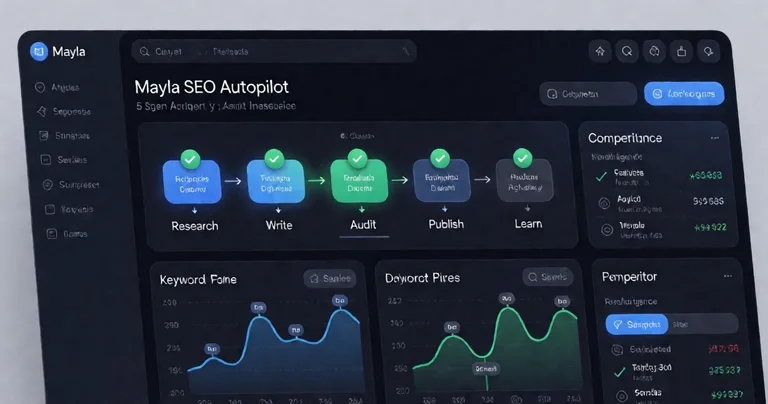
If you run a service business, you already know the problem. You have maybe 20 hours a week to think about marketing, and SEO keeps demanding more: more content, more technical fixes, more competitor tracking. Traditional SEO agencies charge retainers that eat your margin. DIY tools hand you a dashboard and wish you luck. Neither option solves the core issue — SEO is a full-time job, and you already have one.
That is exactly why AI SEO software built for service-based businesses has moved from novelty to necessity. In this guide, we break down what these platforms actually do, how to evaluate them, and how to deploy one without wrecking your brand voice or your budget.
Why Service-Based Businesses Need AI SEO Software
Service businesses live and die by local and intent-driven search. When someone types "emergency plumber near me" or "best CRM for event organisers," they are not browsing — they are buying. Winning those searches requires consistent, authoritative content that answers specific questions.
The math is brutal for small teams. According to industry benchmarks, businesses that publish 16+ blog posts per month generate roughly 3.5x more traffic than those publishing 0–4 posts. But a single well-researched 1,500-word article takes a skilled writer 4–6 hours. That is 64–96 hours a month just for content — before you touch keyword research, on-page optimization, or link building.
AI SEO software for service-based businesses collapses that timeline. Instead of hiring, you deploy a system that researches, writes, and publishes on a schedule. The right platform does not just generate words — it learns your industry, monitors your competitors, and adjusts strategy based on real ranking data.
Google processes over 8.5 billion searches per day, and roughly 46% of all searches have local intent. For service businesses, that local intent is where the highest-converting traffic lives.
What Makes Service Businesses Different from E-Commerce
E-commerce SEO chases product pages and category rankings. Service SEO chases trust. Your prospects need to believe you are the expert before they call. That means your content strategy must prioritize:
- Authority signals — case studies, credentials, and expert commentary
- Problem-solving content — answering the exact questions your buyers ask
- Local relevance — service areas, regional proof, and community presence
- Conversion paths — every article should lead somewhere (a booking page, a quote form, a product)
Generic AI writers fail at all four. They produce surface-level content that reads like a Wikipedia summary. Purpose-built platforms — like the ones described in our breakdown of best AI SEO tool for autonomous growth — are trained to handle the nuance.
How AI SEO Software for Service-Based Businesses Actually Works
The best platforms operate as a closed loop: research → create → publish → measure → learn. Here is what happens at each stage.
Stage 1: Competitor Intelligence and Content Gap Analysis
Before writing a single word, the software crawls your top 10 competitors and maps their keyword footprint. It identifies which terms they rank for, which content formats they use, and — critically — where they have gaps. A good platform surfaces 50–200+ untapped keywords in the first scan.
This is where Mayla Competitor Intelligence earns its keep. It does not just list keywords; it tracks EEAT signals (Experience, Expertise, Authoritativeness, Trustworthiness) so you know which competitor content is actually earning Google's trust versus which is ranking on domain authority alone.
Stage 2: Brand DNA Learning
The single biggest failure mode of AI content is voice mismatch. If your articles sound like a robot wrote them, prospects bounce. The fix is brand DNA learning — the platform ingests your existing website, marketing copy, and tone guidelines, then writes in that voice.
This matters enormously for service businesses. A law firm should not sound like a surf shop. A festival organiser should not sound like a SaaS startup. Platforms that skip this step produce content you will be embarrassed to publish.
Before committing to any AI SEO tool, feed it 5–10 of your best existing articles and ask it to write a test piece. If the voice does not match within 90%, the platform is not ready for your brand.
Stage 3: Quality-Gated Content Production
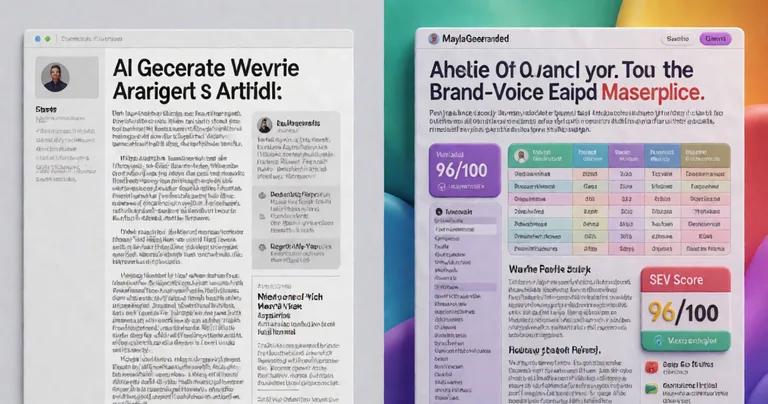
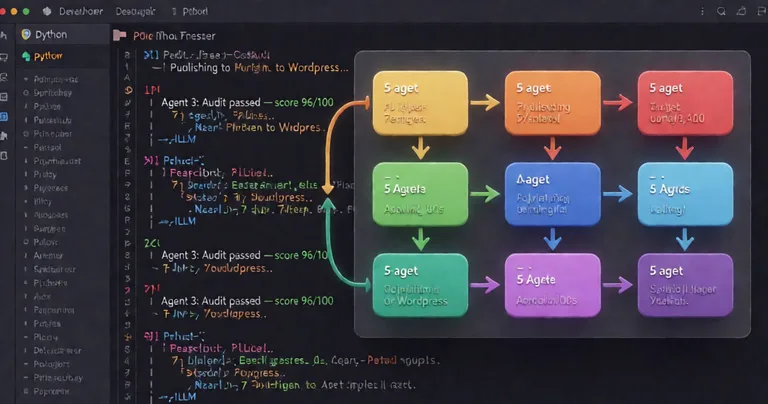
This is where the serious platforms separate from the toys. A quality gate means the article is scored against an SEO rubric before it publishes — and rejected if it falls short. Mayla's pipeline runs five specialized agents (Researcher, Writer, Auditor, Designer, Publisher) with a 95%+ SEO score threshold. Anything below that gets sent back for revision.
For a service business, this gate is non-negotiable. Publishing low-quality content at scale does not just waste effort — it can trigger Google's helpful content penalties and damage your domain.
Stage 4: Multi-Platform Publishing and Authority Building
Publishing to your blog is table stakes. The best platforms also distribute to LinkedIn, X/Twitter, Facebook, and Pinterest, generate featured images, and produce short-form video. This multiplies the reach of every article without extra work.
For service businesses, this multi-channel presence matters because buyers research across platforms. A prospect might find your article on Google, then check your LinkedIn before calling. Consistent distribution builds the trust that closes the gap between interest and inquiry.
Stage 5: Continuous Learning
The final stage is where autonomous systems beat human teams. The platform tracks which articles rank, which keywords move, and which formats convert — then adjusts the next batch accordingly. Over 6–12 months, this compounding loop produces dramatically better results than a static content calendar.
Comparing AI SEO Software Options for Service Businesses
Not all platforms are built the same. Here is how the main categories compare for service-based businesses.
| Platform Type | Typical Cost | Best For | Key Limitation |
|---|---|---|---|
| Traditional SEO Agency | $3,000–$8,000/month | Businesses with budget and patience | Slow output, high cost, limited scalability |
| DIY SEO Tools (Ahrefs, Semrush) | $99–$499/month | Teams with in-house SEO expertise | Requires you to do all the work |
| Generic AI Writers (Jasper, Copy.ai) | $49–$125/month | One-off content generation | No strategy, no publishing, no learning loop |
| Autonomous AI SEO Platforms (Mayla) | $15–$29/month | Service businesses wanting full automation | Requires initial brand DNA setup |
The cost differential is staggering. A service business spending $4,000/month on an agency could deploy an autonomous platform for under $30/month and reinvest the difference into paid acquisition or operations. The trade-off is setup time and the need to trust the system's output — which is why the quality gate matters so much.
What to Look For in an AI SEO Platform
When evaluating options, prioritize these capabilities:
- Competitor monitoring — does it track your top 10 competitors automatically?
- Brand voice learning — can it match your tone without manual prompting?
- Quality scoring — is there a hard threshold before publishing?
- CMS integration — does it connect to WordPress, Shopify, Webflow, or Ghost?
- Search Console integration — does it pull real ranking data to inform strategy?
- Multi-platform distribution — does it amplify content beyond your blog?
- Transparent pricing — are there hidden fees or usage caps?
Mayla checks all seven. Its Google Search Console integration pulls real query data so the platform knows which keywords are actually driving impressions, not just which ones look good in a keyword tool.
Real-World Applications: How Service Businesses Use AI SEO
Abstract benefits are easy to claim. Here is how specific service businesses deploy these platforms in practice.
Event Vendors and Festival Organisers
Consider a farmers market vendor or festival organiser running on Evntle — a CRM and POS platform built for the Australian events market. Their SEO challenge is hyper-local: they need to rank for "farmers market [suburb]," "night market [city]," and "craft fair vendors [region]."
An autonomous AI SEO platform handles this by generating location-specific content at scale — vendor spotlights, event previews, and market guides — each optimized for local search terms. The vendor storefronts at yourname.evntle.com benefit directly from the increased domain authority, and the event discovery listings surface higher in local results.
This is the compounding effect: better SEO drives more event discovery traffic, which drives more vendor signups, which creates more content opportunities. The platform feeds itself.
B2B Service Providers and Consultants
A B2B consultant selling to mid-market clients needs to rank for high-intent terms like "fractional CFO services" or "operations consultant for SaaS." These are competitive keywords with established players. The winning strategy is content depth — publishing 20–40 articles that comprehensively cover the topic cluster.
Doing this manually takes 6–12 months. An autonomous platform compresses it to 6–12 weeks, then continues optimizing based on which articles gain traction. The key is the quality gate — every article must meet the threshold or it does not publish.
"The businesses winning at SEO in 2025 are not the ones with the biggest budgets. They are the ones with the fastest learning loops."
— Mayla Labs, Autonomous SEO Research
Technical Service Businesses
For software and technical service providers, content marketing must demonstrate deep expertise. A Unity asset developer, for example, needs to rank for terms like "Unity inventory system" or "RPG dialogue system asset." The audience is technical and skeptical of fluff.
This is where brand DNA learning becomes critical. A platform writing for RealSoft Games — a Unity asset studio — must understand shader architecture, object pooling, and networking libraries well enough to write credibly. The content needs to reference real technical concepts, not generic marketing language.
When the voice and expertise match, the content performs. Technical buyers convert on demonstrated competence, not persuasive copy.
Measuring ROI: What Results Should You Expect?
SEO is a long game, but autonomous platforms compress the timeline. Here are realistic benchmarks based on typical deployment patterns.
| Timeframe | Expected Output | Typical Ranking Movement | Traffic Impact |
|---|---|---|---|
| Month 1 | 20–40 articles published | Indexing and initial impressions | Minimal (0–10%) |
| Month 2–3 | 40–80 additional articles | Long-tail keywords entering top 50 | Moderate (10–40%) |
| Month 4–6 | 80–150 cumulative articles | Mid-tail keywords reaching top 20 | Significant (40–120%) |
| Month 7–12 | 150–300 cumulative articles | Head terms entering top 10 | Compounding (120–300%+) |
These ranges assume consistent publishing, proper technical SEO foundations, and a quality gate that prevents low-value content from diluting the domain. Businesses that skip the quality gate often see flat or declining results despite high output.
Publishing 100 low-quality articles is worse than publishing 10 excellent ones. Google's helpful content system actively demotes sites that prioritize volume over value. Always verify your platform has a quality threshold.
The Cost Comparison Nobody Talks About
A service business owner spending 10 hours a week on SEO is effectively paying themselves $0 for that time — but the opportunity cost is real. If those 10 hours could be billed at $150/hour, that is $1,500/week or $78,000/year in foregone revenue.
An autonomous platform at $29/month costs $348/year. Even accounting for setup time and oversight, the ROI is measured in multiples, not percentages.
Getting Started: A Practical Deployment Plan
Here is how to deploy AI SEO software for your service business without disrupting operations.
- Audit your current SEO foundation. Ensure your site is technically sound — fast, mobile-friendly, and indexed. No AI content will rank on a broken site.
- Define your top 20 target keywords. Focus on intent-driven terms your buyers actually search.
- Set up brand DNA. Feed the platform your best existing content, tone guidelines, and audience profile.
- Run a competitor scan. Identify the top 10 competitors and their content gaps.
- Start with a trial. Mayla offers a Mayla 7-Day Trial for $1.99 — enough to generate up to 4 articles and evaluate quality.
- Review the first batch manually. Check voice match, accuracy, and SEO scoring before scaling.
- Connect your CMS and Search Console. Automate publishing and enable real-data learning.
- Scale up. Once quality is confirmed, increase publishing frequency and let the learning loop compound.
The entire setup takes 2–4 hours. After that, the system runs continuously with minimal oversight — a weekly review of the analytics dashboard is usually sufficient.
Common Mistakes to Avoid
- Skipping the quality gate — volume without quality damages your domain
- Ignoring brand voice — mismatched tone erodes trust with prospects
- Not connecting Search Console — without real data, the platform cannot learn
- Expecting overnight results — SEO compounds over months, not days
- Abandoning after 30 days — the learning loop needs 90+ days to show real impact
For a deeper dive into the content creation side, our guide on AI content creation tool covers how the pipeline produces brand-voice articles that pass human review.
"The best time to deploy autonomous SEO was six months ago. The second best time is today — because every month you wait, your competitors are publishing."
— Mayla Labs
Frequently Asked Questions
Q: How do I choose the best AI SEO software for my service business?
A: Look for four things: competitor intelligence (tracks your top 10 rivals), brand voice learning (matches your tone), a quality gate (rejects sub-95% SEO scores), and CMS integration (publishes automatically). Cost should be under $100/month for most service businesses. Avoid any platform that publishes without a quality threshold.
Q: Can AI SEO software replace a human SEO agency entirely?
A: For content production, keyword research, and publishing — yes. For complex technical SEO (site migrations, Core Web Vitals fixes, schema restructuring), you may still want human oversight. Most service businesses find that autonomous platforms handle 80–90% of ongoing SEO work, freeing budget for strategic consulting when needed.
Q: How long before AI SEO content starts ranking?
A: Long-tail keywords typically enter the top 50 within 30–60 days. Mid-tail terms reach top 20 in 90–120 days. Competitive head terms take 6–12 months. The compounding effect means months 7–12 deliver the largest traffic gains — assuming consistent publishing and a quality gate.
Q: Will AI-generated content hurt my Google rankings?
A: No — Google's guidelines focus on content quality, not creation method. AI content that demonstrates expertise, answers real questions, and meets EEAT standards ranks well. The risk comes from low-quality, unedited AI output published at scale. A quality gate prevents this entirely.
Q: What's the best AI SEO software for local service businesses?
A: The best option combines local keyword targeting with autonomous publishing. Platforms like Mayla generate location-specific content at scale — critical for service businesses competing in multiple suburbs or regions. Pair this with a Google Business Profile and local citations for maximum impact.
Q: How much does AI SEO software cost compared to hiring a writer?
A: A freelance SEO writer charges $150–$500 per article. Publishing 16 articles monthly costs $2,400–$8,000. Autonomous platforms like Mayla start at $15/month for unlimited articles — a 99% cost reduction. The trade-off is setup time and the need to verify quality in the first month.
AI SEO software for service-based businesses is no longer a nice-to-have — it is the difference between competing and being invisible. The platforms that win are autonomous, quality-gated, and brand-aware. They research competitors, write in your voice, publish across channels, and learn from real ranking data. For service businesses tired of choosing between expensive agencies and time-consuming DIY tools, the answer is a system that runs itself. Start with a trial, verify the quality gate, and let the compounding begin.
More from Mayla Labs

AI SEO Software That Writes and Optimizes Content
AI SEO software that writes and optimizes content autonomously. Mayla's multi-agent pipeline ranks and gets cited. Start your 7-day trial Learn more today.

AI SEO Employee vs Hiring an SEO Agency: Which Wins?
AI SEO employee vs hiring an SEO agency — AI SEO employee vs SEO agency: compare cost, output, and ROI. See why AI wins for 8/10 businesses Learn more today.

AI SEO Automation Review for Growth-Stage Startups
AI SEO automation review for growth-stage startups: multi-agent pipelines, GEO for ChatGPT, and real ROI. See how Mayla replaces agency workflows.

Scale Organic Traffic Without Hiring a Marketing Employee
Scale organic traffic without hiring a marketing employee. Autonomous AI SEO runs the full pipeline for $15/mo. Start your $1.99 trial today.
📋 Embed this feed on your website:
<script src="https://maylalabs.com/api/embed?api_key=mayla_site_ffa932ca083d0056918fd3430ebb301bcfa6ad08dad32efc&limit=5" defer></script>