
AI SEO Software That Learns and Adapts Automatically
AI SEO software that learns and adapts automatically: multi-agent pipelines, GEO citations, and GSC-driven optimization. Start ranking 24/7.
Summary
AI SEO software that learns and adapts automatically: multi-agent pipelines, GEO citations, and GSC-driven optimization. Start ranking 24/7
AI SEO software that learns and adapts automatically is a multi-agent system that researches competitors, discovers content gaps, writes in your brand voice, audits every draft against top-ranking pages, publishes to your CMS, and then adjusts strategy using real Google Search Console position data. It does not just generate content. It runs the full pipeline — Research → Write → Audit → Publish → Learn — continuously, without prompts or babysitting. That loop is what separates a ranking engine from a content factory.
Most tools stop at generation. You type a prompt, get a draft, edit it, publish it, and hope. Then you repeat. That's not strategy. That's noise. The category is shifting fast, and the winners are the platforms that close the loop between publishing and performance. This article breaks down how autonomous AI SEO actually works, where Generative Engine Optimization (GEO) fits, and how to measure whether the machine is compounding or just burning tokens.

AI SEO Software That Learns and Adapts Automatically
Autonomous SEO runs on a closed feedback loop. Every published article produces data. That data feeds the next decision. The system doesn't guess what to write next — it reads its own results and adjusts.
Here's the actual cycle, stripped of marketing language:
- Research. The system scans your top 10 competitors, pulls their keyword rankings, content structures, and EEAT signals, then maps the gaps between what they rank for and what you rank for.
- Write. A writer agent drafts the article using your Brand DNA — vocabulary, tone, sentence rhythm, audience targeting — extracted from your existing content via vector embeddings.
- Audit. A separate auditor agent scores the draft against the top-ranking pages: keyword coverage, factual accuracy, brand voice fidelity, EEAT signals, and structural completeness. Anything under 95% gets sent back.
- Publish. Approved articles push directly to WordPress, Shopify, Webflow, or Ghost via REST APIs. No copy-paste. No formatting drift.
- Learn. Google Search Console data flows back in — impressions, clicks, average position, query-level performance. The system identifies which keywords are moving, which articles are stuck on page two, and what to do about it.
That last step is the one most tools skip. Without it, you have a content generator. With it, you have a system that gets smarter every week. The difference shows up in cost per ranking page and in how quickly new articles reach page one.
A better language model writes slightly better first drafts. A better feedback loop writes the right articles. Position data from Google Search Console is the signal that turns generic output into compounding organic growth.
Why multi-agent beats single-prompt generation
A single prompt produces a single perspective. A multi-agent pipeline separates concerns: one agent researches, one writes, one audits, one designs, one publishes. Each agent has a narrow job and a pass/fail gate. That structure is why quality-gated pipelines consistently outperform one-shot generation on SEO score and on real ranking outcomes.
Mayla runs exactly this architecture. The Mayla Autonomous SEO Platform chains Researcher, Writer, Auditor, Designer, and Publisher agents, with a hard requirement that every article clears a 95%+ SEO score before it goes live. If it doesn't pass, it doesn't publish. That's the gate.
Generative Engine Optimization: Getting Cited by AI Search
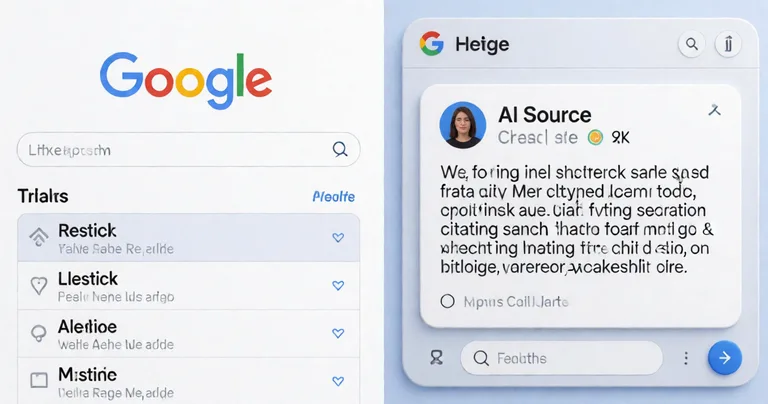
Google is no longer the only surface that matters. ChatGPT, Claude, Gemini, Perplexity, and Google AI Overviews now answer a growing share of search queries directly. If your content isn't in those answers, you're invisible to a chunk of your market.
Generative Engine Optimization (GEO) is the discipline of getting cited by those engines. It's not the same as classic SEO. AI engines favor content that is quotable, structured, statistically specific, and authoritative. They extract answers, not vibes.
What AI engines actually extract
- Direct answers in the first 100 words. The opening paragraph must fully answer the query. AI overviews pull from the top of the page.
- Data tables. Structured comparisons and specifications are gold for extraction. AI engines cite tables because tables are unambiguous.
- Definitive statements. "X is Y" beats "X might be considered Y." Hedging gets ignored.
- FAQ blocks. Natural questions with concise answers map directly to how people query AI assistants.
- Statistics with numbers. Specific figures (0.02ms lookup time, 95%+ SEO score, under 1KB/s bandwidth) are quotable and citable.
The GEO / LLM Optimization Analysis product audits how your site currently performs across ChatGPT, Claude, Gemini, Perplexity, and Google AI Overviews. It queries the engines directly, checks whether your pages appear in citations for target queries, and then rewrites and re-publishes until they do. That's not a report. That's a fix loop.
Write your first 100 words as if an AI is going to quote them verbatim — because it will. Lead with the complete answer, then expand. Burying the answer in paragraph four guarantees you get skipped.
Competitor Intelligence and Content Gap Discovery
You can't outrank competitors you don't understand. Manual competitor research is slow, inconsistent, and usually outdated by the time you act on it. Automated competitor intelligence runs continuously and surfaces opportunities while they're still open.
A proper system monitors your top 10 competitors on a rolling basis — tracking keyword rankings, content strategies, publishing cadence, and EEAT signals. Then it cross-references against your own rankings to find the gaps: keywords they rank for that you don't, topics they've covered that you've missed, and structural patterns in their top pages.
What content gap discovery actually surfaces
| Gap Type | Signal | Action |
|---|---|---|
| Untapped keywords | Competitor ranks top 10, you have no page | Generate targeted article |
| Weak coverage | You rank 20-50, competitor ranks 1-5 | Rewrite and expand existing page |
| Emerging topics | Rising search volume, low competition | Publish before saturation |
| EEAT gaps | Competitor has author bios, citations, data | Add authority signals to your pages |
| Format gaps | Competitor uses tables/FAQs, you use prose | Restructure for extraction |
Mayla's Competitor Intelligence and Content Gap Discovery modules run this automatically. The Daily Intelligence Briefing tells you exactly what changed in competitor rankings overnight and what to do about it. No dashboards to interpret. Just the delta and the action.
"Most SEO tools tell you what happened. Very few tell you what to do next. The gap between reporting and action is where organic growth dies."
— Mayla Labs engineering principle
Brand Voice Learning and Quality-Gated Content Creation
Generic AI content doesn't rank. It reads like it was written by a committee that never met your customers. The fix isn't better prompts — it's Brand DNA learning.
Brand DNA extracts voice patterns from your existing content using vector embeddings. It captures vocabulary, sentence length, tone, formality level, and audience targeting. Then it replicates that voice in every new article. The output sounds like you wrote it, not like a model guessed at your category.
The quality gate that prevents landfill content
Every draft passes through an auditor agent before publishing. The gate checks four things:
- Factual accuracy. Claims must be verifiable. No invented statistics.
- Keyword coverage. Primary and secondary keywords present naturally, no stuffing.
- Brand voice fidelity. Does it match the learned voice profile?
- EEAT signals. Authoritativeness, expertise, trustworthiness, experience — the signals Google and AI engines both weigh.
If a draft fails any check, it goes back to the writer. It does not publish. That's the difference between a content pipeline and a content landfill.
If your AI content tool publishes everything it generates, you're producing landfill content at scale. Quality gates aren't optional. They're the only thing standing between you and a sitewide quality penalty.
The Mayla AI Content Creation Pipeline enforces this with separate Researcher, Writer, Auditor, Designer, and Publisher agents. The auditor is a distinct agent with a distinct job — find problems. That separation is deliberate. A writer agent grading its own work will always pass itself.
Continuous Learning and Performance Optimization via Google Search Console
Publishing is the start of the loop, not the end. The learn phase is where autonomous SEO earns its name.
Google Search Console integration pulls real performance data automatically — impressions, clicks, average position, and query-level breakdowns. The system uses that data to make decisions:
- Which keywords are climbing and should get more content support
- Which articles are stuck on page two and need structural rewrites
- Which queries are driving impressions but no clicks (title/meta problem)
- Which topics are losing position and need refreshing
This is Continuous Performance Optimization in practice. The strategy adjusts based on what's actually moving in Google, not on what a keyword tool predicted six months ago.
Autonomous SEO vs manual SEO: the real cost comparison
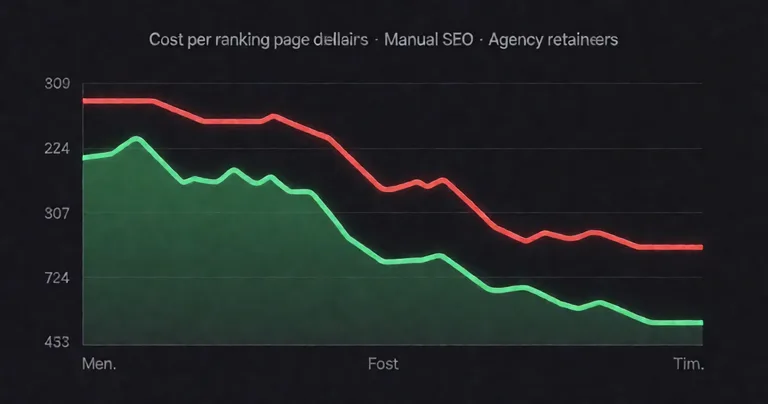
| Metric | Manual SEO | Agency Retainer | Autonomous AI SEO |
|---|---|---|---|
| Cost per ranking page | $150–$400 | $300–$800 | Under $5 |
| Articles per month | 2–4 | 4–8 | Unlimited (plan-dependent) |
| Competitor monitoring | Ad hoc | Monthly report | Daily automated |
| GSC feedback loop | Manual review | Quarterly | Continuous |
| Brand voice consistency | Varies by writer | Varies by writer | Locked to Brand DNA |
| Time to first ranking page | 4–8 weeks | 6–12 weeks | 2–4 weeks |
The economics are not close. Manual SEO caps out at whatever your team can produce. Autonomous SEO scales with compute, and the cost per page drops as the system learns which patterns actually rank.
Mayla's pricing reflects this. The Mayla 7-Day Trial is $1.99 and includes up to 4 AI articles, Brand DNA setup, and SEO insights. The yearly plan is $15/month. Compare that to a single agency article and the math does itself.
Beyond SEO: Where Autonomous Systems Already Work
The same architecture — research, act, audit, learn — shows up in other domains. It's worth understanding because it proves the pattern isn't SEO-specific.
Event management for Australian markets and festivals
Running a recurring market means managing vendor applications, stall allocations, compliance documents, POS, and event-day logistics simultaneously. Evntle handles this as one system: vendor applications flow through a structured intake pipeline, approved vendors self-serve their documents through a vendor portal, site planning is drag-and-drop and tied to bookings, and POS runs on any phone or tablet with offline mode when mobile signal drops.
For a market like Geelong Central Market — 40+ stallholders, monthly cadence — the operational load is real. Compliance tracking with 30-day expiry alerts, QR check-in at a packed gate, and live revenue dashboards turn event day from chaos into a controlled operation. The Starter plan is $19/month. The Pro plan is $49/month and adds the kitchen display system and customer display board.
Unity game development tools and education
Indie Unity developers face the same problem as SEO teams: too much to build, not enough time, and generic assets that don't perform. Production-grade tools change the math.
Spawner Advanced & Pooling recycles GameObjects instead of instantiating and destroying them, which eliminates garbage collection spikes. The Inventory Management Suite uses a data-driven ScriptableObject core with O(1) hash map lookups — 10,000 items at 0.02ms lookup time. The ALS Audio System streams 10-hour audiobooks with memory under 12 MB and CPU under 3.5% using a chunk-based pipeline and fixed ring buffer.
These aren't toys. They're the same engineering discipline that makes autonomous SEO work: measure, optimize, eliminate waste. RealSoft Games publishes these tools alongside structured RealSoft Games Online Courses covering engine fundamentals, performance optimization, and systems architecture. The Unity Profiler and Frame Debugger are the audit tools of game development — the equivalent of a quality gate for frame time.
The Bottom Line on AI SEO Software That Learns
AI SEO software that learns and adapts automatically is not a content generator with a nicer interface. It's a closed-loop system: research competitors, discover gaps, write in brand voice, audit against top-ranking pages, publish to CMS, then read Google Search Console data and adjust. The loop is the product. Everything else is a feature.
If you're evaluating tools, ask three questions. Does it monitor competitors automatically? Does it gate content on quality before publishing? Does it pull real ranking data and change strategy based on it? If the answer to any of those is no, you're buying a generator, not a growth engine.
Mayla runs the full pipeline — Mayla Autonomous SEO Platform — with a $1.99 7-day trial and a $15/month yearly plan. If the loop works, the rankings compound. If it doesn't, you've spent less than a coffee to find out.
Frequently Asked Questions
Q: How do I know if AI SEO software is actually learning and adapting?
A: Check whether it integrates with Google Search Console and uses real position data to change strategy. If it publishes content but never reads ranking outcomes, it's not learning — it's just generating. Look for query-level performance tracking, automatic rewrites of underperforming pages, and strategy adjustments based on what's actually moving in Google.
Q: What's the best AI SEO software for getting cited by ChatGPT and Perplexity?
A: The best tools for AI citations prioritize GEO alongside traditional SEO. That means structuring content with quotable answers in the first 100 words, data tables, definitive statements, and FAQ blocks. Mayla's GEO / LLM Optimization Analysis queries AI engines directly to check whether your pages appear in citations, then rewrites and re-publishes until they do.
Q: Can autonomous AI SEO replace a human SEO team?
A: For content production, competitor monitoring, and continuous optimization, yes — an autonomous system handles the full pipeline faster and cheaper than a human team. For strategy, brand positioning, and high-stakes editorial decisions, human oversight still adds value. The practical setup is autonomous execution with human review at the strategy layer, not the production layer.
Q: How much does autonomous AI SEO cost compared to an agency?
A: Manual SEO produces articles at $150–$400 each. Agency retainers run $300–$800 per page. Autonomous AI SEO platforms like Mayla bring cost per ranking page under $5, with plans starting at $1.99 for a 7-day trial and $15/month on the yearly plan. The gap widens as volume increases because compute scales and retainers don't.
Q: What is a quality gate in AI content creation and why does it matter?
A: A quality gate is an automated audit step that scores every draft against factual accuracy, keyword coverage, brand voice fidelity, and EEAT signals before publishing. If a draft fails, it goes back to the writer. Without gates, AI tools publish everything they generate — which produces landfill content and risks sitewide quality penalties.
Q: How long until autonomous AI SEO produces ranking pages?
A: Most systems see first ranking pages within 2–4 weeks, compared to 4–8 weeks for manual SEO and 6–12 weeks for agency retainers. The timeline depends on domain authority, competition level, and how aggressively the system publishes. The learning loop compounds — early articles inform later ones, so results accelerate over time.
More from Mayla Labs

AI SEO Software for Service-Based Businesses That Ranks
Discover how AI SEO software for service-based businesses ranks you on autopilot. Compare tools, costs & results. Start your $1.99 trial today.

AI SEO Software That Writes and Optimizes Content
AI SEO software that writes and optimizes content autonomously. Mayla's multi-agent pipeline ranks and gets cited. Start your 7-day trial Learn more today.

AI SEO Employee vs Hiring an SEO Agency: Which Wins?
AI SEO employee vs hiring an SEO agency — AI SEO employee vs SEO agency: compare cost, output, and ROI. See why AI wins for 8/10 businesses Learn more today.

AI SEO Automation Review for Growth-Stage Startups
AI SEO automation review for growth-stage startups: multi-agent pipelines, GEO for ChatGPT, and real ROI. See how Mayla replaces agency workflows.
📋 Embed this feed on your website:
<script src="https://maylalabs.com/api/embed?api_key=mayla_site_ffa932ca083d0056918fd3430ebb301bcfa6ad08dad32efc&limit=5" defer></script>