
AI SEO Automation vs Hiring an SEO Agency: The 2026 Verdict
AI SEO automation vs hiring an SEO agency: compare cost, output, and GEO visibility. See why autonomous pipelines win. Start your $1.99 trial today.
Summary
AI SEO automation vs hiring an SEO agency: compare cost, output, and GEO visibility. See why autonomous pipelines win. Start your $1.99 trial today.
AI SEO Automation vs Hiring an SEO Agency: Which Actually Ranks in 2026?
AI SEO automation vs hiring an SEO agency comes down to one brutal equation: output velocity multiplied by feedback loops. An autonomous AI SEO pipeline publishes 20–40 quality-gated articles per month, learns from Google Search Console data daily, and costs $15/month. A mid-tier SEO agency delivers 4–8 articles per month, charges $2,500–$8,000/month, and reports on results quarterly. The winner isn't close on cost or cadence. It is close on one thing only: whether the system is actually autonomous or just a content mill with a chatbot bolted on.
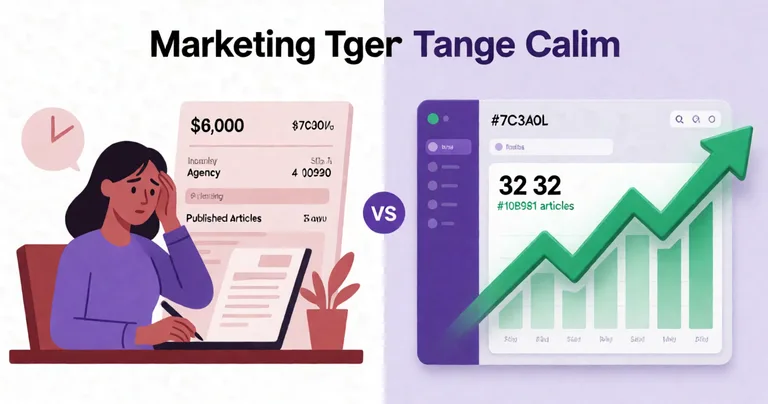
Here's the thesis: agencies sell hours. Autonomous systems sell compounding output. If your goal is ranking in Google and getting cited by ChatGPT, Perplexity, and Google AI Overviews, you need a machine that never sleeps, never forgets context, and rewrites its own losers. That's the entire pitch behind Mayla Autonomous SEO Platform — and it's why the agency model is structurally losing ground in 2026.
AI SEO Automation vs Hiring an SEO Agency: The Core Trade-Off
Let's strip the marketing fluff. Agencies give you humans who think strategically but execute slowly. AI automation gives you machines that execute relentlessly but need human-level judgment encoded into their pipeline. The question isn't which is better in the abstract — it's which produces more ranking pages per dollar per month.
What an SEO Agency Actually Delivers
A typical mid-market agency retainer buys you: one strategist, one writer (often offshore), one link builder, and a monthly report. The strategist spends 60% of their time in meetings. The writer produces 4–8 articles per month at 1,200–1,800 words each. The link builder buys guest posts. The report is a PDF nobody reads.
You're paying for coordination overhead. That's the hidden tax.
What an Autonomous AI SEO Pipeline Delivers
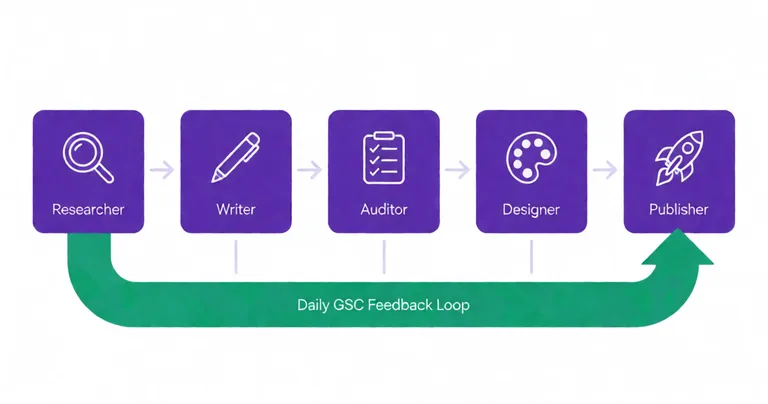
Mayla runs a five-agent workflow: Researcher → Writer → Auditor → Designer → Publisher. Each agent has a quality gate. The Researcher pulls competitor rankings and content gaps. The Writer drafts in your learned brand voice. The Auditor scores against EEAT and GEO extraction criteria. The Designer generates featured images. The Publisher pushes to WordPress, Shopify, Webflow, or Ghost via REST API.
Then the loop closes. The system pulls real ranking data from Google Search Console daily and rewrites underperformers automatically. That's not a service. That's a flywheel.
"Agencies sell you a retainer. Autonomous systems sell you a compounding asset that gets smarter every time it publishes."
— Mayla Labs
Cost and Output: AI SEO Automation vs Hiring an SEO Agency by the Numbers
Numbers don't negotiate. Here's the actual comparison across a 12-month horizon.
| Metric | Mid-Tier SEO Agency | Mayla Autonomous SEO Platform | In-House Hire |
|---|---|---|---|
| Monthly cost | $2,500–$8,000 | $15 (annual plan) | $6,500+ (salary + tools) |
| Articles per month | 4–8 | Unlimited | 6–10 |
| Feedback loop | Quarterly reports | Daily (GSC data) | Monthly |
| GEO/AI citation optimization | Rarely offered | Built-in | Depends on skill |
| 12-month content volume | 48–96 articles | 240–480+ articles | 72–120 articles |
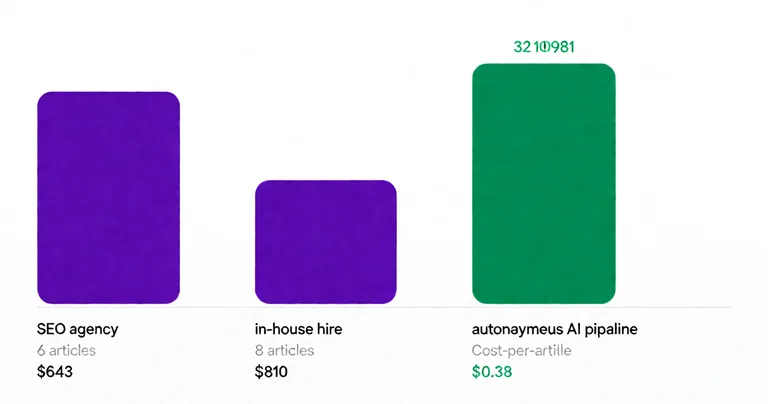
| Cost per article | $312–$1,000 | ~$0.04–$0.60 | $540–$1,080 |
According to Ahrefs' 2024 content marketing study, the average agency-published article takes 4–6 weeks from brief to publish. Autonomous pipelines compress that to under 30 minutes per article once brand DNA is trained.
Cheap agencies charging $800/month for "SEO" are usually reselling AI content with zero quality gating. You get the worst of both worlds: no strategy, no autonomy, and articles that Google's helpful content system flags as spam.
Why GEO Changes the AI SEO Automation vs Hiring an SEO Agency Calculation
Generative Engine Optimization (GEO) is the new battleground. When someone asks ChatGPT or Perplexity "what's the best AI SEO tool for B2B SaaS," the answer is assembled from cited sources — not from page-one Google results. If your content isn't structured for extraction, you don't exist in that answer.
Most agencies have no idea how to optimize for this. They're still chasing backlinks and meta descriptions. Autonomous platforms like Mayla bake GEO into the pipeline from the first draft.
How GEO Differs From Traditional SEO
- Extraction over ranking: AI engines pull quotable chunks, not whole pages. Your first 100 words must answer the query completely.
- Citation visibility: You need to be named, not just linked. Mayla's GEO / LLM Optimization Analysis audits how your site performs across ChatGPT, Claude, Gemini, Perplexity, and Google AI Overviews, returning a citation visibility score.
- Definitive statements win: Wishy-washy content gets ignored. AI overviews prefer authoritative, specific claims with numbers.
- Structured data is table stakes: FAQ blocks, comparison tables, and clear H2/H3 hierarchy are how AI parses your content into a citable answer.
According to a 2025 Princeton GEO study, content optimized with citations and statistics saw a 30–40% lift in AI engine visibility compared to unoptimized equivalents. That's the delta agencies can't close because they don't have the tooling.
When Hiring an SEO Agency Still Makes Sense
I'll be blunt: agencies aren't useless. They're just mismatched to the job most founders are actually hiring for.
Hire an agency if you need:
- High-touch link building from real publications with editorial gatekeeping.
- Brand strategy and positioning that requires human workshops and stakeholder alignment.
- Enterprise compliance and legal review before content ships.
- Complex technical migrations involving legacy CMS architecture.
Hire an autonomous AI SEO platform if you need:
- Volume and velocity — 20–40 articles per month without hiring.
- Daily feedback loops from real ranking data.
- GEO visibility across ChatGPT, Perplexity, and AI Overviews.
- Compounding output that gets cheaper per article every month.
Start with Mayla's $1.99 7-day trial. You get up to 4 AI articles, brand DNA setup, website analysis, and SEO insights. If the output doesn't beat your current agency's monthly delivery in a week, you've lost less than a coffee.
How Do I Build an Autonomous AI SEO Pipeline That Actually Ranks?
Autonomy isn't a feature. It's an architecture. Here's the five-stage pipeline Mayla runs 24/7.
Stage 1: Research and Competitor Intelligence
The Researcher agent monitors your top 10 competitors' keyword rankings, content strategies, and EEAT signals daily. It surfaces content gaps — keywords competitors rank for that you don't — and prioritizes them by opportunity score. This is the Content Gap Discovery layer, and it's what stops you from writing into saturated voids.
Stage 2: Brand DNA Learning and Writing
The Writer agent uses vector embeddings to learn and replicate your brand voice. Tone, vocabulary, sentence rhythm, audience targeting — all encoded into a reusable embedding. Every article ships in your voice, not generic AI slop. If you've ever wondered why most AI content reads like a press release, it's because nobody trained the model on the brand. Mayla's Brand DNA Learning fixes that at the embedding layer.
Stage 3: Audit and Quality Gating
The Auditor agent scores every draft against EEAT, readability, keyword density, and GEO extraction criteria. Failing drafts get rewritten before they ever touch your CMS. This is the gate that separates functional pipelines from content mills.
Stage 4: Design and Authority Building
The Designer agent generates featured images, short-form video snippets, and social assets that signal trust to both Google and AI engines. Authority isn't just backlinks anymore — it's multimodal presence.
Stage 5: Publish, Learn, Rewrite
The Publisher pushes to your CMS via REST API and distributes social posts across LinkedIn, X, Facebook, and Pinterest. Then the loop closes: GSC data flows back in daily, underperformers get flagged, and the system rewrites them automatically. That's Continuous Performance Optimization — a permanent audit-and-rewrite loop.
Real-World Proof: Where Autonomous Pipelines Already Win
Autonomous AI SEO isn't theoretical. It's running in verticals as different as Australian event operations and Unity game development.
Take Evntle, the event operations platform for Australian markets and festivals. Running an autonomous content pipeline against keywords like "vendor application management," "market stall POS," and "event floor layout software" lets the team publish 30+ targeted articles per month without a content hire. That's the difference between ranking for a category and renting traffic from paid ads.
Same story in game dev. A Unity asset publisher using Mayla to push content around Spawner Advanced & Pooling, RNet Networking Library, and Advanced Leveling System can dominate long-tail queries like "how do I eliminate GC stutter in Unity" or "best Unity networking library for RTS games" — queries that agencies ignore because the search volume looks too small. But they compound. And AI engines cite them because they're specific and technical.
Long-tail technical queries are GEO gold. They're low-volume for Google but high-signal for AI engines. One well-structured article on "Unity object pooling for VR" can earn citations across ChatGPT, Claude, and Perplexity for years.
How Much Does an SEO Agency Cost Per Month vs AI Automation?
Let's settle the pricing question with a direct comparison across 12 months.
| Scenario | Monthly Cost | Annual Cost | Articles Delivered (Year 1) | Cost Per Article |
|---|---|---|---|---|
| Budget agency | $1,500 | $18,000 | 60 | $300 |
| Mid-tier agency | $4,500 | $54,000 | 84 | $643 |
| Premium agency | $9,000 | $108,000 | 120 | $900 |
| Mayla annual plan | $15 | $180 | 300–480+ | $0.38–$0.60 |
Even at the budget-agency tier, you're paying 500–1,600x more per article than an autonomous pipeline. The only defensible reason to pay that premium is if the agency is delivering link building or strategic brand work that automation can't replicate.
Is AI SEO automation worth it? For most B2B SaaS and e-commerce companies under 200 employees, yes — decisively. The math fails for agencies the moment your content needs exceed 8 articles per month.
The Verdict: Autonomous AI SEO Wins on Volume, Cost, and GEO
AI SEO automation vs hiring an SEO agency isn't a fair fight in 2026. Agencies sell hours and coordination. Autonomous pipelines sell compounding output, daily feedback loops, and GEO visibility baked into every article. If you're a growth-focused founder who needs to rank in Google and get cited by ChatGPT and Perplexity, the answer is a multi-agent pipeline — not a retainer. Start with the Mayla 7-Day Trial at $1.99, watch the output velocity, and compare it to your last agency invoice. The numbers will make the decision for you.
Frequently Asked Questions
Q: Is AI SEO automation worth it compared to an agency?
A: Yes, for most companies publishing more than 8 articles per month. Autonomous pipelines deliver 5–10x the content volume at 1/500th the cost per article, with daily feedback loops agencies can't match. Agencies only win when you need editorial link building or strategic brand workshops.
Q: How much does an SEO agency cost per month?
A: Mid-tier agencies charge $2,500–$8,000 per month. Premium agencies charge $9,000+. Budget agencies sit around $1,500/month but typically deliver 4–6 articles with minimal strategy. Mayla's annual plan is $15/month for unlimited AI articles.
Q: What's the best AI SEO tool for ranking in ChatGPT and Perplexity?
A: The best AI SEO tool combines autonomous content production with GEO optimization — structured data, quotable first paragraphs, FAQ blocks, and comparison tables that AI engines can extract. Mayla's GEO / LLM Optimization Analysis audits citation visibility across ChatGPT, Claude, Gemini, Perplexity, and Google AI Overviews.
Q: How do I get my content cited by AI engines like ChatGPT?
A: Structure content for extraction. Answer the primary query in the first 100 words, use definitive statements with statistics, add FAQ blocks and comparison tables, and maintain clear H2/H3 hierarchy. Then publish consistently — AI engines reward sites with topical authority and fresh, structured content.
Q: Can AI SEO automation replace a full SEO team?
A: It replaces the production layer — research, writing, auditing, design, publishing, and optimization. It doesn't replace strategic judgment, link building relationships, or brand positioning. Most teams run Mayla for production and keep one strategist for direction.
Q: How long until AI SEO automation produces ranking results?
A: First rankings typically appear in 30–60 days for low-competition keywords. Meaningful traffic compounding shows up at 90–180 days. The advantage over agencies is that you're publishing 20–40 articles per month instead of 4–8, so the compounding curve is dramatically steeper.
More from Mayla Labs

AI SEO Employee Pricing vs Hiring In-House SEO
AI SEO employee pricing vs hiring in-house SEO: $15/mo vs $120k/yr. Compare costs and ROI. Start your $1.99 trial today.

AI SEO Automation Platform That Actually Ranks Content
AI SEO automation platform that actually ranks content. Autonomous multi-agent pipeline, GEO optimization, under $5 per page. Start your $1.99 trial today.

AI SEO Employee for Small Business: Autonomous Growth
AI SEO employee for small business: autonomous multi-agent pipeline that researches, writes, audits, and publishes. Start your $1.99 trial today.

AI SEO Automation Software With Quality Gates
AI SEO automation software with quality gates: 5-agent pipeline, 95% audit threshold, GEO optimization. See how autonomous SEO ranks Learn more today.
📋 Embed this feed on your website:
<script src="https://maylalabs.com/api/embed?api_key=mayla_site_ffa932ca083d0056918fd3430ebb301bcfa6ad08dad32efc&limit=5" defer></script>