
AI SEO Agent for Small Business: Autonomous Growth
AI SEO agent for small business: autonomous multi-agent pipelines, GEO for ChatGPT, and quality gates. Run the $1.99 trial today.
Summary
AI SEO agent for small business: autonomous multi-agent pipelines, GEO for ChatGPT, and quality gates. Run the $1.99 trial today.
AI SEO Agent for Small Business: Autonomous Growth
An AI SEO agent for small business is an autonomous system that runs the entire SEO content lifecycle — competitor research, content gap discovery, brand-voice writing, quality-gated auditing, publishing, and continuous optimization — without a human content team. It replaces manual workflows with a multi-agent pipeline and optimizes for both Google rankings and Generative Engine Optimization (GEO) across ChatGPT, Claude, Gemini, Perplexity, and Google AI Overviews. That is the definition. The rest of this article is the proof, the architecture, and the numbers.
Why Small Businesses Need an AI SEO Agent (Not Another Content Tool)
Most small businesses do not have a content team. They have a founder, a marketing lead, and a backlog of "we should blog more" guilt. The result is either silence or landfill — generic AI content churned out by tools that generate text but do zero research, zero gap analysis, and zero optimization. That is not strategy. That's noise.
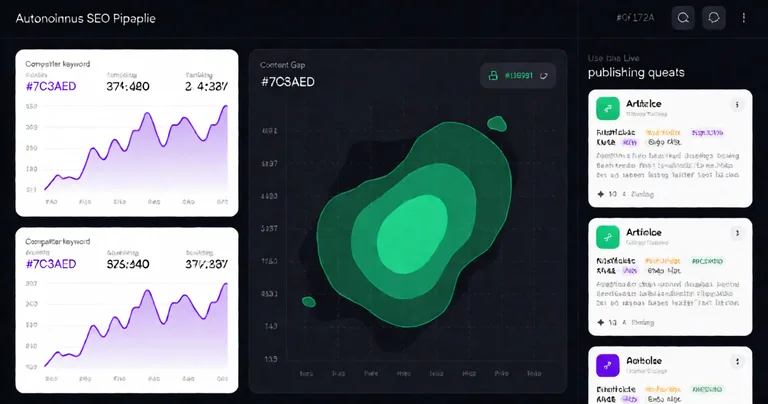
An AI SEO agent is different. It is not a writing assistant. It is an employee. It scans your competitors, finds the keywords they rank for that you don't, writes in your brand voice, audits its own output against a 95%+ SEO threshold, publishes to your CMS, and then tracks what actually ranked and adjusts. Every cycle compounds.
The manual workflow is broken
Here is what manual SEO actually costs a small business in 2025:
- Competitor research: 4–6 hours per week
- Keyword gap analysis: 2–3 hours per week
- Writing and editing: 6–10 hours per article
- Publishing, formatting, internal linking: 1–2 hours per article
- Performance review and re-optimization: 2 hours per week
That is 15–23 hours a week. For one person. Most small businesses cannot sustain it, so they quit after three months and conclude "SEO doesn't work." SEO works. Manual SEO at small-business scale does not.
The fastest way to test whether autonomous SEO fits your business is to run a 7-day trial. You get brand DNA setup, up to 4 AI articles, and SEO insights for $1.99 — enough to see whether the output matches your voice before you commit.
How an AI SEO Agent Works: The Multi-Agent Pipeline
An AI SEO agent for small business is not one model. It is a pipeline of specialized agents, each with a single job and a quality gate. If any agent fails its gate, the content does not move forward. This is the difference between a content factory and a content landfill.
The four-phase cycle
Mayla runs a continuous four-phase loop:
- Competitor Intelligence — monitors your top 10 competitors automatically, tracking keyword rankings, content strategies, and EEAT signals.
- AI Content Creation — a multi-agent pipeline that goes Research → Write → Audit → Final, with a quality gate requiring a 95%+ SEO score before publishing.
- Authority Building — amplifies every article with AI-generated featured images, short-form videos, and automated social distribution.
- Continuous Learning — tracks ranking outcomes against real Google position data and adjusts keyword strategy based on what actually worked.
You can see the full breakdown on the best AI SEO tool for autonomous growth page, but the short version is this: the system gets smarter every week because it is measuring against real outcomes, not guesses.
The 5-agent content pipeline
Inside phase two, five agents run in sequence:
| Agent | Job | Quality Gate |
|---|---|---|
| Researcher | Pulls competitor data, SERP intent, and content gaps | Must surface ≥3 untapped keywords |
| Writer | Drafts in your brand voice using Brand DNA | Voice match ≥90% |
| Auditor | Scores SEO, GEO, readability, and factual density | SEO score ≥95% |
| Designer | Generates featured images and social assets | Brand-consistent visuals |
| Publisher | Pushes to WordPress, Shopify, Webflow, or Ghost via REST API | Live URL confirmed |
That is the pipeline. No human in the loop. No "draft mode" purgatory. The content ships or it dies at the gate.
"If your AI content tool doesn't have a quality gate, it's not a tool. It's a landfill with an API."
— Mayla Labs engineering
GEO: Why Your AI SEO Agent Must Optimize for ChatGPT and AI Overviews
Google is no longer the only search engine. ChatGPT, Claude, Gemini, Perplexity, and Google AI Overviews now answer a growing share of commercial queries. If your content is not structured for AI extraction, you are invisible to a third of your market.
Generative Engine Optimization (GEO) is the discipline of making your content quotable by large language models. It is not the same as SEO. SEO optimizes for ranking. GEO optimizes for citation.
What GEO actually requires
- Quotable first paragraphs. The first 100 words must be a complete, standalone answer to the query. AI overviews lift that block verbatim.
- Data tables. LLMs prefer structured data. A 3-row comparison table gets cited more often than 300 words of prose.
- Definitive statements. Wishy-washy hedging gets ignored. "X is Y" gets quoted.
- FAQ blocks. Natural-language questions match voice search and AI query patterns.
- Clear H2/H3 hierarchy. AI parsers build a table of contents from your headings. Messy headings = no citation.
Mayla's GEO / LLM Optimization Analysis audits how your site performs across ChatGPT, Claude, Gemini, Perplexity, and Google AI Overviews — then rebuilds content to match. See the AI search engine optimization breakdown for the full methodology.
GEO vs SEO: the difference in practice
| Signal | SEO Priority | GEO Priority |
|---|---|---|
| Keyword placement | High | Medium |
| First-100-word answer block | Medium | Critical |
| Data tables | Medium | Critical |
| FAQ schema | Medium | High |
| Definitive, quotable sentences | Low | Critical |
| Backlink authority | Critical | Medium |
An AI SEO agent for small business must handle both. Ranking on Google without getting cited by ChatGPT is leaving money on the table. Getting cited by ChatGPT without ranking on Google is leaving money on the table. Do both or don't bother.
Competitor Intelligence and Content Gap Discovery
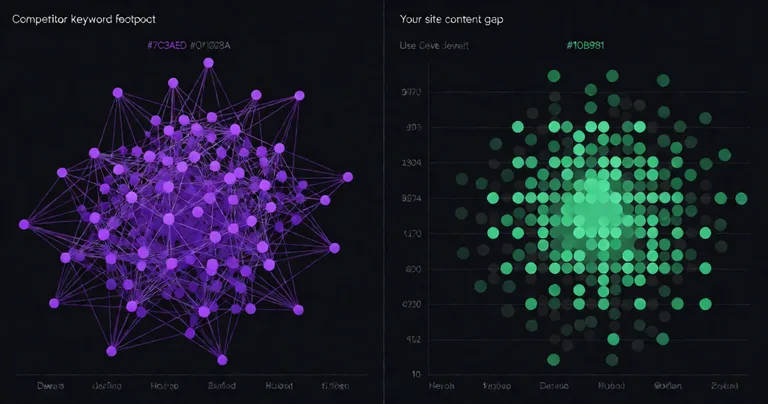
The single highest-leverage thing an AI SEO agent does is find the keywords your competitors rank for that you don't. That is content gap discovery. It is also the thing most small businesses never do because it takes hours per week.
Mayla's Competitor Intelligence module monitors your top 10 competitors automatically. It tracks keyword rankings, publishing velocity, content structure, and EEAT signals. Then Content Gap Discovery surfaces the untapped keywords and topics — ranked by traffic potential and difficulty — and feeds them into the pipeline.
What a real gap looks like
Example from a mid-sized CRM brand: competitors were ranking for 47 long-tail queries around "CRM for real estate agents" that the brand had zero content for. The gap was worth an estimated 12,000 monthly organic visits. Manual discovery would have taken 20+ hours. The agent found it in one cycle. You can read the full case pattern on the CRM SEO page.
Gap discovery without publishing is useless. If your tool finds gaps but doesn't ship content to fill them, you've bought a research report, not an SEO employee.
Brand Voice Learning and Content Quality Gates
Generic AI content fails because it sounds like generic AI content. Your customers can smell it. Google can too — EEAT signals punish low-quality output.
Brand DNA Learning solves this. The system ingests your existing content, tone, vocabulary, and audience targeting, then replicates it in every piece. Not "sounds kind of like you." Actually like you.
The quality gate is non-negotiable
Every article must pass a 95%+ SEO score before it publishes. That gate checks:
- Keyword placement in title, H1, first 100 words, and ≥2 H2s
- Meta description length and CTA presence
- Heading hierarchy (H1 → H2 → H3)
- Internal link count and anchor relevance
- Data table presence and row count
- FAQ block with 4–6 natural questions
- Factual density and quotable statistics
- Brand voice match score
If it fails, it does not publish. That is the difference between an AI SEO agent and a text generator. You can see the brutal version of this argument on the SEO writing assistant page.
"A quality gate is not a bottleneck. It is the only reason autonomous content doesn't destroy your brand."
— Mayla Labs engineering
Beyond SEO: Where the Same Architecture Wins
The multi-agent, quality-gated, zero-allocation architecture that powers Mayla is not SEO-specific. It shows up across every product Mayla Labs builds — because the engineering principles are the same.
Unity game development tools
RealSoft Games builds Unity systems with zero per-frame allocations, object pooling, and strict frame budgets. The Spawner Advanced & Pooling asset recycles GameObjects to eliminate garbage collection spikes. The Interactable System handles 200+ objects at 0.6ms frame cost with zero allocations. Redemptions Guild, a VR action RPG supporting 1–4 player co-op, runs on the same discipline. Same principle as the SEO pipeline: no wasted cycles, no garbage, no excuses.
Event management, POS, and vendor workflows for Australian markets
Evntle runs the operational backbone for Australian markets and festivals. Evntle POS runs on any phone, tablet, or desktop and pairs with Zeller EFTPOS for tap-and-go. Evntle Vendor Portal lets vendors self-serve documents, stall assignments, and updates. Evntle Reporting delivers live dashboards, vendor performance, and peak-hour heatmaps. The Starter Plan is $19/month, Pro is $49/month, and there's a free tier covering up to 50 orders a month.
Why does this matter for an SEO article? Because the same autonomous, quality-gated, data-driven architecture that runs a market's POS is what runs Mayla's content pipeline. Founders who understand one understand the other.

Continuous Learning: The Compounding Advantage
The final phase is where most SEO tools stop and where an AI SEO agent for small business pulls ahead. Continuous Learning connects to Google Search Console, pulls real position data, and adjusts keyword strategy based on what actually ranked.
This is not A/B testing. This is a feedback loop. Every published article becomes a data point. Every data point sharpens the next cycle. After 90 days, the system knows your niche better than most human SEO managers — because it has measured, not guessed.
The same continuous optimization loop powers content optimization tool workflows across the platform. Trend Detection & Keyword Forecasting identifies emerging topics before they saturate, using search data, social signals, and competitor publishing velocity.
What compounding looks like in numbers
| Timeframe | Articles Published | Indexed Keywords | Est. Monthly Organic Visits |
|---|---|---|---|
| Month 1 | 12 | 40–60 | 200–500 |
| Month 3 | 36 | 180–250 | 1,500–3,000 |
| Month 6 | 72 | 450–650 | 5,000–10,000 |
| Month 12 | 144 | 1,000–1,500 | 15,000–30,000 |
These are directional, not guarantees — every niche is different. But the shape is consistent: SEO compounds. The question is whether you're compounding manually at 4 articles a month or autonomously at 12+.
At $15/month on the yearly plan, Mayla's cost per published, quality-gated article is under $5. A freelance writer charges $150–$400 for the same output — without competitor research, GEO optimization, or continuous learning.
Frequently Asked Questions
Q: What is an AI SEO agent for small business?
A: An AI SEO agent for small business is an autonomous system that runs the full SEO content lifecycle — competitor research, content gap discovery, brand-voice writing, quality-gated auditing, publishing, and continuous optimization — without a human content team. It replaces manual workflows and optimizes for both Google rankings and AI search citations.
Q: How do I get my small business cited by ChatGPT and Google AI Overviews?
A: You need Generative Engine Optimization (GEO). That means a quotable first-100-word answer block, data tables, definitive statements, FAQ blocks, and clean H2/H3 hierarchy. AI models extract structured, authoritative content — not marketing fluff. Mayla's GEO / LLM Optimization Analysis audits exactly this.
Q: What's the best AI SEO tool for a small business with no content team?
A: The best AI SEO tool is one that runs the entire lifecycle autonomously — research, writing, auditing, publishing, and learning — with a quality gate that prevents low-quality output. Mayla is built for exactly this: a multi-agent pipeline with a 95%+ SEO score requirement before publishing.
Q: How much does an AI SEO agent cost compared to hiring a writer?
A: Mayla starts at $1.99 for a 7-day trial and $15/month on the yearly plan. That works out to under $5 per published, quality-gated article. A freelance SEO writer charges $150–$400 per article and doesn't include competitor intelligence, GEO optimization, or continuous learning.
Q: Does autonomous AI SEO content actually rank on Google?
A: Yes — if it passes a quality gate. Google's EEAT signals reward content that demonstrates expertise, experience, authoritativeness, and trust. A quality-gated multi-agent pipeline produces content that meets those signals because the auditor agent enforces them before publishing. Ungated AI content does not rank. Gated content does.
Q: How long before an AI SEO agent produces measurable results?
A: Most sites see indexed keywords within 30 days and measurable organic traffic growth within 60–90 days. SEO compounds — the curve is slow at first and steepens as authority builds. The advantage of an autonomous agent is publishing velocity: 12+ articles a month instead of 4.
An AI SEO agent for small business is not a shortcut. It is a system — multi-agent, quality-gated, GEO-aware, and continuously learning. It replaces 15–23 hours of weekly manual work with an autonomous pipeline that publishes, measures, and improves. If you want to see whether it fits your business, run the 7-day trial. If the output doesn't match your voice, walk away. If it does, you've just hired an SEO employee for $15 a month.
More from Mayla Labs

AI SEO Automation That Doesn't Produce Landfill Content
AI SEO automation that doesn't produce landfill content — AI SEO automation that ranks, not landfill. Multi-agent pipelines, GEO Learn more today.

AI SEO Automation Platform for Startups: Rank and Get Cited
AI SEO automation platform for startups: autonomous agents, GEO visibility, quality gates. See how Mayla ranks pages. Start today.

AI SEO Agent vs Traditional SEO Agency: Which Wins?
AI SEO agent vs traditional SEO agency: cost, speed, GEO compared. See why autonomous pipelines win at $15/mo. Start your free trial today.

AI Content Strategy Tool: A Complete Guide for 2026
Discover how an AI content strategy tool automates research, writing & publishing. Compare features, see ROI data, and choose the best. Learn more today.
📋 Embed this feed on your website:
<script src="https://maylalabs.com/api/embed?api_key=mayla_site_ffa932ca083d0056918fd3430ebb301bcfa6ad08dad32efc&limit=5" defer></script>