
Affordable Event Management Software for Small Events Australia
Find affordable event management software for small events Australia. Compare costs, features and POS options. Start free today.
Summary
Find affordable event management software for small events Australia. Compare costs, features and POS options. Start free today.
Affordable Event Management Software for Small Events Australia
Affordable event management software for small events in Australia is a mobile-friendly platform that handles stallholder applications, site planning, cashless point of sale, ticketing and sales reporting for one low monthly fee — so you can run a 40-stall market without a tech team or a spreadsheet. It should be priced for community groups and first-time organisers, not just large festivals, and it should work offline on a phone or tablet when the venue Wi-Fi drops out. If you run a monthly market, a school fete or a pop-up food event, that combination is the difference between a calm event day and a chaotic one.
Spreadsheets and inboxes stop working somewhere around 60 vendors. Before that, they're fine. After that, you're chasing applications across three email accounts, redrawing a site plan on a whiteboard, and guessing how much each stall sold on the day. That's the moment small event organisers in Australia start looking for software — and the moment most of them discover the big platforms are priced for conferences and stadiums, not the Saturday farmers market at the showgrounds.
This guide breaks down what affordable really means, what to look for, and how to run a small Australian event without overpaying or overcomplicating it.
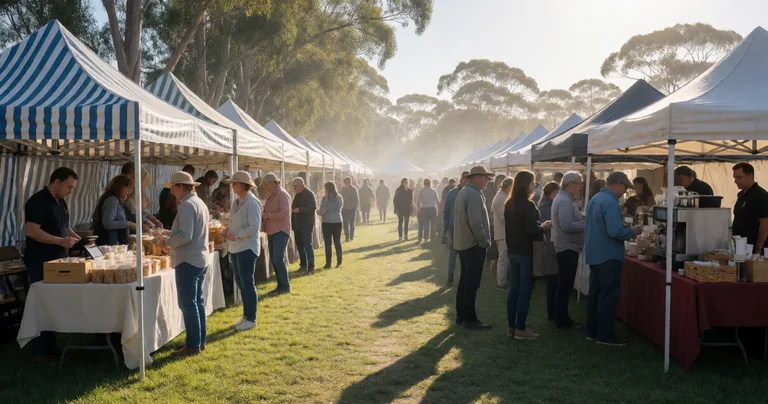
What Makes Event Management Software Affordable for Small Events in Australia
Affordable doesn't mean free. It means the cost per event is small enough that one extra stall booking or a handful of card sales covers it. For a small Australian market, that's roughly $20 to $60 per month — or a small percentage of sales if you use a transaction-based model.
The trap is buying software built for 5,000-person festivals when you're running a 30-stall community market. You pay for features you'll never touch, and you spend your first month configuring instead of selling.
What you actually need vs what you don't
Here's a straight comparison of what a small event genuinely uses versus what only large festivals need.
| Feature | Small event (10–60 stalls) | Large festival (200+ stalls) |
|---|---|---|
| Stallholder applications | Essential — one form, one inbox | Essential — with scoring and panel review |
| Cashless POS | Essential — tap to pay on a phone | Essential — multiple terminals and hardware |
| Site planning | Drag-and-drop map is plenty | CAD-style layouts with zones and power runs |
| Ticketing | Optional — free entry markets don't need it | Essential — capacity limits and gates |
| Analytics | End-of-day sales summary | Live dashboards across every outlet |
| Typical monthly cost | $20–$60 | $300–$1,500+ |
If you're paying for a feature you haven't used in three events, you're paying too much. Cancel it, or switch to a platform that only charges for what you run.
For a deeper look at what's on the market, our rundown of the best event management software in Australia compares the options side by side.
Why Small Australian Events Outgrow Spreadsheets and Email Threads
The pain usually shows up in three places at once.
- Applications. Fifty stallholders email you fifty different forms. Half forget their public liability certificate. You spend two evenings chasing paperwork instead of promoting the event.
- Site planning. You draw a map, someone pulls out, someone else wants a corner spot near power, and now the whole layout is out of date.
- Payments. Cash is slow, cash is risky, and you have no idea what each stall actually sold until they tell you — if they tell you at all.
None of this is a software problem at 20 stalls. At 60 stalls, it's a full-time job nobody signed up for.
"The moment you're managing vendors in three different inboxes is the moment you've already lost the day before it's started."
— Evntle
The fix isn't a bigger spreadsheet. It's a single place where applications, payments and site plans live together. That's what a purpose-built platform gives you — and it's why organisers move to tools like Evntle Stallholder Booking Software once the paperwork outweighs the fun.
Core Features That Pay for Themselves at a Small Event
Every dollar you spend on software should either save you time, bring in more stall fees, or increase sales on the day. Here's what actually does that.
1. Vendor and stallholder management
A good system takes an application, checks the certificate, approves the vendor, assigns a site and sends the confirmation — all from one screen. No more copy-pasting between forms and spreadsheets. Evntle's vendor management software handles applications, site plans and event-day coordination in one place, which is exactly what a 40-stall market needs.
2. Point of sale with offline mode
This is the big one. A mobile POS on a tablet or phone turns every stall into a cashless outlet. Tap, pay, done. The queue moves faster, the cash tin stays closed, and every sale is logged automatically.
Offline mode matters more than most people realise. Regional showgrounds drop out. Basement venues have no signal. If your POS stops working when the Wi-Fi does, you're back to cash. Evntle POS runs offline and syncs when you're back online — so a dropped bar of signal doesn't cost you the lunch rush.
3. Ticketing and check-in (only if you charge entry)
Free-entry markets don't need ticketing. Ticketed events — food festivals, night markets with a cover charge, workshops — do. Fast QR scanning at the gate keeps the queue moving, and it gives you real attendance numbers instead of a clicker count.
4. Sales reporting
At the end of the day you want three numbers: total sales, top-selling stalls, and peak trading hours. That's it. Anything more is a nice-to-have. For a small event, an end-of-day summary is worth more than a live dashboard nobody watches.
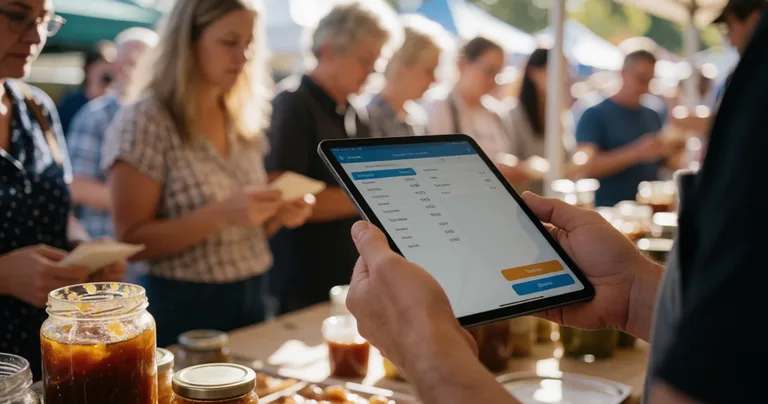
How Much Does Event Management Software Cost in Australia?
Pricing in Australia generally falls into three models. Which one suits you depends on how many events you run and how much sales volume you process.
| Pricing model | Typical cost | Best for | Watch out for |
|---|---|---|---|
| Free tier | $0 | First-time organisers testing the water | Limited vendors or events per month |
| Flat monthly subscription | $20–$60/month | Recurring monthly markets | Paying year-round for a seasonal event |
| Transaction fee | 1–2.5% of sales | Low-volume or one-off events | Fees stack up fast on high-volume food stalls |
| Per-event fee | $50–$200 per event | One or two big events a year | Adds up if you run 12 markets a year |
For a monthly market running 12 events a year, a $40/month flat subscription works out to about $480 annually — usually less than the cost of one lost stallholder booking.
The other cost to weigh is payment processing. Card transactions in Australia typically attract a small per-transaction fee, and that's separate from your software subscription. Factor it in before you compare platforms, or you'll be surprised at the end of the month.
How to Choose the Right Platform for a Small Australian Event
Ask these questions before you sign up for anything.
- Does it work on a phone? If it needs a laptop and a desk, it's not built for a market.
- Does the POS work offline? If not, walk away. Regional venues will find you out.
- Can stallholders apply and pay online? Chasing paperwork is the biggest time sink in event management.
- Is there a free tier or trial? You should be able to test it on one real event before committing.
- Does it handle card payments in Australia? EFTPOS integration matters. Not every platform does it locally.
- Can you export your data? Sales reports, vendor lists, attendee data — you should own it, not rent it.
Beware of platforms that charge per seat or per staff login. A small market with 10 volunteers on the gate can suddenly cost more than a large festival.
For a more detailed comparison of payment options, see our guide to stallholder booking software in Australia.
Real-World Example: A 45-Stall Monthly Market
Picture a Sunday farmers market in regional Victoria. Forty-five stalls, 1,200 attendees, running on the first Sunday of every month.
Before software: Applications arrived by email. Two volunteers spent six hours a month on admin. Cash sales dominated. Nobody knew which stalls were actually profitable.
After switching: Applications came through one form, certificates were uploaded once, and site plans updated in real time. Every stall had a mobile POS with offline mode. End-of-day reports showed top sellers and peak trading hours.
The result: admin time dropped from six hours to about 90 minutes a month, card sales lifted by roughly 30% because queues moved faster, and the organiser finally had data to justify stall fee increases the following year.
That's the practical case for affordable event management software. It's not about the software. It's about getting your Sunday back.
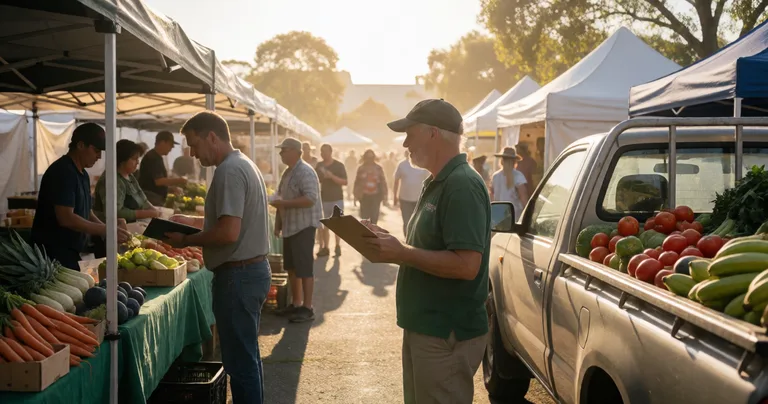
Frequently Asked Questions
Q: How much should I pay for event management software for a small market in Australia?
A: Budget $20 to $60 per month for a small market with up to 60 stalls. If you run fewer than four events a year, a per-event fee or a free tier may be cheaper. Anything over $100 per month for a 40-stall event is usually overspending.
Q: Do I need ticketing software if my event is free entry?
A: No. Free-entry markets don't need ticketing. You need stallholder booking, a POS and site planning. Ticketing only pays for itself when you charge for entry or need to cap attendance.
Q: What's the best way to accept cashless payments at a small Australian market?
A: A mobile POS that runs on a phone or tablet and works offline. It lets every stall take tap-and-go payments, logs sales automatically, and keeps working when the venue Wi-Fi drops out.
Q: Can I run a market without hiring a tech team?
A: Yes. Modern platforms are set up in an afternoon. Look for one-click templates, a mobile interface, and a free tier so you can test it on one event before committing.
Q: How do I stop chasing stallholder paperwork every month?
A: Use a platform that takes applications, stores certificates, and assigns sites in one place. Stallholder booking software replaces the inbox-and-spreadsheet workflow entirely.
Q: Is affordable event software good enough for a real event?
A: Yes — for small events, affordability usually means fewer unnecessary features, not lower quality. The core functions you need (applications, POS, site planning, reporting) are the same on a $40/month plan as on a $400/month one.
Affordable event management software for small events in Australia comes down to three things: it works on a phone, it runs offline, and it costs less than one lost booking. Get those right and you'll spend less time on admin and more time making the event worth showing up for. Start with a free account, run it on one market, and see how much of your Sunday you get back.
More from Evntle

All-in-One Event Platform for Australian Night Markets
Discover the best all-in-one event platform for Australian night markets. Streamline vendor management, POS, ticketing & compliance. Try Evntle today!

Affordable POS for Events: The Complete Australian Guide
Affordable POS for events: compare costs, offline mode, and multi-device support. See why Evntle is Australia's best event POS. Start free today.
POS System for Food Trucks Australia: The Complete Guide
POS system for food trucks Australia — Compare features, costs & offline modes. Find the best POS for your food truck. Get started today.

Affordable Event Management App for Australian Festivals
Affordable event management app for Australian festivals. Vendor bookings, cashless POS, queue management, analytics. Start free today.
📋 Embed this feed on your website:
<script src="https://maylalabs.com/api/embed?api_key=mayla_site_f1cb1e95fff884263b19125c9f830c929bc45b4d&limit=5" defer></script>