
Affordable Event Management App for Australian Festivals
Affordable event management app for Australian festivals. Vendor bookings, cashless POS, queue management, analytics. Start free today.
Summary
Affordable event management app for Australian festivals. Vendor bookings, cashless POS, queue management, analytics. Start free today.
Affordable Event Management App for Australian Festivals
An affordable event management app for Australian festivals is software that combines vendor applications, site planning, POS, ticketing, and event-day operations into one platform at a price that suits community events and pop-ups. For most organisers, that means Evntle — a purpose-built platform starting with a free account, no lock-in contracts, and tools that replace spreadsheets, group texts, and three separate apps. You get stallholder booking, cashless payments, bump-in tracking, and live sales reporting in one place, so you can run a 40-stall market or a 4,000-person food festival without hiring a full ops team.
If you've ever run a festival on a shoestring, you know the drill. Spreadsheets for applications. A group chat for vendor questions. A card reader that dies at 11am. A clipboard for bump-in. And a shoebox of receipts at the end of the day. It works — until it doesn't. The good news is that affordable event management software for Australian festivals has caught up with what organisers actually need. You no longer have to choose between a $12,000 enterprise contract and a duct-taped stack of free tools.
This guide walks through what to look for, what it costs, and how to run a festival that vendors want to come back to — without blowing the budget before the gates open.
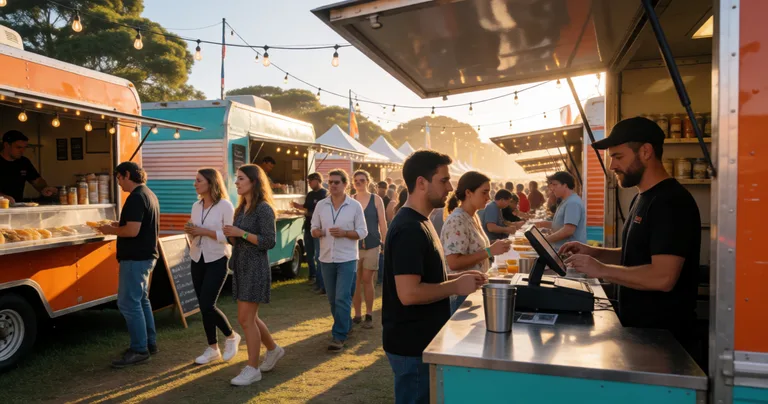
What Makes an Event Management App Affordable for Australian Festivals
Affordable doesn't mean cheap. It means the total cost of running the event — software, admin hours, payment fees, and the cost of getting it wrong — comes down. A $99/month app that saves you 20 hours of admin a month is cheaper than a free spreadsheet that eats your weekends.
Here's what actually drives cost in festival operations:
- Admin hours. Manually reviewing vendor applications, chasing insurance certificates, and reconciling payments adds up fast. Most organisers spend 15–25 hours per event on this alone.
- Payment fees. Card processing fees at markets typically run 1.4%–1.9% per transaction. On a $60,000 event day, that's $840–$1,140 in fees — worth understanding before you sign up.
- Double-handling. Entering the same vendor details into a spreadsheet, an email list, and an invoicing tool is the silent killer of event budgets.
- Lost sales. Long queues and cash-only stalls cost vendors money. Every minute in a queue is a customer who walks away.
- Reactive decisions. Without live sales data, you can't tell which zones are underperforming until after the event.
Before you compare software prices, write down the hours you spend on admin per event. Multiply by your hourly rate. That number is your real software budget — and it's usually higher than you think.
The True Cost of a Spreadsheet-Run Festival
Spreadsheets are free until they're not. Here's a realistic breakdown for a 60-stall Australian market or festival:
| Task | Spreadsheet Approach | Integrated Platform | Time Saved |
|---|---|---|---|
| Vendor applications & review | 8–12 hrs | 2–3 hrs | ~8 hrs |
| Site plan & stall allocation | 4–6 hrs | 1–2 hrs | ~4 hrs |
| Bump-in check-in | 3–5 hrs (clipboard) | 1 hr (digital) | ~3 hrs |
| Sales & attendance reporting | 5–8 hrs (manual) | Real-time | ~6 hrs |
| Incident logging & compliance | 2–4 hrs | 15 mins | ~3 hrs |
| Total per event | 22–35 hrs | 4–8 hrs | ~24 hrs |
At $45/hour, that's over $1,000 of your time saved per event. Run six events a year and you're looking at $6,000+ in recovered capacity. That's the real affordability story.
"Affordable isn't about the monthly fee. It's about how many hours you get back and how many vendor relationships you don't burn chasing paperwork."
— Evntle
How Affordable Event Management Software Simplifies Stallholder Bookings
Stallholder bookings are where most festivals lose time and goodwill. Applications arrive by email, Instagram DM, and a form that half the vendors can't find. You review them in a spreadsheet, chase insurance certificates, assign stalls by hand, and invoice one by one. It's exhausting, and it's the same job every single event.
Affordable event management software for Australian festivals fixes this by giving you a single pipeline. Vendors apply through a public form, you review and approve in one dashboard, and the system handles the rest — stall allocation, insurance document collection, invoicing, deposits, and waitlists.
What to Look For in Vendor Booking Tools
- Public application form. Vendors should be able to apply in under five minutes from their phone.
- Review pipeline. Approve, decline, or waitlist with one click — and keep a record of why.
- Document collection. Insurance certificates, food safety permits, and public liability should be attached to the vendor profile, not buried in email.
- Automated invoicing. Deposits and final payments triggered on approval, not chased manually.
- Waitlist management. When a stallholder drops out, the next vendor on the list should get an automatic offer.
- Site allocation. Drag-and-drop stall mapping that updates in real time when vendors change.
Evntle's stallholder booking software handles all of this out of the box. You get vendor applications, review pipelines, stall allocation, insurance documents, invoicing, deposits, waitlists, and bump-in check-in in one place. For a 40-stall market, that's the difference between a weekend of admin and a couple of hours.
If you're running a recurring market, vendor waitlists are your secret weapon. A well-managed waitlist means you never scramble to fill a stall — and vendors feel respected because they hear back either way.
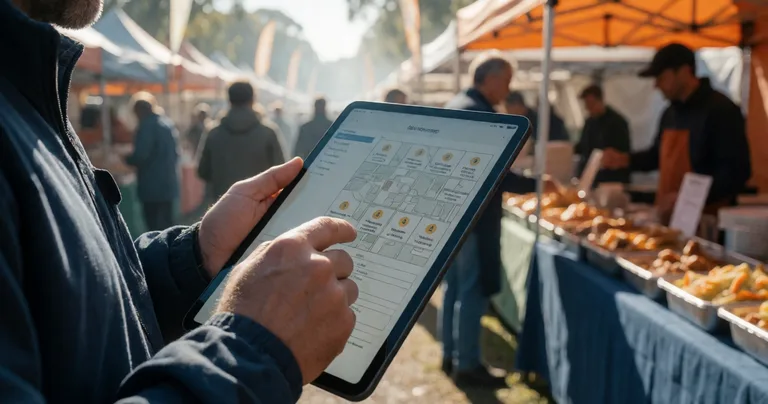
Point of Sale and Cashless Payments That Keep Queues Moving
Cash slows everything down. Counting change, running out of coins, and reconciling a cash tin at the end of the day costs vendors time and costs you accuracy. Cashless payments at Australian markets and festivals are now the norm — and the right POS setup is the single biggest lever for vendor sales.
The goal is simple: a customer should be able to tap, pay, and move on in under 15 seconds. Anything slower and the queue builds, the vibe drops, and people leave.
Cashless Terminals vs Mobile POS for Festivals
There's a real decision here, and it depends on your event layout and vendor mix. Here's how the two compare:
| Factor | Standalone Card Terminal | Mobile POS (e.g. Evntle POS) |
|---|---|---|
| Setup cost per stall | $0–$300 (terminal) | $0 (runs on phone/tablet) |
| Offline mode | Rarely supported | Yes — keeps selling when signal drops |
| Menu & stock tracking | No | Yes — live stock alerts |
| Multi-device sync | No | Yes — phones, tablets, desktop |
| Reporting | End-of-day only | Real-time dashboards |
| Best for | Single-operator stalls | Food vendors, retail, multi-stall events |
For most Australian festivals, mobile POS wins. Evntle POS runs on any phone or tablet, works offline, supports multiple devices per stall, and syncs live sales back to your event dashboard. If you're weighing up options, cashless terminals versus mobile POS breaks down the trade-offs in detail.
Food Vendor Operations and Queue Management
Food vendors are the heartbeat of a festival — and the biggest queue risk. A busy food truck can serve 80–120 covers an hour when the flow is right. Get it wrong and you're looking at 20-minute waits and abandoned orders.
The fix is a proper order flow. Evntle's food stall point of sale pairs with a Kitchen Display System (KDS) and an Order Board so orders move from counter to kitchen to customer without anyone shouting over the noise. Here's how it works in practice:
- Order taken at the counter on a tablet or phone.
- Order appears instantly on the KDS in the kitchen — no paper tickets.
- Order Board shows the customer their number and status.
- Ready alert fires when the kitchen marks it done.
- Sales logged automatically for end-of-day reporting.
For food festivals with multiple outlets, this is the difference between a smooth service and a meltdown. If you're managing several food vendors, best food queue management tools covers the broader toolkit.
Never rely on festival Wi-Fi for payments. Mobile signal at regional showgrounds and parks is patchy. Choose a POS with offline mode so a dropped connection doesn't stop sales.
Market and Festival Planning Tools That Fit a Tight Budget
Planning a festival is a logistics problem disguised as a fun day out. Site maps, bump-in schedules, parking, power, waste, safety, and vendor comms all need to line up — and they need to be visible to the right people at the right time.
Affordable event management apps handle this by treating the site plan as a living document, not a PDF that's out of date the moment it's exported.
Bump-In and Bump-Out Without the Chaos
Bump-in is where events go wrong. Vendors arrive early, can't find their site, and block the access road. A digital bump-in checklist with real-time vendor arrivals fixes this. Evntle's bump-in and bump-out tracking lets you check vendors in on arrival, confirm their site, and log any issues — all from a phone at the gate.
Site Planning That Adapts on the Day
Stalls move. Vendors cancel. A food truck needs more space than expected. If your site plan lives in a spreadsheet, every change means reprinting and re-emailing. If it lives in a proper site planning tool, you drag, drop, and everyone sees the update instantly.
For a deeper look at layout decisions, event floor layouts guide walks through how to place stalls to balance vendor needs, safety, foot traffic, and sales.
Incident Management and Compliance
Every Australian festival needs an incident log. It's not optional — it's a compliance requirement and a risk-management essential. Paper forms get lost. Group texts get buried. A digital incident management module with custom forms, severity tracking, and timestamped records keeps you covered.
Evntle's incident management software lets you log issues, assign an owner, and keep a full history for every venue. If something goes wrong, you have a clean record. If nothing goes wrong, you have proof of diligence.
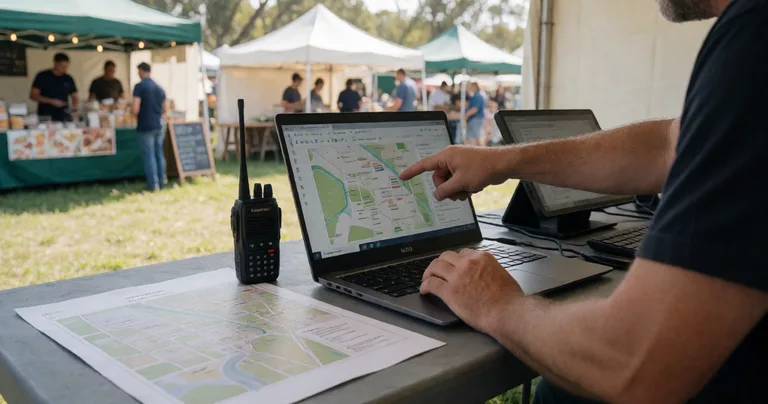
Attendee Discovery and Engagement on a Budget
You can run the smoothest event in the country and still have a quiet day if nobody knows it's on. Attendee discovery is where affordable event management apps earn their keep — because the same platform that runs your operations can also fill your festival.
Evntle's event discovery app for markets lets attendees preview stalls, plan their visit, and return for every market day. Vendors get a storefront. Organisers get a listing. Attendees get a reason to show up and spend.
Turning One-Time Buyers into Regulars
Loyalty is underused at Australian markets. A simple digital loyalty program — track visits, reward repeat spend — can lift return visits meaningfully. For vendors, this is the difference between a one-off sale and a customer who comes back every month.
Pair that with a vendor storefront and you've got a loop: attendee discovers the market, buys at the stall, follows the vendor online, and returns next time. That's how you build a festival with a real community around it.
Sponsorship and Promotion
Affordable doesn't mean no budget — it means spending it well. Sponsorship can cover a significant chunk of festival costs if you approach it right. how to get sponsors for a market or festival in Australia breaks down the pitch, the packages, and the follow-up that actually converts.
Event Analytics and Reporting: Know What Actually Worked
Most festivals end with a rough guess about what worked. The food trucks did well. The craft stalls were quiet. Attendance felt up. That's not data — that's a vibe.
Event analytics turn those vibes into decisions. Evntle's event analytics tracks sales, vendors, and attendees so you can improve every event without extra admin. You see which stalls sold best, which zones got foot traffic, and which hours were peak.
What Good Reporting Looks Like
| Metric | Why It Matters | How to Act On It |
|---|---|---|
| Stall-by-stall sales | Identifies top and bottom performers | Adjust vendor mix next event |
| Peak hour heatmap | Shows when crowds spend | Time promotions and entertainment |
| Average transaction value | Reveals pricing and bundling opportunities | Introduce product bundles |
| Repeat attendee rate | Measures community loyalty | Invest in loyalty and comms |
| Incident count & type | Flags operational risk | Adjust site plan or staffing |
Over a year of events, this data compounds. You stop guessing and start planning. That's the real return on an affordable event management app.
"The organisers who improve fastest aren't the ones with the biggest budgets. They're the ones who look at the numbers after every event and change one thing."
— Evntle
Australian Event Industry Insights
Australia's market and festival scene is growing, and the operational expectations are rising with it. A few things stand out for organisers planning the year ahead:
- Cashless is now expected. The majority of attendees at metro markets arrive without cash. Vendors who don't take tap payments lose sales.
- Vendors are more selective. Good stallholders choose events with clear communication, fair fees, and decent foot traffic. Admin chaos is a reason they don't return.
- Compliance is tightening. Incident logs, allergen declarations, and insurance documentation are being checked more carefully by councils and insurers.
- Discovery is digital. Attendees find events through apps and social, not flyers. If your festival isn't listed, it's invisible to a chunk of your audience.
- Pop-ups and night markets are booming. Shorter, sharper events with strong vendor curation are pulling big crowds.
If you're planning a seasonal event, spring event planning guide Australia covers the timing, vendor mix, and promotional rhythm that works in Australian conditions. And if you're running a winter market, Christmas in July market ideas Australia has ideas that translate well to any cool-weather event.
Start with a free account and run one event on the platform. Compare the admin hours to your last spreadsheet event. That comparison will tell you everything you need to know about affordability.
Frequently Asked Questions
Q: How much does an affordable event management app for Australian festivals cost?
A: Most affordable platforms start with a free account and scale to $50–$200 per month depending on event size and features. Evntle offers a free account to set up events and manage vendors, with paid plans for POS, ticketing, and analytics. Compare that to 20+ hours of admin per event and the maths is straightforward.
Q: What's the best event management software for a small Australian market?
A: For markets under 60 stalls, the best fit is a platform that combines vendor applications, site planning, POS, and reporting without enterprise pricing. Evntle's best event management software Australia guide compares the options by cost, features, and suitability for community events.
Q: Can I run cashless payments at my festival without reliable internet?
A: Yes — if your POS has offline mode. Evntle POS keeps selling when the connection drops and syncs transactions when signal returns. Always test offline mode before event day and have a backup terminal for high-volume stalls.
Q: How do I manage food vendor queues at a busy festival?
A: Use a POS with a Kitchen Display System and an Order Board. Orders move from counter to kitchen to customer without paper tickets, and customers can see their order status. This typically cuts perceived wait times and reduces abandoned orders.
Q: How do I attract stallholders to my festival?
A: Make applying easy, communicate clearly, and pay attention to vendor mix. A public application form, fast review turnaround, and a well-managed waitlist signal that you're organised. Vendors talk to each other — a good reputation fills stalls faster than any ad.
Q: Why should I move off spreadsheets for event management?
A: Spreadsheets don't sync, don't send automatic updates, and don't give you live sales data. An integrated platform replaces 3–4 tools, saves 20+ hours per event, and gives you the reporting you need to improve. Integrated event tools vs spreadsheets breaks down the comparison.
Running an affordable festival doesn't mean running a scrappy one. The right event management app for Australian festivals gives you vendor bookings, cashless POS, queue management, site planning, and analytics in one place — at a price that makes sense for community events and pop-ups. Start with a free account, run one event, and compare the admin hours to your last spreadsheet run. That's the only affordability test that matters. If you want to see the POS, KDS, and order board in action first, book a live demo and watch how a food stall runs when the tools are built for festival day.
More from Evntle

Affordable Event Management Software for Small Events Australia
Find affordable event management software for small events Australia. Compare costs, features and POS options. Start free today.

All-in-One Event Platform for Australian Night Markets
Discover the best all-in-one event platform for Australian night markets. Streamline vendor management, POS, ticketing & compliance. Try Evntle today!

Affordable POS for Events: The Complete Australian Guide
Affordable POS for events: compare costs, offline mode, and multi-device support. See why Evntle is Australia's best event POS. Start free today.
POS System for Food Trucks Australia: The Complete Guide
POS system for food trucks Australia — Compare features, costs & offline modes. Find the best POS for your food truck. Get started today.
📋 Embed this feed on your website:
<script src="https://maylalabs.com/api/embed?api_key=mayla_site_f1cb1e95fff884263b19125c9f830c929bc45b4d&limit=5" defer></script>