
24/7 SEO Automation: Autonomous AI That Ranks While You Sleep
24/7 SEO automation runs autonomous AI pipelines that research, write, audit, and publish. Start your $1.99 trial today.
Summary
24/7 SEO automation runs autonomous AI pipelines that research, write, audit, and publish. Start your $1.99 trial today.
24/7 SEO Automation: How Autonomous AI Ranks Pages While You Sleep
24/7 SEO automation is the practice of running a fully autonomous, multi-agent content pipeline that researches competitors, discovers content gaps, writes in your brand voice, audits its own output against quality gates, publishes to your CMS, and learns from real ranking data — continuously, without human intervention. It replaces the manual SEO workflow (keyword spreadsheets, writer briefs, editor reviews) with a closed-loop system that never stops scanning, creating, and optimizing. Mayla Labs builds exactly this. It is not a content generator. It is an SEO employee that works nights, weekends, and public holidays.
Most teams still treat SEO as a project. You do a sprint, publish 12 articles, then go quiet for a quarter. Rankings decay. Competitors out-publish you. AI search engines stop citing you because your content graph is stale.
That's not strategy. That's noise.
This article breaks down how 24/7 SEO automation actually works — the architecture, the quality gates, the GEO layer for ChatGPT and AI Overviews, and the cost math that makes manual content teams look absurd.
What Is 24/7 SEO Automation and Why Manual Workflows Lose
Manual SEO has a hard ceiling. A human content team of three can realistically produce 8–12 quality articles per month. That's 96–144 pages a year. A 24/7 SEO automation pipeline produces 150+ pages per month on the entry plan and unlimited pages on higher tiers. The compounding math is not close.
Here's the structural problem: SEO is a continuous learning problem, not a one-time production problem. Google re-ranks constantly. Competitors publish weekly. AI overviews refresh their source citations based on freshness and authority signals. A static content library is a depreciating asset.
SEO isn't a project you finish. It's a system you run. If your system requires a human to trigger every step, it's not a system — it's a to-do list with extra steps.
Automation wins because it runs the loop continuously: scan → analyze → create → publish → measure → adjust. Every cycle makes the next one smarter. That's what Mayla - Your Autonomous AI SEO Employee does — it runs a 4-phase cycle (Competitor Intelligence, AI Content Creation, Authority Building, Continuous Learning) on repeat.
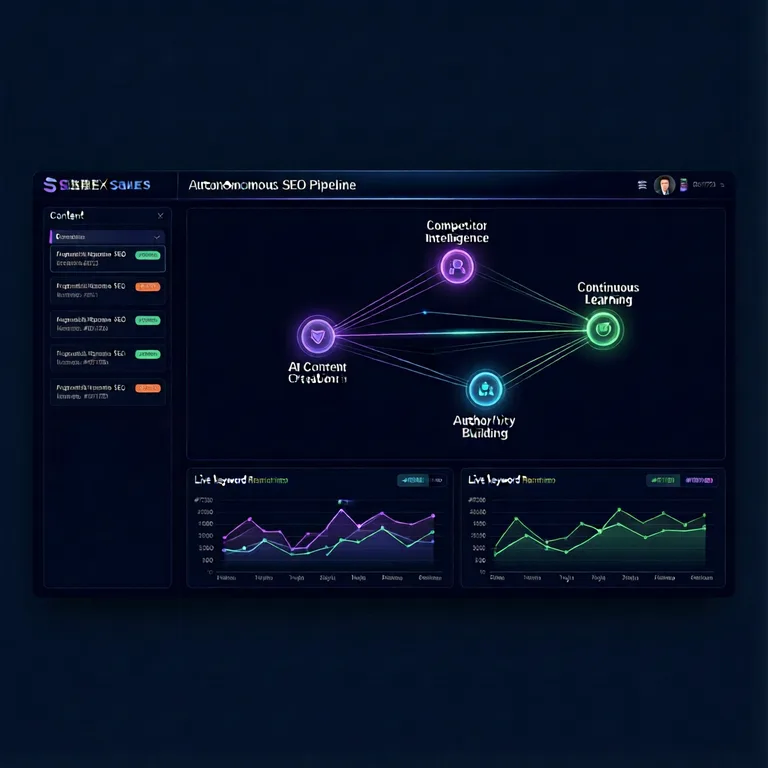
The three failure modes of manual SEO
- Velocity collapse. Publishing slows after the first sprint. Momentum dies. Rankings follow.
- Blind spots. Nobody audits the top 10 competitors weekly. Content gaps go undiscovered for months.
- No feedback loop. Articles publish and are never revisited. Underperformers stay published. Winners are never expanded.
Automation solves all three by design. Not by adding headcount.
Inside the Multi-Agent Pipeline: Research, Write, Audit, Publish
A real 24/7 SEO automation system is not one model with a prompt. It's a multi-agent pipeline with specialized agents and quality gates between them. Mayla's AI Content Creation pipeline runs five agents in sequence:
- Researcher agent — pulls SERP data, competitor rankings, EEAT signals, and content gaps.
- Writer agent — drafts the article using learned brand DNA.
- Auditor agent — scores the draft against SEO + GEO criteria. Requires 95%+ to pass.
- Designer agent — generates a featured image and formats the piece.
- Publisher agent — pushes to WordPress, Shopify, Webflow, or Ghost via REST API.
Quality gates are the whole point. A pipeline without an auditor is just a faster way to publish landfill. The auditor agent is what separates an autonomous SEO employee from a text generator.
"A content pipeline without a quality gate is a spam cannon. The gate is the product."
— Mayla Labs engineering
Why multi-agent beats single-prompt generation
Single-prompt generation produces generic output because one model has to hold research, brand voice, structure, and SEO constraints in a single context. Multi-agent systems separate concerns. The researcher doesn't write. The writer doesn't score. The auditor doesn't publish. Each agent optimizes for one job.
The result is measurable: articles that pass a 95%+ SEO score before they ever hit your CMS. Compare that to the SEO writing assistant brutal truth most tools deliver — a spell-checker with a keyword counter. That's not a pipeline. That's a linter.
| Approach | Monthly Output | Quality Gate | Cost Per Page |
|---|---|---|---|
| Manual content team (3 people) | 8–12 articles | Human editor | $150–$400 |
| Single-prompt AI tool | 50–100 articles | None | $2–$5 |
| Mayla 24/7 autonomous pipeline | 150+ articles | 95%+ SEO score required | Under $5 |
GEO for ChatGPT, Claude, Gemini, and AI Overviews
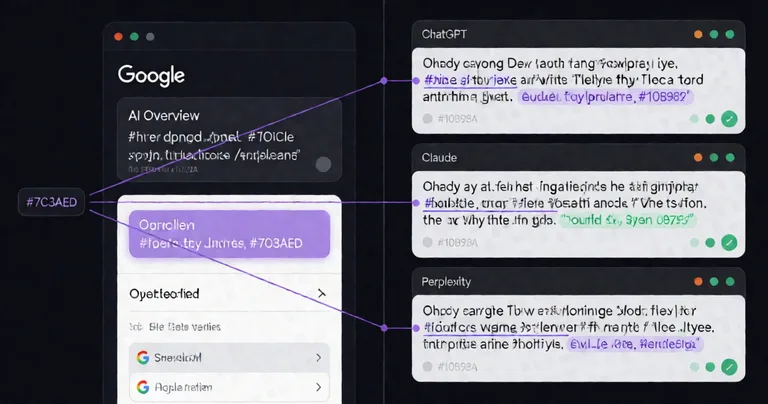
Generative Engine Optimization (GEO) is the discipline of getting your content cited by AI search engines — ChatGPT, Claude, Gemini, Perplexity, and Google AI Overviews. It is not the same as classic SEO. Classic SEO optimizes for a ranked list. GEO optimizes for a synthesized answer.
The mechanics differ. AI engines favor: definitive statements, structured data (tables, lists), quotable first paragraphs, FAQ blocks, and clear H2/H3 hierarchy. They penalize hedging, filler, and vague claims.
If a sentence can't be lifted out of context and used verbatim as an answer, rewrite it. AI engines cite sentences, not paragraphs.
How to optimize for AI Overviews and LLM citations
- Lead with the answer. First 100 words should fully answer the primary query.
- Use tables. AI engines extract structured comparisons at a much higher rate.
- Add FAQ blocks. Natural questions ("how do I...", "what's the best...") map directly to voice and AI queries.
- State facts with numbers. "150+ articles per month" gets cited. "High volume" does not.
- Build entity authority. Consistent brand mentions across your content graph signal EEAT.
Mayla runs a GEO / LLM Optimization Analysis on your domain that audits how you currently perform across each AI engine, then feeds those gaps back into the content pipeline. Every article published then targets both Google rankings and AI citation slots.
| Signal | Classic SEO Weight | GEO / AI Citation Weight |
|---|---|---|
| Keyword density | High | Low |
| Definitive factual statements | Medium | Very High |
| Structured tables & lists | Medium | Very High |
| FAQ blocks | Medium | High |
| Backlink profile | Very High | Medium |
| Content freshness | Medium | Very High |
Competitor Intelligence and Content Gap Discovery at Scale
You cannot automate SEO without automating competitor research. The manual version — checking 10 competitors' sitemaps weekly, logging new keywords, tracking publishing velocity — takes 6–10 hours a week. Nobody does it consistently. That's why gaps persist.
Mayla's Competitor Intelligence module monitors your top 10 competitors continuously. It tracks keyword rankings, publishing velocity, content structure, and EEAT signals. Every new competitor article becomes a data point. Every keyword they rank for that you don't becomes a content gap candidate.
What a content gap actually looks like
A content gap isn't just a missing keyword. It's a missing intent cluster. If three competitors rank for "best CRM for real estate agents" and you rank for none of the 14 related long-tail terms, that's a cluster gap — not a single-page gap. Automation finds clusters. Humans find keywords.
Once gaps are identified, they're ranked by opportunity score (search volume × ranking difficulty × competitor weakness). The pipeline then queues the highest-value gaps for the next content cycle. No spreadsheet. No meeting. No brief.
By the time you finish a manual gap analysis, the data is 2–3 weeks old. Competitors have published 20 new pages. You're optimizing for a snapshot. Automation optimizes for a live feed.
Brand Voice Learning and Content Quality Gates
Generic AI content is the reason most teams distrust automation. The output reads like a press release written by a committee. The fix isn't better prompts. It's Brand DNA Learning — a system that ingests your existing content, extracts tone, vocabulary, sentence rhythm, and audience targeting, then replicates it in every new article.
Brand DNA isn't a style guide. It's a learned model. It captures:
- Vocabulary — which technical terms you use and which you avoid.
- Sentence length distribution — short and punchy, or long and analytical.
- Personality traits — pragmatic, skeptical, contrarian, or warm.
- Audience assumptions — what your reader already knows.
- Structural habits — do you lead with data or narrative?
The quality gate then enforces it. If a draft drifts off-brand, the auditor agent rejects it before publishing. That's the difference between a pipeline and a content mill.
"Brand voice isn't a checkbox. It's a quality gate. If the auditor can't detect your voice, the article doesn't ship."
— Mayla Labs
If you want to see how brand voice learning performs in a real vertical, the women's fashion AI SEO case study shows how a niche retailer used it to rank in both Google and ChatGPT citations. Same pipeline. Different DNA.
Continuous Learning: How the System Gets Smarter Every Week
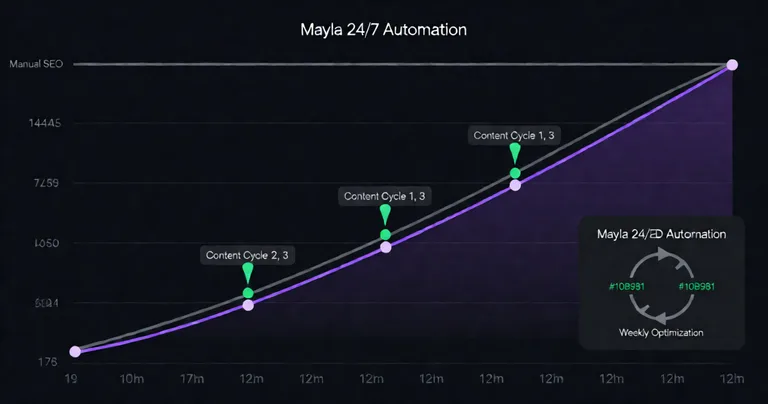
Publishing is not the end of the pipeline. It's the midpoint. The real value of 24/7 SEO automation is the feedback loop — connecting published content to real ranking data and adjusting strategy based on outcomes.
Mayla integrates with Google Search Console integration to pull position data automatically. Every article's performance is tracked. Winners are identified. Losers are flagged. The next content cycle adjusts keyword targets, internal linking, and topic priorities based on what actually ranked.
The weekly optimization loop
- Pull GSC data for all published articles.
- Score each article against target keyword position.
- Flag underperformers for rewrite or expansion.
- Boost winners with internal links and social amplification.
- Update keyword strategy based on new ranking signals.
- Queue next cycle of content gaps.
This is Continuous Performance Optimization in practice. It's not a report. It's a control loop. The system learns what your audience responds to and doubles down.
Zero-Allocation Architecture: Why Performance Matters at Scale
Running a 24/7 pipeline means running a lot of operations — scraping, parsing, embedding, generating, auditing. Every unnecessary memory allocation compounds. Every garbage collection pause adds latency. At scale, that's the difference between a pipeline that runs continuously and one that stalls under load.
Mayla Labs engineers for zero-allocation patterns across the stack. The same discipline applies to our RealSoft Games Unity development tools — object pooling, ring buffers, and job-system decoders that eliminate GC spikes. The Spawner Advanced & Pooling system recycles GameObjects to keep frame times flat. The ALS Audio System streams 10-hour audiobooks under 12 MB of memory using a fixed ring buffer.
Why does this matter for SEO automation? Because the same architectural principles — no per-operation allocations, deterministic memory footprints, bounded buffers — keep a content pipeline running 24/7 without degradation. A pipeline that leaks memory is a pipeline that crashes at 3 AM.
If your pipeline allocates on every request, it will eventually fall over. Design for steady-state memory. Recycle buffers. Prefer structs over classes. The same rules that keep a Unity game at 60 FPS keep an SEO pipeline alive for months.
This is also why we document our architecture publicly — see the Python for autonomous AI SEO guide for the backend patterns, and the Unity performance optimization tools breakdown for the front-end principles. The engineering discipline is the same regardless of domain.
Event, POS, and Vendor Workflows: The Same Automation Logic Applied
Autonomous pipelines aren't just for SEO. The same multi-agent, quality-gated architecture powers Evntle — our event management platform for Australian markets and festivals. Vendor applications, stall allocations, POS transactions, compliance documents, and live analytics all run through structured intake and review pipelines.
The Evntle Vendor Portal lets vendors self-serve their documents and stall assignments. Evntle POS runs on any phone or tablet and pairs with Zeller EFTPOS for tap-and-go payments. Evntle Reporting / Analytics delivers live dashboards and peak-hour heatmaps. Every workflow is automated. Every data point feeds back into the system.
Same philosophy. Different vertical. Automation isn't a feature — it's the architecture.
Cost Per Ranking Page: The Math That Ends the Debate
Let's talk numbers. A junior content writer costs $4,000–$6,000/month. A senior SEO manager costs $8,000–$12,000/month. A content agency retainer runs $3,000–$10,000/month with 8–12 articles delivered. None of them work 24/7. None of them run competitor intelligence weekly. None of them optimize for AI citations.
| Option | Monthly Cost | Articles/Month | Cost Per Article | Runs 24/7 |
|---|---|---|---|---|
| In-house writer | $5,000 | 10 | $500 | No |
| Content agency | $6,000 | 12 | $500 | No |
| Single-prompt AI tool | $99 | 100 | $0.99 | Partial |
| Mayla Yearly Plan | $15 | Unlimited | Under $5 | Yes |
Mayla's Mayla 7-Day Trial costs $1.99 and delivers up to 4 AI articles, brand DNA setup, and SEO insights. The yearly plan runs $15/month. That's less than a single freelance article — for an entire autonomous SEO employee.
The math isn't close. The only question is whether you want to keep paying $500 per article for content that doesn't run on weekends.
Frequently Asked Questions
Q: What is 24/7 SEO automation?
A: 24/7 SEO automation is a fully autonomous multi-agent pipeline that continuously researches competitors, discovers content gaps, writes in your brand voice, audits output against quality gates, publishes to your CMS, and learns from real ranking data — without human intervention. It runs around the clock, not in sprints.
Q: How do I get my content cited by ChatGPT and Google AI Overviews?
A: Optimize for GEO, not just SEO. Lead with a complete quotable answer in your first 100 words, use structured tables and FAQ blocks, make definitive factual statements with numbers, and maintain content freshness. Mayla's GEO optimization services audit and optimize for ChatGPT, Claude, Gemini, Perplexity, and AI Overviews simultaneously.
Q: What's the best way to find content gaps competitors are ranking for?
A: Automate it. Manual gap analysis takes 6–10 hours weekly and produces stale data. An autonomous competitor intelligence module monitors your top 10 competitors continuously, tracking keyword rankings, publishing velocity, and EEAT signals — then queues the highest-value gaps for the next content cycle automatically.
Q: Will AI-generated SEO content sound like my brand?
A: Only if the pipeline includes brand DNA learning and a quality gate. Mayla ingests your existing content to learn tone, vocabulary, sentence rhythm, and audience targeting, then enforces it with an auditor agent that rejects off-brand drafts before publishing. Generic AI content is a prompt problem. Brand voice is a pipeline problem.
Q: How much does 24/7 SEO automation cost compared to hiring a content team?
A: Mayla starts at $1.99 for a 7-day trial and $15/month on the yearly plan for unlimited AI articles. A junior content writer costs $4,000–$6,000/month for 10 articles. That's a cost per article difference of roughly 100x, before accounting for the fact that the automated system runs 24/7 and the human doesn't.
Q: Can 24/7 SEO automation publish directly to my CMS?
A: Yes. Mayla integrates with WordPress, Shopify, Webflow, and Ghost via REST APIs. Articles are formatted, image-generated, and scheduled automatically. No manual export, no copy-paste, no editorial bottleneck.
The Bottom Line
24/7 SEO automation isn't a productivity hack. It's a structural shift in how organic growth compounds. A manual team publishes 10 articles a month and stops. An autonomous pipeline publishes 150+, audits every one against a 95% SEO gate, optimizes for both Google and AI citations, and learns from real ranking data every week. The compounding curve isn't linear — it's exponential. If you're still running SEO as a project, you're competing against systems that never sleep. Start your $1.99 trial and see what your pipeline looks like when it runs around the clock.
More from Mayla Labs

AI SEO Automation That Doesn't Produce Landfill Content
AI SEO automation that doesn't produce landfill content — AI SEO automation that ranks, not landfill. Multi-agent pipelines, GEO Learn more today.

AI SEO Automation Platform for Startups: Rank and Get Cited
AI SEO automation platform for startups: autonomous agents, GEO visibility, quality gates. See how Mayla ranks pages. Start today.

AI SEO Agent vs Traditional SEO Agency: Which Wins?
AI SEO agent vs traditional SEO agency: cost, speed, GEO compared. See why autonomous pipelines win at $15/mo. Start your free trial today.

AI Content Strategy Tool: A Complete Guide for 2026
Discover how an AI content strategy tool automates research, writing & publishing. Compare features, see ROI data, and choose the best. Learn more today.
📋 Embed this feed on your website:
<script src="https://maylalabs.com/api/embed?api_key=mayla_site_ffa932ca083d0056918fd3430ebb301bcfa6ad08dad32efc&limit=5" defer></script>