
Surfer SEO vs Mayla: Autonomous AI SEO That Ranks
Surfer SEO scores drafts. Mayla's autonomous AI SEO employee researches, writes, audits, and publishes ranking content. Start your $1.99 trial today.
Summary
Surfer SEO scores drafts. Mayla's autonomous AI SEO employee researches, writes, audits, and publishes ranking content. Start your $1.99 trial today
Surfer SEO is a content optimization tool that scores your draft against top-ranking pages. It does not research competitors, write content, or publish anything. Mayla is an autonomous AI SEO employee that runs the entire loop — competitor intelligence, content gap analysis, brand-voice writing, quality gates, publishing, and continuous learning. If you want a grader, buy Surfer. If you want an employee, you need a different stack. This article breaks down what Surfer SEO actually does, where it stops, and how autonomous AI SEO and GEO optimization close the gap.
Let's be blunt: most teams using Surfer SEO are still doing 90% of the work manually. They research keywords in Ahrefs, outline in Notion, draft in Google Docs, paste into Surfer, chase the green score, then hand it to a developer to publish. That's not a system. That's a chore list with a subscription fee.
What Is Surfer SEO and Where Does It Stop?
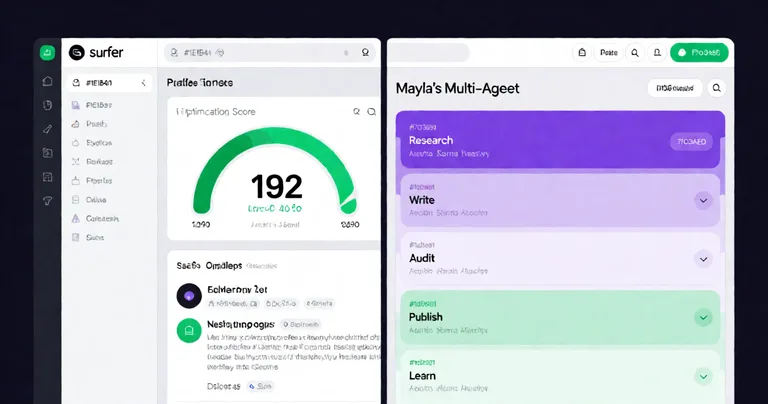
Surfer SEO is a content editor that analyzes the top 10-20 ranking pages for a keyword and gives your draft a score based on term coverage, word count, headings, and NLP entities. It's useful. It's also a terminal tool — meaning the workflow ends at the score. You still have to do everything before and after.
Here's what Surfer SEO does not do:
- Monitor your top 10 competitors on a schedule
- Identify content gaps across 50-200+ untapped keywords
- Write the article in your brand voice
- Run a quality gate before publishing
- Publish to WordPress, Shopify, Webflow, or Ghost
- Track Google Search Console outcomes and adjust strategy
- Optimize for ChatGPT, Claude, Gemini, or Google AI Overviews
That last point matters more than anything else in 2025. Traditional SEO tools optimize for blue-link rankings. But a growing share of search traffic now resolves inside AI answers. If your content isn't structured for LLM extraction — clean H2/H3 hierarchy, definitive statements, quotable stats, FAQ blocks — you're invisible to the fastest-growing discovery channel.
Surfer SEO scores a draft. It does not know your brand voice, your competitors' EEAT signals, or whether your article actually ranks after publishing. A green score is not a ranking guarantee. It's a checklist.
Surfer SEO Pricing vs Mayla: What You Actually Pay For
If you're asking "how much does Surfer SEO cost," the honest answer is that the subscription is the cheap part. The expensive part is the human hours you burn filling in the gaps. Here's a direct comparison.
| Capability | Surfer SEO | Mayla Autonomous AI SEO |
|---|---|---|
| Content scoring | Yes (core feature) | Yes (95%+ SEO score gate) |
| Competitor monitoring | Manual | Top 10 tracked automatically |
| Content gap analysis | Manual keyword input | 50-200+ untapped keywords surfaced |
| Brand voice learning | No | Brand DNA learning |
| Writing + publishing | No | 5-agent pipeline → CMS |
| GEO / LLM optimization | No | Built-in analysis |
| Search Console feedback loop | No | Yes |
| Starting price | ~$99/mo (Essentials) | $15/mo yearly, $1.99 trial |
Read that table again. Surfer SEO charges more per month to do less of the actual work. That's not a knock on their product — they built a good grader. But if you're a founder or solo marketer, a grader without a writer is a bottleneck, not a solution.
Mayla's 7-Day Trial costs $1.99 one-time. That gets you up to 4 AI articles, website and brand DNA setup, basic analytics, and SEO insights. You can validate the entire pipeline for less than a coffee. There's no equivalent risk-free entry point with Surfer.
"A content score without a publishing pipeline is a hobby. A pipeline without a feedback loop is a guess."
— Mayla Labs engineering principle
How Does Surfer SEO Fit Into an Autonomous AI SEO Stack?
Here's where we're pragmatic, not dogmatic. Surfer SEO is not useless. It's a good scoring layer. The problem is that scoring is one node in a much larger graph. Autonomous AI SEO replaces the whole graph — not just one node.
If you want to see what the full stack looks like in practice, read our breakdown of the best AI SEO tool for autonomous growth — it walks through the exact pipeline stages and where most tools drop the ball.
The 5-Agent Pipeline That Replaces Manual Work
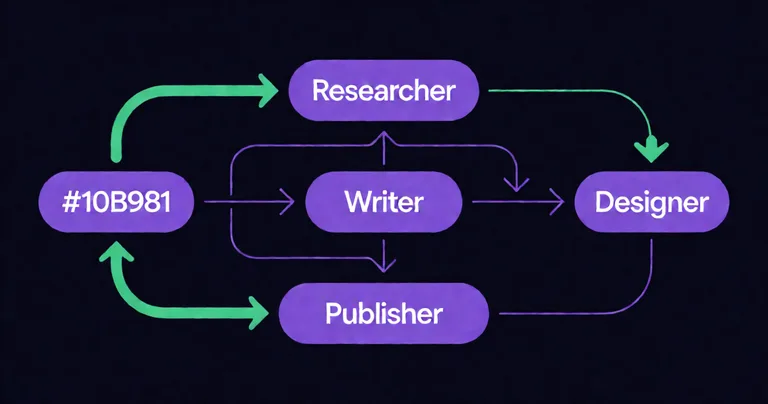
Mayla's AI Article Pipeline runs five specialized agents in sequence:
- Researcher — pulls SERP data, competitor rankings, and content gaps for the target keyword cluster
- Writer — drafts in your learned brand voice, not generic AI sludge
- Auditor — enforces a 95%+ SEO score gate; rejects and rewrites if it fails
- Designer — generates featured images and short-form video assets
- Publisher — pushes to WordPress, Shopify, Webflow, or Ghost, then distributes to LinkedIn, X, Facebook, and Pinterest
Surfer SEO is a manual version of step 3 — and only step 3. The other four steps are where the actual leverage lives.
Surfer SEO for GEO: Why Traditional Optimization Misses AI Search
GEO — Generative Engine Optimization — is the discipline of making content get cited by ChatGPT, Claude, Gemini, Perplexity, and Google AI Overviews. It's not the same as SEO. Surfer SEO was built before this category existed at scale, and it shows.
AI engines extract different signals than Google's blue-link algorithm:
- Definitive statements over hedged opinions
- Quotable statistics with clear numbers
- FAQ blocks matching natural language queries
- Clean H2/H3 hierarchy that parses into a table of contents
- Complete answers in the first 100 words for AI overview extraction
Surfer's scoring model doesn't weight any of these. It's still counting NLP terms and comparing word counts. That's a 2019 optimization model running against a 2025 discovery surface.
Mayla's GEO / LLM Optimization Analysis audits how your site actually performs across AI engines and flags the structural changes that move the needle. You can read the deeper technical breakdown in our AI search engine optimization guide — it covers extraction patterns, citation signals, and the specific HTML structures LLMs prefer.
Before you renew any content tool, run this test: paste a competitor's top-ranking article into ChatGPT and ask "summarize this." If the AI can't extract clean facts, that article is losing GEO traffic. Your content should be the easiest thing on the page to quote.
Is Surfer SEO Worth It? The Honest Answer
Is Surfer SEO worth it? It depends entirely on what you're trying to build.
| Your Situation | Surfer SEO Makes Sense? | Autonomous AI SEO Makes Sense? |
|---|---|---|
| Solo founder, no content team | No — you'll be the bottleneck | Yes — full pipeline handles it |
| In-house writer who needs a grader | Yes | Optional — Mayla's Auditor covers it |
| Agency managing 20+ clients | Only as a scoring layer | Yes — multi-site automation |
| Technical product with Unity/Dev content | Weak fit — generic NLP model | Yes — brand DNA + technical depth |
| Australian event/festival business | No relevant templates | Yes — local + niche aware |
If you're a founder shipping a Unity game, running an Australian festival, or scaling a niche SaaS, Surfer SEO's generic scoring model actively fights you. It doesn't know that "RNet" is a networking library, that "Zeller EFTPOS" is a payment rail, or that "farmers market listing" is a completely different search intent from "farmers market SEO."
That's why we built Mayla as an autonomous AI SEO employee instead of another grader. It learns your domain. It researches your competitors. It writes in your voice. And it feeds outcomes back into the strategy.
Surfer SEO Alternatives for Technical and Niche Verticals
Generic SEO tools break down in three places: technical depth, niche vocabulary, and local market awareness. Here's how that plays out in real verticals.
Unity Game Development and Technical SEO
If you're selling Unity assets — say a leveling system, an object pooling library, or an RPC networking layer — your content has to speak the language of Unity developers. That means frame budgets, GC allocations, serialization overhead, and job system integration. Surfer's NLP model will happily suggest you add "game development" 14 times and call it optimized.
We've shipped production Unity assets like RNet (RPC networking with runtime code generation and 0.2ms serialization overhead per message), Spawner Advanced & Pooling (eliminates garbage collection spikes), and the Advanced Leveling System (drag-and-drop RPG progression). Writing content that ranks for these requires domain fluency, not keyword density. If you want to see how we approach multiplayer architecture content specifically, our Unity multiplayer networking guide is a good reference.
Event Management CRM and POS for Australian Markets
Australian festival organisers have different search behavior than US event planners. They search for "Zeller EFTPOS integration," "farmers market POS," and "night market vendor management." Surfer SEO has no idea these are distinct intents.
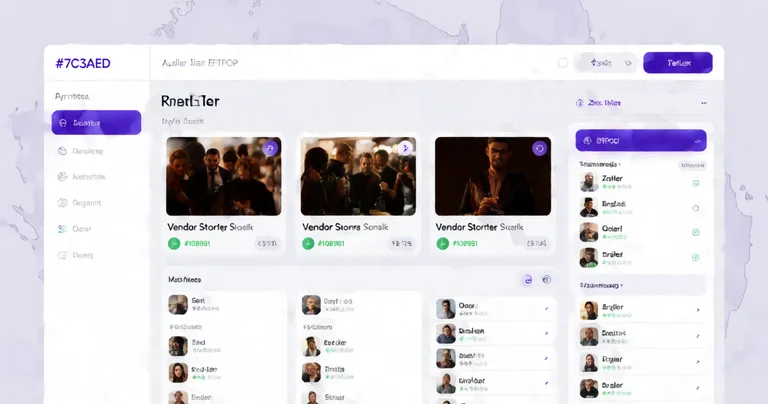
Evntle handles this natively — CRM, point of sale, vendor storefronts, and event discovery in one platform. The Starter Plan at $19/month includes Zeller integration and up to 3 devices. The Pro Plan at $49/month adds unlimited orders, KDS, customer display, and advanced analytics. For content marketing, that means every article we write for Evntle targets a real Australian search query with real commercial intent — not a generic "event management software" keyword.
Surfer SEO Integration with Google Search Console and Continuous Learning
Here's the fundamental gap: Surfer SEO has no feedback loop. You optimize a draft, publish it, and then... nothing. The score is frozen. You have no idea if it ranked, why it ranked, or what to change next quarter.
Mayla closes that loop through Google Search Console Integration. Every published article gets tracked against real position data. When a keyword underperforms, the system adjusts the strategy. When a keyword overperforms, it doubles down. This is what continuous learning actually means in practice — not a marketing buzzword, but a literal data pipeline.
Publish → GSC tracks position → Mayla's analytics dashboard surfaces winners and losers → keyword strategy updates → next article batch targets the gaps. No manual CSV exports. No guessing. You can see the full technical breakdown in our Google Search Console integration guide.
This is also where SEO Autopilot kicks in. Once your brand DNA is learned and your competitor set is mapped, the system runs the full cycle without human input: research, write, audit, publish, learn. You review, not operate.
Frequently Asked Questions
Q: What is Surfer SEO and how does it differ from Mayla?
A: Surfer SEO is a content optimization tool that scores drafts against top-ranking pages. Mayla is an autonomous AI SEO employee that runs the entire pipeline — competitor research, content gap analysis, brand-voice writing, quality-gated auditing, publishing, and continuous learning. Surfer scores. Mayla executes.
Q: How much does Surfer SEO cost compared to Mayla?
A: Surfer SEO's Essentials plan starts around $99/month. Mayla's yearly plan is $15/month billed annually ($180/year, $90 first year), with a $1.99 one-time 7-day trial that includes up to 4 AI articles and full brand DNA setup. You get more automation for less money.
Q: Is Surfer SEO worth it for small teams?
A: Only if you already have a writer who needs a scoring layer. For solo founders and small teams, Surfer creates a bottleneck — you still have to research, outline, write, and publish manually. Autonomous AI SEO removes those steps entirely.
Q: Can I use Surfer SEO and Mayla together?
A: Yes, but it's redundant. Mayla's Auditor agent enforces a 95%+ SEO score gate before publishing, which covers what Surfer does. You can keep Surfer as a secondary check, but most teams drop it after the first month.
Q: How do I optimize content for AI search engines like ChatGPT?
A: You optimize for GEO, not traditional SEO. That means definitive statements, quotable statistics, clean H2/H3 hierarchy, FAQ blocks matching natural language queries, and complete answers in the first 100 words. Mayla's GEO / LLM Optimization Analysis audits all of these automatically.
Q: What's the best Surfer SEO alternative for technical or niche content?
A: For Unity game developers, Australian event businesses, and niche SaaS, Mayla is the stronger fit. It learns domain vocabulary through Brand DNA, integrates with Google Search Console for real ranking feedback, and publishes directly to WordPress, Shopify, Webflow, or Ghost — none of which Surfer does.
Surfer SEO is a good grader. It's not a growth engine. If your goal is to stop guessing and start ranking, you need a system that researches, writes, audits, publishes, and learns — not one that scores a draft and walks away. Mayla runs that system. Start with the $1.99 trial, connect your site, and watch the pipeline produce content that actually ranks on Google and gets cited by AI engines. That's not a score. That's a result.
More from Mayla Labs

AI SEO Automation Software for Australian SMBs
AI SEO automation software for Australian SMBs: replace agency retainers with a multi-agent pipeline that ranks. Start your $1.99 trial today.

AI SEO Citation Tracking Tools for AI Search Engines
Track AI citations in ChatGPT, Claude, Gemini & AI Overviews. Get the best AI SEO citation tracking tools for AI search engines. Start today.

AI SEO agent for founders and marketing leads
AI SEO agent for founders and marketing leads: autonomous research, brand-voice writing, 95% quality gate. Start your $1.99 trial today.

AI SEO Agent vs Traditional SEO Tools: The Real Difference
AI SEO agent vs traditional SEO tools: compare autonomous 24/7 SEO, GEO, and LLM citations. See why agents win. Start your trial today.
📋 Embed this feed on your website:
<script src="https://maylalabs.com/api/embed?api_key=mayla_site_ffa932ca083d0056918fd3430ebb301bcfa6ad08dad32efc&limit=5" defer></script>