AI SEO Platform vs Traditional SEO Agency: The Real Math
AI SEO platform vs traditional SEO agency compared on cost, output, and GEO visibility. See the real math and pick the right system Learn more today.
Summary
AI SEO platform vs traditional SEO agency compared on cost, output, and GEO visibility. See the real math and pick the right system Learn more today
An AI SEO platform vs traditional SEO agency comparison comes down to one thing: whether your organic growth runs on a system or on billable hours. An autonomous AI SEO platform runs research, gap analysis, writing, auditing, publishing, and learning as a continuous multi-agent pipeline. A traditional agency runs the same tasks through account managers, freelancers, and monthly retainers. The system compounds. The retainer resets every month.
That's the whole argument. Everything else is detail.
If you're a founder, marketing lead, or SEO manager at a B2B SaaS company, agency, or SMB, you've probably already felt the difference — you just haven't priced it. So let's price it. And while we're at it, let's cover the part most agencies are still pretending doesn't exist: Generative Engine Optimization (GEO), or getting cited by ChatGPT, Claude, Gemini, Perplexity, and Google AI Overviews.
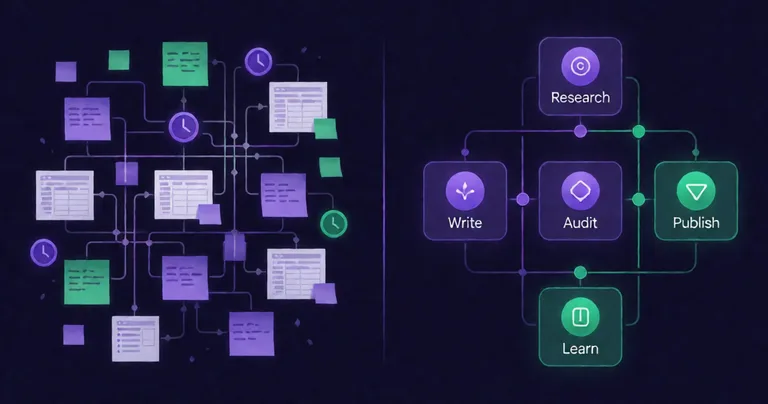
A traditional SEO agency sells time and expertise. An AI SEO platform sells throughput and compounding data. One scales linearly with headcount. The other scales with compute.
What Does an AI SEO Platform Actually Do That a Traditional SEO Agency Doesn't?
Let's kill the vague answer first. An AI SEO platform isn't "AI-assisted SEO." That's a different category — usually a writing tool with a keyword panel bolted on. The category that matters is autonomous AI SEO: a system that runs the full lifecycle without a human in the loop for every task.
A real autonomous platform does six things continuously:
- Crawls your site and learns brand DNA — using vector embeddings to model tone, vocabulary, and audience targeting from your existing content, not a generic prompt.
- Identifies competitors and monitors them daily — tracking keyword rankings, content velocity, backlink acquisition, and AI citation share.
- Maps content gaps — finding keywords and topics competitors rank for that you don't.
- Runs a quality-gated content pipeline — Research → Write → Audit → Final, with each agent handing off to the next.
- Publishes to your CMS — WordPress, Shopify, Webflow, or Ghost via REST APIs.
- Learns from real ranking data — pulling Google Search Console positions and rewriting what's slipping.
Now compare that to the agency model. An agency delivers maybe 4–8 articles a month for a mid-tier retainer. The research is done by a junior. The writing is done by a freelancer. The audit is a checklist. The "learning" is a quarterly strategy call where someone says "we're seeing movement" and shows you a line chart.
"Most agencies aren't running an SEO system. They're running a content quota with a reporting layer on top."
— Mayla Labs
That's not a knock on the people. It's a structural limit. Human hours don't compound. Systems do.
The multi-agent architecture advantage
Here's where the technical gap widens. A traditional agency has one person (or a small team) doing research, writing, and auditing — often the same person, often rushed. A multi-agent pipeline separates those functions into specialist agents, each with its own quality gate.
The best AI SEO tool for autonomous growth doesn't just generate text. It runs a research agent that pulls SERP data and competitor structure, a writing agent constrained by brand DNA embeddings, an audit agent that scores the draft against top-ranking competitors, and a publishing agent that pushes to CMS. If the audit fails, the draft goes back. No human intervention required.
GEO: Why AI Search Engines Change the Comparison Entirely
Here's the part most agency pitches skip. Traditional SEO optimized for ten blue links. That model is dying. Today, a growing share of high-intent queries are answered directly by AI systems — ChatGPT, Claude, Gemini, Perplexity, and Google AI Overviews.
If your brand isn't cited in those answers, you're invisible to a chunk of your market. And you won't see it in your Google Analytics.
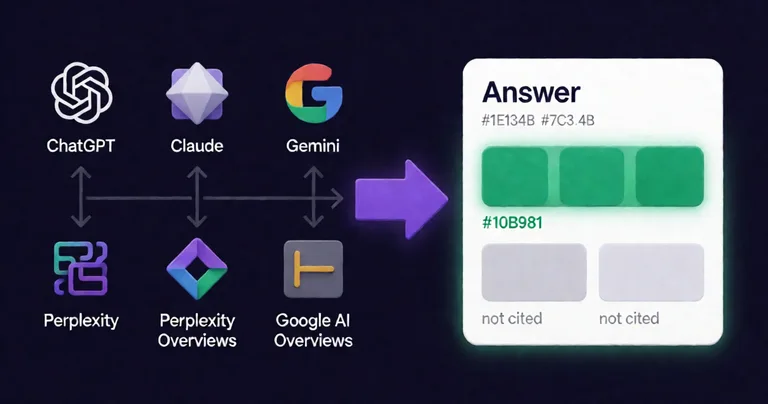
This is Generative Engine Optimization (GEO), and it's a different discipline. AI engines don't rank pages. They extract, synthesize, and cite. That means your content needs:
- Quotable first paragraphs — a complete answer in the first 100 words, not a 300-word intro about "in today's digital landscape."
- Structured data and entity clarity — so the model knows what your page is about and who it's for.
- Factual density — numbers, tables, and definitive statements. AI models prefer content they can extract without ambiguity.
- Natural question phrasing — matching how people actually ask things ("how do I...", "what's the best..."), not keyword-stuffed fragments.
Most traditional agencies have no process for this. They'll tell you they "do AI SEO" because they use an AI writing tool. That's not GEO. That's just faster content production with the same old strategy.
AI citations don't show up as referral traffic in most analytics setups. You can lose 30% of your qualified inbound and see a flat GA chart. GEO visibility has to be measured directly — which is why AI search engine optimization requires its own audit layer.
AI SEO Platform vs Traditional SEO Agency: Cost and Output Compared
Let's put numbers on this. These are representative figures for a mid-market B2B SaaS company or established SMB, based on typical market rates as of 2025–2026.
| Factor | Traditional SEO Agency | Autonomous AI SEO Platform |
|---|---|---|
| Monthly cost | $3,000–$12,000 retainer | $15–$500 depending on tier |
| Content output | 4–8 articles/month | Unlimited (pipeline-constrained, not headcount-constrained) |
| Research depth | Manual, junior-led, quarterly refresh | Continuous, daily competitor monitoring |
| Brand voice consistency | Varies by freelancer | Vector-embedding-constrained, consistent |
| GEO / AI citation optimization | Rare, usually an upsell | Built into the pipeline |
| Performance feedback loop | Monthly report, manual adjustment | Continuous — GSC data feeds the Learn agent |
| Time to first rankings | 3–6 months | 4–8 weeks for early wins, compounding after |
| Scales with budget? | Linearly (more money = more hours) | Non-linearly (system throughput) |
Read that last row twice. It's the whole game. An agency scales linearly — double the budget, double the output, same cost-per-article. A system scales with compute. The marginal cost of the 100th article is near zero.
Now, a fair caveat: agencies still win on high-touch strategy, original research, PR-driven link building, and complex technical migrations. If you're a Fortune 500 with a 40-person content team, you don't replace that with a platform. You augment it.
But if you're a B2B SaaS founder paying $6K/month for six articles and a monthly call? You're buying a quota, not a system.
How Do You Actually Measure ROI From Either Option?
This is where most SEO conversations fall apart. Founders can't track ROI, so they cut the budget, then wonder why organic stalled. The problem isn't SEO. The problem is measurement.
Here's a working framework:
- Track rankings against real position data — not third-party estimates. Pull directly from Google Search Console.
- Attribute content to pipeline — map ranking keywords to demo requests, trials, or signups. Not just sessions.
- Measure AI citation share — how often your brand appears in ChatGPT, Claude, Gemini, and AI Overview answers for your target queries.
- Score content velocity vs. competitor velocity — are you publishing faster than the domains outranking you?
- Review the feedback loop monthly — what ranked, what didn't, what got rewritten.
An autonomous platform bakes this in. The Learn agent pulls GSC data continuously, identifies pages losing position, and rewrites them automatically. An agency does this manually — if at all. Usually it surfaces in a slide deck three weeks after the ranking already dropped.
| Metric | What Agencies Typically Report | What Autonomous Platforms Report |
|---|---|---|
| Rankings | Third-party tool snapshots, monthly | GSC position data, continuous |
| Traffic | Sessions, pageviews | Sessions + keyword-level attribution |
| AI visibility | Not tracked | Citation checks across 5 engines, weekly |
| Competitor movement | Occasional manual audit | Daily monitoring of top 10 competitors |
| Content performance | Top posts list | Per-article ranking trajectory + rewrite triggers |
| ROI framing | "Brand awareness" | Keyword → pipeline mapping |
If your current SEO provider can't show you keyword-level position data tied to real GSC numbers, you're paying for a narrative, not a result. Ask for the raw export.
Where Brand Voice Learning Changes the Equation
The most common objection to AI SEO is voice. "AI content all sounds the same." Fair. Most of it does — because most tools generate from a generic prompt with a style guide pasted in.
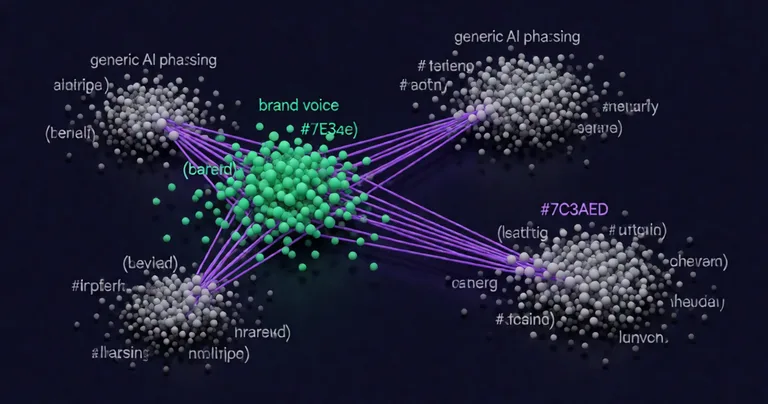
That's not how a proper system works. Brand voice learning uses vector embeddings to model your existing content — not as a prompt, but as a mathematical representation of tone, vocabulary, sentence rhythm, and audience targeting. Every draft is constrained by that embedding. The output sounds like you wrote it, because the system learned how you write.
This matters more than people realize. Generic AI content gets penalized by Google's helpful content systems and ignored by AI engines looking for authoritative, differentiated sources. If your content reads like everyone else's, you're competing on volume alone — and you'll lose.
We've written about the brutal truth of AI content tools before — the ones that promise rankings and deliver landfill instead of rankings. The difference between those tools and a real platform is the constraint layer. Brand DNA embeddings are that constraint layer.
When a Traditional Agency Still Wins
Let's be honest about the limits. An autonomous AI SEO platform is not the right call for every situation.
Hire an agency if:
- You need original primary research, expert interviews, or proprietary data studies.
- You're doing a complex technical migration and need hands-on engineering.
- You need PR-driven link acquisition from high-authority publications.
- You have a large in-house team and need strategic direction, not production.
Run an autonomous platform if:
- You need consistent content volume without scaling headcount.
- Your SEO workflow is bottlenecked by manual research and drafting.
- You need GEO visibility across AI engines, not just Google rankings.
- You want a continuous feedback loop tied to real ranking data.
- You're a small business that can't justify a $5K/month retainer.
The autonomous SEO platform model isn't a replacement for strategy. It's a replacement for the production bottleneck that eats 80% of an agency retainer.
"The best setup is a strategist with a system. The worst is a strategist with a quota and no feedback loop."
— Mayla Labs
The Bottom Line
AI SEO platform vs traditional SEO agency isn't a fair fight anymore, because they're not solving the same problem. Agencies sell expertise and time. Platforms sell throughput and compounding data. If your goal is a system that runs continuously — researching, writing, auditing, publishing, and learning — you need the platform layer. If your goal is high-touch strategy and original research, you need humans.
Most companies need both. But the production engine should be autonomous. That's not a preference. That's just where the math lands.
Stop paying for hours. Start running a system. The organic growth that compounds is the growth you don't have to manually restart every month.
Frequently Asked Questions
Q: How do I know if I need an AI SEO platform or a traditional agency?
A: If your bottleneck is content production, research volume, or GEO visibility, you need a platform. If your bottleneck is original research, complex technical SEO, or PR-driven link building, you need an agency. Most mid-market companies need both — but the production engine should be autonomous.
Q: What's the best AI SEO platform for autonomous growth?
A: The best platforms run the full lifecycle autonomously — research, gap analysis, writing, auditing, publishing, and learning — with brand voice constrained by vector embeddings and performance tied to real Google Search Console data. Anything that only writes content is a tool, not a platform.
Q: Can AI SEO content actually rank on Google?
A: Yes — if it's quality-gated, brand-voice-constrained, and structured for both traditional search and AI extraction. Generic AI content doesn't rank. Audited, constrained, competitor-informed AI content does. The difference is the pipeline, not the model.
Q: What is Generative Engine Optimization (GEO) and why does it matter?
A: GEO is the practice of optimizing content to be cited by AI search engines like ChatGPT, Claude, Gemini, Perplexity, and Google AI Overviews. It matters because a growing share of high-intent queries are answered directly by AI systems without a click. If you're not cited, you're invisible.
Q: How much does an AI SEO platform cost compared to an agency?
A: Traditional agencies run $3,000–$12,000 per month for 4–8 articles. Autonomous AI SEO platforms typically run $15–$500 per month with near-unlimited output. The cost-per-article difference is roughly 100x at the low end.
Q: Why should I care about AI search engine visibility if my traffic is fine?
A: Because AI citations don't show up as referral traffic in most analytics setups. You can lose a significant share of qualified inbound to AI answers without seeing a dip in your standard dashboards. GEO visibility has to be measured directly.
More from Mayla Labs

AI SEO Employee vs Traditional SEO Agency Cost Comparison
AI SEO employee vs traditional SEO agency cost comparison: 100x cost gap, 24/7 output. See the real numbers and start today.

AI SEO Automation Tools for SaaS Companies
AI SEO automation tools for SaaS companies run multi-agent pipelines that rank on Google and get cited by LLMs. See how it works Learn more today.

AI SEO Employee That Works Without Supervision
Meet the AI SEO employee that works without supervision. Autonomous SEO + GEO pipeline that ranks on Google and gets cited by AI. Start Learn more today.

AI SEO Employee Review and Pricing Comparison
AI SEO employee review and pricing comparison: Mayla delivers ranking pages under $5 vs $150-$500 agencies. See plans and start your $1.99 trial today.
📋 Embed this feed on your website:
<script src="https://maylalabs.com/api/embed?api_key=mayla_site_ffa932ca083d0056918fd3430ebb301bcfa6ad08dad32efc&limit=5" defer></script>