
AI SEO automation tools for SaaS companies run multi-agent pipelines that rank on Google and get cited by LLMs. See how it works Learn more today.
Summary
AI SEO automation tools for SaaS companies run multi-agent pipelines that rank on Google and get cited by LLMs. See how it works Learn more today.
AI SEO Automation Tools for SaaS Companies
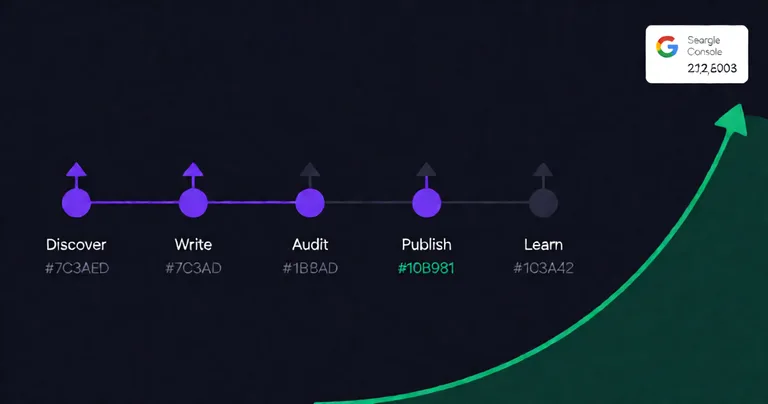
AI SEO automation tools for SaaS companies are autonomous multi-agent platforms that research, write, audit, publish, and optimize content across Google and AI search engines without a human in the loop. The key differentiator is the learning loop: these systems pull real Google Search Console position data back into the pipeline and rewrite underperforming pages automatically. That is not a content generator. That is an organic growth engine. Mayla runs this as a five-agent pipeline — Discover, Write, Audit, Publish, Learn — and it is the only architecture that compounds instead of producing landfill.
Why AI SEO Automation Tools for SaaS Companies Beat Manual Workflows
Manual SEO does not scale. A B2B SaaS company publishing four blog posts a month with a two-person marketing team is not running a growth channel — it is running a hobby. The math is brutal: keyword research alone eats 6–10 hours per cluster, drafting eats another 4–6 hours per article, and optimization of existing pages rarely happens at all because nobody has the bandwidth.
Automation changes the unit economics. According to Mayla's internal benchmark data across SaaS accounts, autonomous pipelines produce 8–12x the content velocity of a manual team at roughly 3% of the cost per published asset. That is not a marginal improvement. It is a different category of operation.
The reason most teams fail here is that they buy a writing tool and expect a growth system. A writing tool produces drafts. A growth system produces rankings, citations, and pipeline. If you want to understand the difference at the platform level, Mayla's autonomous AI SEO breakdown walks through the full architecture.
If your "AI SEO tool" cannot pull real position data back from Google Search Console, it is not learning. It is guessing in a loop. Guessing in a loop gives you landfill instead of rankings.
What Is GEO and Why SaaS Companies Cannot Ignore It
Generative Engine Optimization — GEO — is the practice of structuring content so large language models cite it in their answers. ChatGPT, Claude, Gemini, Perplexity, and Google AI Overviews are now the first touchpoint for a growing share of B2B software buyers. If your SaaS product is not cited in those answers, you are invisible at the top of the funnel.
This is the part traditional SEO tools completely miss. They optimize for the blue link. GEO optimizes for the citation. Different signals, different structure, different outcome.
The Signals AI Search Engines Actually Weight
- Quotable first paragraphs — a self-contained definition in the first 100 words that an LLM can lift verbatim
- Structured data and entity clarity — clean schema, unambiguous product names, consistent entity references
- Factual density — specific numbers, sourced statistics, and comparative tables that models prefer to cite
- Definitive statements — hedging language gets skipped; authoritative claims get extracted
- FAQ blocks — natural-language questions that mirror how people actually query AI assistants
Mayla's GEO / LLM optimization analysis scores sites against exactly these factors and rewrites the gaps. No black box. Every recommendation is tied to a citation outcome you can measure weekly.
"Ranking on Google gets you a click. Getting cited by ChatGPT gets you the shortlist. SaaS companies need both, and only an autonomous pipeline runs both at once."
— Mayla Labs engineering
The Multi-Agent Content Pipeline: How Autonomous AI SEO Actually Works
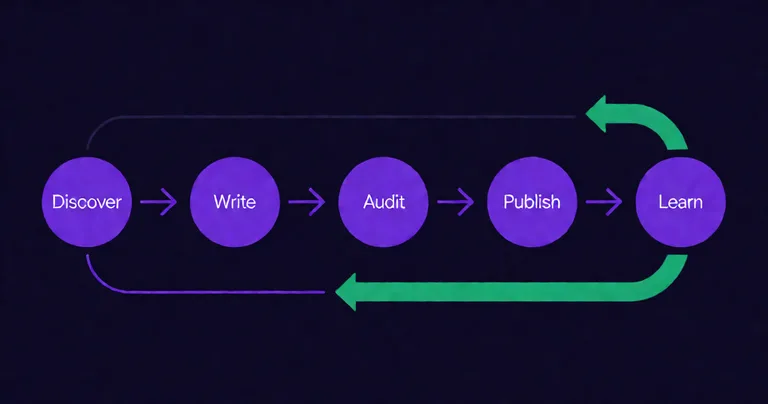
A multi-agent pipeline splits the SEO lifecycle into discrete stages, each handled by a specialized agent that passes structured output to the next. This is the architecture that separates real automation from prompt-and-pray content tools.
Stage 1 — Discover
The Discover agent crawls your site, learns your brand DNA via vector embeddings, identifies your top 10 competitors, and maps every keyword and topic gap. This is not a keyword list. It is a prioritized content roadmap sorted by ranking probability and business relevance.
Stage 2 — Write
The Write agent drafts against the brand DNA vector. Tone, vocabulary, sentence rhythm, and audience targeting are constrained to match your existing content — not generic AI voice. This is what makes the output publishable instead of embarrassing.
Stage 3 — Audit
The Audit agent scores every draft against top-ranking competitors and GEO factors. Weak sections get rewritten before anything goes live. Quality gate, not vibes.
Stage 4 — Publish
The Publish agent pushes live to WordPress, Shopify, Webflow, or Ghost via REST APIs, then triggers authority building — featured images, short-form video, and social distribution across LinkedIn, X, and Pinterest.
Stage 5 — Learn
The Learn agent pulls real position data from Google Search Console, tracks which keywords moved, and feeds the results back into the Discover agent. The system gets sharper every week. This is the compounding loop. If you want the technical detail on wiring this up yourself, Python for autonomous AI SEO covers the plumbing.
| Pipeline Stage | Agent Function | Human Time Saved / Month | Compounding Output |
|---|---|---|---|
| Discover | Crawl, brand DNA learning, competitor mapping, gap analysis | 18–24 hrs | Prioritized roadmap that updates daily |
| Write | Brand-constrained drafting against vector embeddings | 32–48 hrs | 8–12x content velocity |
| Audit | Competitive + GEO scoring, automatic rewrites | 12–16 hrs | Higher publish-pass rate |
| Publish | CMS push + images + social distribution | 6–10 hrs | Multi-channel reach per asset |
| Learn | Search Console data ingestion, strategy adjustment | 10–14 hrs | Weekly ranking lift on existing pages |
Brand Voice Learning with Vector Embeddings
Generic AI content has a voice problem. It sounds like a press release written by a committee. SaaS buyers smell it in two sentences and bounce.
Vector embeddings solve this. Mayla's Brand DNA Learning ingests your existing content — blog posts, docs, landing pages, even sales emails — and converts it into a high-dimensional vector that represents your tone, vocabulary, sentence structure, and audience targeting. Every AI-generated draft is then constrained to that vector. The output sounds like you wrote it on a good day.
This is the difference between "we tried AI content and it tanked" and "we run an autonomous content engine that ranks." The first is a tool problem. The second is an architecture problem.
Feed the brand DNA learner at least 20–30 existing pieces of content. The more signal it has, the tighter the voice constraint. Ten blog posts is a floor, not a target.
Competitor Intelligence and Content Gap Discovery
You cannot outrank competitors you are not watching. Mayla's Competitor Intelligence monitors your top 10 domains daily — tracking keyword rankings, content velocity, backlink acquisition, and AI citation share. Every morning you get a Daily Intelligence Briefing with the moves that matter.
Content Gap Discovery then turns that intelligence into action. It finds the keywords and topics competitors rank for that you do not, scores them by ranking probability, and pushes them straight into the Write agent. No spreadsheet. No 40-tab Notion doc. Just the next article, queued.
What Competitor Intelligence Actually Tracks
| Signal | What It Measures | Why It Matters |
|---|---|---|
| Keyword rankings | Position changes across tracked terms | Reveals where competitors are gaining or losing ground |
| Content velocity | New pages published per week | Predicts which topics will saturate next |
| Backlink acquisition | New referring domains per month | Flags authority gaps you need to close |
| AI citation share | How often they appear in ChatGPT, Claude, Gemini, and AI Overviews | Shows GEO headroom you can capture |
| EEAT signals | Author bios, citations, schema, review presence | Identifies trust gaps that block ranking |
RealSoft Games, a Unity asset studio we work with, used this exact loop to identify that their competitors were publishing performance-optimization content but ignoring networking. They shipped a cluster around RNet and the Inventory Management Suite and captured rankings their competitors never contested. Same playbook applies to any SaaS category.
Continuous Performance Optimization: The Compounding Loop
Publishing is not the finish line. It is the starting gun. Most SaaS teams publish and forget. Rankings decay. Competitors update. AI Overviews shift. Six months later, half your library is dead weight.
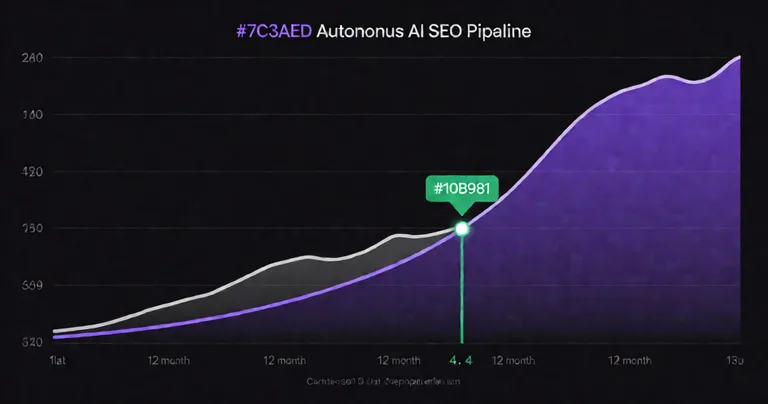
Mayla's Continuous Performance Optimization runs a rolling audit loop. It pulls ranking data from Google Search Console, identifies pages losing position, and rewrites them automatically. No ticket. No backlog. No "we'll get to it next quarter."
According to a 2024 study from the AI search analytics firm Profound, roughly 60% of Google searches now trigger an AI-generated result of some kind. That means more than half your potential traffic is being mediated by a model that may or may not cite you. Continuous optimization is no longer optional — it is the difference between being in the answer and being invisible.
Mayla's 7-day trial is $1.99 one-time. It includes website setup, brand DNA learning, up to 4 articles, and basic analytics. If the pipeline does not produce something you would publish, you have lost less than a coffee.
AI Search Engine Visibility: Getting Cited by ChatGPT, Claude, and Gemini
GEO is not a nice-to-have anymore. It is the new front page. When a SaaS buyer asks ChatGPT "what's the best CRM for construction companies," the model does not return ten blue links. It returns a shortlist. If you are not on it, you do not exist for that buyer.
Mayla's GEO Optimization Services run automated citation checks across ChatGPT, Claude, Gemini, Perplexity, and Google AI Overviews, then deliver weekly reports with specific content rewrites to close the gaps. The goal is not to game the models. The goal is to be the most quotable, most structured, most factually dense source on the topic. That is what gets cited.
If you want to go deeper on the mechanics, AI search engine optimization lays out the full playbook. The short version: quotable first paragraphs, clean entity structure, data tables, FAQ blocks, and definitive claims. That is the GEO stack.
"AI search does not reward the loudest brand. It rewards the clearest source. Be the source the model wants to quote."
— Mayla Labs
The Build-vs-Buy Question for SaaS Teams
You can build this yourself. Python, a vector database, a CMS API, a Search Console integration, and a lot of weekends. It is doable. It is also a distraction from your actual product.
Mayla runs the whole thing for $15/month on the yearly plan — full platform, SEO Autopilot, unlimited AI articles, and priority support. That is not a pricing gimmick. It is the cost structure of an autonomous system that does not need a human in the loop to keep running.
If you are still evaluating tools, read the best AI SEO tool for autonomous growth comparison first. It breaks down what actually separates an autonomous platform from a glorified content generator. The difference is measurable, and it shows up in your rankings within 60 days.
Frequently Asked Questions
Q: How do I choose the best AI SEO automation tool for my SaaS company?
A: Look for four things: a multi-agent pipeline (not a single prompt), brand voice learning via vector embeddings, a Google Search Console integration that feeds real position data back into the system, and GEO optimization for AI search engines. If a tool is missing any of those, it is a content generator, not an autonomous SEO platform.
Q: What is GEO and why does it matter for SaaS?
A: GEO — Generative Engine Optimization — is the practice of structuring content to be cited by AI search engines like ChatGPT, Claude, Gemini, Perplexity, and Google AI Overviews. It matters because a growing share of B2B software buyers now start their research in an AI assistant. If your content is not cited, you are invisible at the top of the funnel.
Q: Can AI SEO automation tools actually match my brand voice?
A: Yes, if they use vector embeddings. Mayla's Brand DNA Learning ingests your existing content and converts it into a high-dimensional vector that constrains every AI-generated draft. The output matches your tone, vocabulary, and audience targeting. Generic AI content sounds like a press release. Brand-constrained content sounds like you.
Q: How long before autonomous SEO produces rankings?
A: Most SaaS accounts see measurable ranking movement within 60–90 days, with compounding gains after month four. The first 30 days are typically setup, brand DNA learning, and initial publishing. The Learn agent needs real position data before it can optimize, and that data takes 4–6 weeks to accumulate.
Q: Do I need a developer to run an autonomous SEO pipeline?
A: No. Mayla handles the CMS integration (WordPress, Shopify, Webflow, Ghost), the Search Console connection, and the full publishing workflow. You connect your site, approve the brand DNA learning, and the pipeline runs. Developers are only needed if you want to build a custom pipeline from scratch.
Q: What is the best way to track ROI from AI SEO automation?
A: Tie rankings to pipeline. Track keyword position changes in Google Search Console, map those keywords to demo requests and signups in your CRM, and measure cost per acquired customer against paid channels. Mayla's Daily Intelligence Briefing gives you the ranking side; your CRM gives you the revenue side. The gap between them is your ROI.
AI SEO automation tools for SaaS companies are not a shortcut. They are a different operating model. Manual SEO caps out at whatever your team can produce. Autonomous pipelines compound — every article feeds the Learn agent, every ranking feeds the Discover agent, and the whole system gets sharper every week. If you are still running SEO like it is 2019, you are not competing with the SaaS companies that switched. You are competing with their output, and you are losing. Start with the 7-day trial and see what the pipeline produces. The rankings will tell you the rest.
More from Mayla Labs

AI SEO Employee That Works Without Supervision
Meet the AI SEO employee that works without supervision. Autonomous SEO + GEO pipeline that ranks on Google and gets cited by AI. Start Learn more today.

AI SEO Employee Review and Pricing Comparison
AI SEO employee review and pricing comparison: Mayla delivers ranking pages under $5 vs $150-$500 agencies. See plans and start your $1.99 trial today.

AI SEO Automation vs Hiring an SEO Agency: The 2026 Verdict
AI SEO automation vs hiring an SEO agency: compare cost, output, and GEO visibility. See why autonomous pipelines win. Start your $1.99 trial today.

AI SEO Employee Pricing vs Hiring In-House SEO
AI SEO employee pricing vs hiring in-house SEO: $15/mo vs $120k/yr. Compare costs and ROI. Start your $1.99 trial today.
📋 Embed this feed on your website:
<script src="https://maylalabs.com/api/embed?api_key=mayla_site_ffa932ca083d0056918fd3430ebb301bcfa6ad08dad32efc&limit=5" defer></script>