
AI SEO Employee vs Traditional SEO Tools: The Real Difference
AI SEO employee vs traditional SEO tools: see why autonomous multi-agent pipelines outrank dashboards. Start your $1.99 Mayla trial today.
Summary
AI SEO employee vs traditional SEO tools: see why autonomous multi-agent pipelines outrank dashboards. Start your $1.99 Mayla trial today
An AI SEO employee is an autonomous multi-agent system that researches, writes, audits, publishes, and optimizes content continuously — while traditional SEO tools are passive dashboards that hand you data and leave the work to you. That's the entire difference. One runs the lifecycle. The other sells you a subscription to your own to-do list. If you're a founder or marketing lead asking how do I get compounding organic growth without hiring a full SEO team, this is the comparison that actually matters.
Most teams don't have a content problem. They have a throughput problem. You buy Ahrefs or Semrush, you stare at keyword lists, you brief a writer, you wait three weeks, you publish, you check rankings, you do nothing for a month, and then you wonder why organic traffic is flat. That's not a strategy. That's a treadmill with extra steps.
What Is an AI SEO Employee and Why It Beats Traditional SEO Tools
An AI SEO employee is software that owns outcomes, not tasks. Traditional SEO tools own features. That distinction is everything.
When you open Semrush, you get a keyword database. When you open Surfer, you get a content score. When you open Google Search Console, you get position data. None of them will write the article, audit it against the top 10 competitors, publish it to your CMS, generate a featured image, cut a short-form video, distribute it to social, monitor its rankings for 90 days, and rewrite it when it slips. You do that. Or nobody does.
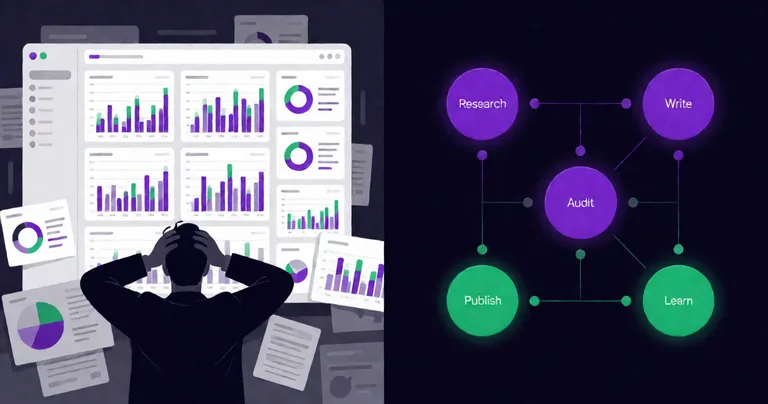
Mayla is built on the opposite premise. It's an autonomous SEO platform where each agent handles one stage of the SEO lifecycle and passes output to the next. Research feeds writing. Writing feeds auditing. Auditing feeds publishing. Publishing feeds a learning loop that pulls real Google position data back through Google Search Console and adjusts the keyword strategy based on what actually ranked.
That's the difference between a tool and an employee. A tool waits. An employee ships.
"Traditional SEO tools give you a dashboard. An AI SEO employee gives you published, ranking, continuously optimized content. One is a subscription to work. The other is the work."
— Mayla Labs
The Five-Agent Pipeline That Replaces Your SEO Stack
Here's how the AI SEO Employee actually runs. No black box. No vague promises.
- Research Agent — crawls your site, identifies your top 10 competitors, maps their keyword rankings, and surfaces content gaps you don't rank for.
- Write Agent — generates drafts constrained by your Brand DNA vector embeddings, so output sounds like you, not like ChatGPT's default voice.
- Audit Agent — grades every draft against top-ranking competitors and GEO factors before anything goes live.
- Publish Agent — pushes to WordPress, Shopify, Webflow, or Ghost via REST APIs, with featured images and short-form video generated automatically.
- Learn Agent — pulls real position data from Google Search Console, identifies pages losing rank, and rewrites them.
If your current SEO stack requires you to manually connect keyword research to content briefs to publishing to rank tracking, you don't have a system. You have five disconnected tools and a human glue gun.
Traditional SEO Tools vs AI SEO Employee: The Head-to-Head
Let's stop being abstract. Here's the operational comparison that matters.
| Capability | Traditional SEO Tools | AI SEO Employee (Mayla) |
|---|---|---|
| Keyword research | Manual, you pick targets | Autonomous gap discovery against top 10 competitors |
| Content creation | None — you brief a writer | Multi-agent pipeline: Research → Write → Audit → Final |
| Brand voice | Not addressed | Vector embedding model trained on your existing content |
| Publishing | Manual copy-paste to CMS | Native REST API push to WordPress, Shopify, Webflow, Ghost |
| Rank tracking | Passive dashboard | Continuous loop that rewrites losing pages automatically |
| AI search visibility | Not measured | GEO audit across ChatGPT, Claude, Gemini, Perplexity, Google AI Overviews |
| Time to first published article | 2–4 weeks with a writer | Under 24 hours from setup |
Read that table again. Every row on the left is a task you're currently doing manually or paying someone else to do. Every row on the right is a task the system does without you.
Why "Just Use ChatGPT" Fails
Founders love to ask why they can't just prompt ChatGPT and paste the output into WordPress. Here's why that fails.
- No brand voice constraint. ChatGPT writes in ChatGPT voice. Your audience notices.
- No competitor grounding. It doesn't know what's already ranking for your target keyword.
- No EEAT signals. No author entity, no structured data, no citation-worthy statistics.
- No GEO optimization. Roughly 60% of Google searches now end without a click. If AI overviews don't cite you, you're invisible.
- No learning loop. You publish, you forget, the article rots.
That's not an SEO strategy. That's a content landfill with a publishing date.
Generative Engine Optimization: The Metric Traditional SEO Tools Ignore
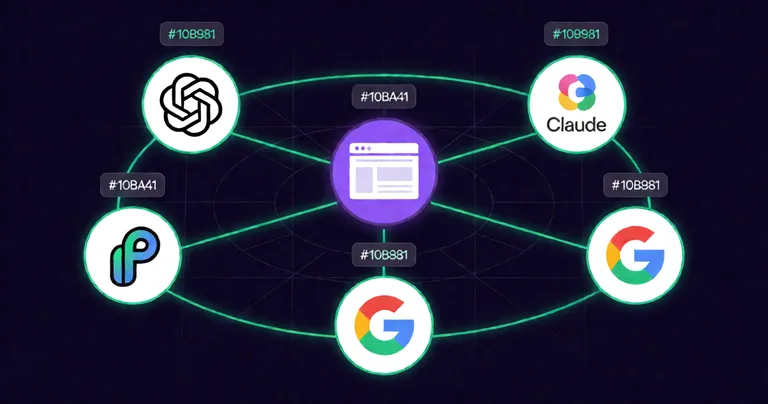
Here's the uncomfortable truth. Traditional SEO tools were built for a search results page that no longer exists. Google AI Overviews, ChatGPT, Claude, Gemini, and Perplexity now answer a huge chunk of queries directly. If your content isn't cited in those answers, your rankings on page one are worth less every quarter.
Generative Engine Optimization — GEO — is the discipline of making content that AI engines quote. It's not the same as classic SEO. AI engines reward different signals.
| GEO Signal | Why AI Engines Care | Traditional Tool Support |
|---|---|---|
| Quotable first paragraph | AI overviews extract the first 100 words as the answer | None |
| Structured data / schema | Entity clarity for LLM retrieval | Partial plugins only |
| Definitive statements | LLMs prefer authoritative claims over hedged ones | Not measured |
| Factual statistics | Numbers get cited in AI answers | Not tracked |
| Entity consistency across pages | Helps LLMs connect your brand to topics | Not measured |
| Citation share in ChatGPT / Gemini | Directly drives AI-referred traffic | Not tracked |
Mayla GEO Optimization Services runs automated citation checks across ChatGPT, Claude, Gemini, and Google AI Overviews weekly, then rewrites content that isn't being cited. Traditional tools don't do this because they were built before AI search existed at scale.
If your SEO tools can't tell you how often ChatGPT cites your domain, you're optimizing for half the search market. The other half is where your competitors are quietly winning.
Brand Voice Learning: Why Vector Embeddings Beat Prompt Templates
Every AI content tool claims it can "write in your brand voice." Almost none of them can. Here's the technical reason why.
Most tools use prompt templates. You paste three sample paragraphs into a "brand voice" field, and the LLM tries to mimic the tone. It works for about two paragraphs, then drifts back to generic AI voice. That's because prompt templates are shallow — they describe voice, they don't encode it.
Mayla Brand DNA Learning uses vector embeddings. It ingests your existing content, converts it into high-dimensional vectors, and constrains every generated draft to sit inside that embedding space. Tone, vocabulary, sentence rhythm, audience targeting — all encoded numerically, not described in a prompt.
The difference shows up in output. Prompt-template tools produce content that sounds like a smart intern. Vector-constrained systems produce content that sounds like you wrote it on a good day.
"Prompt templates describe your brand voice. Vector embeddings encode it. One is a suggestion. The other is a constraint. Constraints ship consistent content."
— Mayla Labs engineering
How Brand DNA Learning Actually Works
- System crawls your existing site content and internal docs.
- Content is chunked and converted to vector embeddings.
- A brand-voice model is trained on the embedding distribution.
- Every future draft is generated inside that embedding space.
- Audit agent scores each draft for voice drift before publishing.
No prompt engineering. No "tone slider." Just a numeric fingerprint of how your brand writes.
Competitor Intelligence and Content Gap Discovery at Scale
Traditional SEO tools show you competitor data. AI SEO employees act on it.
Mayla Competitor Intelligence monitors your top 10 competitors daily — tracking keyword rankings, content velocity, backlink acquisition, and AI citation share. When a competitor starts ranking for a keyword you don't have a page for, that gap gets flagged, researched, and turned into a draft before the keyword saturates.
That's the compounding advantage. Traditional tools surface a gap and wait for you to notice. The autonomous system closes the gap in the same week it opens.
What Continuous Performance Optimization Looks Like
Here's the loop that traditional tools can't run because they don't publish content:
- Pull real position data from Google Search Console daily.
- Flag any page that dropped more than 3 positions in 14 days.
- Re-audit that page against current top 10 competitors.
- Rewrite headings, tighten first 100 words, add missing statistics.
- Republish and monitor for recovery.
That's Continuous Performance Optimization in practice. It's not a report. It's a rolling audit loop that keeps your content from rotting.
The average blog post loses 40% of its organic traffic within 12 months if it's never updated. Continuous optimization isn't a nice-to-have. It's the difference between compounding and decaying.
Who Actually Needs an AI SEO Employee vs Traditional SEO Tools
Not every business needs an autonomous system. Be honest about which category you're in.
| Business Type | Traditional Tools Are Fine If... | You Need an AI SEO Employee If... |
|---|---|---|
| Early-stage SaaS | You have a full-time SEO hire | You're the founder doing SEO at 11pm |
| B2B agency | You only run client audits | You're delivering content at scale for 10+ clients |
| Ecommerce / Shopify | You sell 20 SKUs | You have 500+ product pages that need optimization |
| Local services (pest control, real estate) | You rank for your city already | You're invisible in AI overviews for your service category |
| Unity asset / game dev | You only sell on the Asset Store | You need organic discovery outside the marketplace |
That last row matters more than people think. Studios like RealSoft Games ship production-grade Unity assets — Advanced Leveling System, RNet, Inventory Management Suite — and the Asset Store alone doesn't drive compounding discovery. Organic content does. The same pipeline that ranks a SaaS blog ranks a Unity asset documentation page.
If you're a pest control company, Pest Control SEO is the same system with a different brand DNA. If you're in real estate, Homes for Sale AI SEO. If you're a CRM brand, CRM SEO. The agents don't care about your vertical. They care about the pipeline.
The Economics: What an AI SEO Employee Actually Costs
Let's talk money, because that's where traditional tools quietly win the argument in a budget meeting and quietly lose it over 12 months.
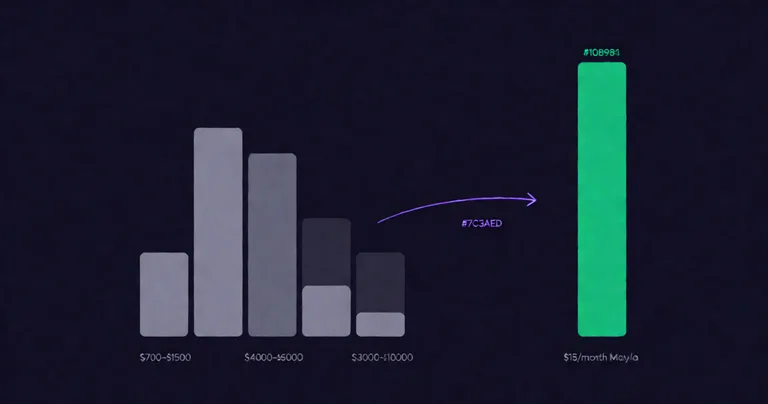
- Ahrefs + Surfer + Clearscope + a freelance writer = roughly $700–$1,500/month for 8–12 articles.
- A junior SEO hire = $4,000–$6,000/month fully loaded.
- An agency retainer = $3,000–$10,000/month.
- Mayla yearly plan = $15/month for unlimited AI articles, SEO Autopilot, and priority support.
That's not a rounding error. That's a category shift. And before you assume "cheap means worse," run the Mayla 7-Day Trial for $1.99 — website setup, brand DNA learning, up to 4 articles, and basic analytics. Judge the output, not the price tag.
Frequently Asked Questions
Q: What's the best AI SEO tool for autonomous growth?
A: The best AI SEO tool for autonomous growth is one that runs the full lifecycle — research, writing, auditing, publishing, and continuous optimization — without human intervention. Mayla's multi-agent platform is built exactly for this. Traditional tools like Ahrefs or Semrush excel at data but require a human to act on it. If you want autonomous growth, you need an employee, not a dashboard.
Q: How do I get my content cited by ChatGPT and Google AI Overviews?
A: You need GEO optimization, not just SEO. That means a quotable first 100 words, structured data, definitive statements instead of hedged opinions, factual statistics, and consistent entity signals across your site. Mayla's GEO Optimization Services audit citation share across ChatGPT, Claude, Gemini, Perplexity, and Google AI Overviews weekly and rewrite content that isn't being cited.
Q: Can an AI SEO employee really replace my SEO agency?
A: If your agency's main output is content production, rank tracking, and monthly reports, yes. An autonomous system does all three continuously instead of monthly. If your agency provides high-touch strategy, PR, or link building through relationships, an AI employee complements rather than replaces them. Most teams use both for the first 90 days.
Q: How does brand voice learning with vector embeddings work?
A: The system ingests your existing content, converts it into high-dimensional vector embeddings, and trains a brand-voice model on the embedding distribution. Every future draft is generated inside that embedding space, so tone, vocabulary, and sentence rhythm stay consistent. It's a numeric constraint, not a prompt suggestion — that's why the output doesn't drift.
Q: What's the difference between GEO and traditional SEO?
A: Traditional SEO optimizes for ranking in a list of blue links. GEO optimizes for being quoted inside an AI-generated answer. The signals overlap but aren't identical — GEO rewards quotable first paragraphs, structured data, and definitive claims more heavily. Roughly 60% of Google searches now end without a click, so ignoring GEO means optimizing for shrinking real estate.
Q: How fast does an autonomous SEO system produce results?
A: First articles publish within 24 hours of setup. Early keyword movement typically shows in 30–60 days. Compounding traffic growth — the kind that comes from a learning loop rewriting losing pages — shows in 90–180 days. That's faster than hiring a writer, and dramatically faster than waiting for an agency's onboarding cycle.
Traditional SEO tools sell you features. An AI SEO employee sells you outcomes. If you're still copy-pasting keyword lists into briefs, briefing writers, waiting three weeks, publishing, and hoping — you're not running SEO. You're running a manual assembly line that competitors with autonomous systems are already outproducing. The question isn't whether AI SEO employees are better. It's whether you can afford another quarter of doing it the old way. Start with the Mayla 7-Day Trial for $1.99 and see what a real pipeline ships.
More from Mayla Labs

Unity Game Development Performance-Optimized Assets and Systems
Unity game development performance-optimized assets and systems: pooling, inventory, networking benchmarks. Build faster, ship smoother. Read the guide.

Unity Asset Store Alternatives for Production-Grade Assets
Unity Asset Store alternatives for production-grade assets: benchmarks, zero-allocation systems, and cost math. Stop buying shelf filler.

AI SEO Software That Ranks Without Manual Work
AI SEO software that ranks without manual work. Mayla's autonomous pipeline researches, writes, audits, publishes. Start your $1.99 trial today.

AI SEO ROI Measurement for B2B: The Honest Math
AI SEO ROI measurement for B2B: track cost per ranking page, AI citations & pipeline. See the honest math and cut cost per page under $5. Start now.
📋 Embed this feed on your website:
<script src="https://maylalabs.com/api/embed?api_key=mayla_site_ffa932ca083d0056918fd3430ebb301bcfa6ad08dad32efc&limit=5" defer></script>