
Event Payments Australia
Event payments in Australia: POS, contactless, stall fees, compliance. Build a setup that sells. A stall runs out of stock and needs to redirect customers.
Summary
Event payments in Australia: POS, contactless, stall fees, compliance. Build a setup that sells. A stall runs out of stock and needs to redirect customers
Event payments in Australia are the systems and rules that let market organisers collect stall fees and let vendors take money from customers on event day. If you want the short answer: use a mobile POS with contactless card acceptance, set clear stall fee terms, and reconcile everything through one platform so you can see what sold and what you are owed. That is the setup that keeps queues moving, keeps you compliant, and keeps vendors coming back. This guide covers the lot — POS, contactless, stall fees, food safety, and the event-day logistics that make or break your market.
Whether you run a farmers market in Geelong, a craft fair in the Blue Mountains, or a gaming convention at a convention centre, payments sit at the centre of the whole operation. Get them right and everything else gets easier. Get them wrong and you will spend your Sunday night chasing bank transfers and arguing about who owes what.
Why Event Payments in Australia Are Different
Australia is one of the most card-dominant markets on earth. According to the Reserve Bank of Australia, contactless card payments now account for the majority of in-person transactions, and cash use has fallen to roughly 13% of consumer payments. That number matters for every stallholder. If you cannot take a tap, you are turning away most of your potential customers before they even look at your menu.
The Australian market scene also runs on tight margins. Stallholders pay site fees, insurance, food registration, and transport before they sell a single item. Organisers collect those fees and need to reconcile them against vendor lists, site allocations, and last-minute cancellations. Throw in state-based food safety rules — each state has its own regulator — and you have a compliance load that spreadsheets were never built to handle.
Contactless payments make up over 90% of in-person card transactions in Australia. Cash now sits at around 13% of total consumer payments and keeps falling. If your market is cash-only, you are operating against the tide.
What organisers actually need to track
- Stall fees collected, pending, and refunded per vendor
- Site allocation and bump-in schedules
- Insurance certificates and food registration documents
- POS sales totals for vendors using your recommended system
- Incident reports logged during the event
- Attendance and foot traffic data for future planning
Most organisers currently run this across three or four tools — a spreadsheet, an inbox, a bank account, and a paper site map. That is where the admin hours disappear. An integrated approach like Evntle Event Commerce Software pulls all of it into one place, so you are not reconciling four sources on a Monday morning.
How Do I Set Up POS and Contactless Payments for a Market Stall?
Setting up a POS for a market stall in Australia takes about 30 minutes if you have the right hardware. Here is the practical path.
- Choose your payment processor. In Australia, the main options are Zeller, Square, and Tyro. Zeller is popular with market vendors because of its EFTPOS terminal pricing and next-day settlement. Square is common for craft stalls because of its flat rate and simple app. Tyro suits food businesses that want integrated EFTPOS with their POS.
- Pick your POS software. A dedicated market POS like Evntle POS handles product categories, modifiers, split payments, and thermal receipt printing. It also works offline, which matters when you are in a park with patchy mobile coverage.
- Set up your product list. Group items into categories, add modifiers (sizes, extras, dietary options), and set tax correctly. If you sell food, declare allergens in your store profile.
- Test the setup before event day. Run a test transaction, print a receipt, and check that the terminal pairs correctly. Do this at home, not at 6am on event morning.
- Train your staff. Use training mode to run through a busy service. Staff who know the POS move faster and make fewer mistakes.
Always carry a backup payment method. If your terminal fails, a mobile checkout option on a phone with a card reader can keep sales moving while you troubleshoot. Never rely on a single device at a busy market.
Contactless vs mobile POS — what's the difference?
A contactless terminal is a dedicated card reader. A mobile POS is a full point of sale system on a phone or tablet that also takes cards. For most market vendors, mobile POS wins because it does more. You get product management, sales reporting, and loyalty features alongside the payment. If you want a detailed breakdown, see the comparison on Evntle Cashless Terminals vs Mobile POS.
| Payment method | Setup cost | Transaction fee (typical) | Best for |
|---|---|---|---|
| Zeller EFTPOS terminal | $0–$299 | 1.4%–1.9% | Food stalls, high-volume vendors |
| Square Reader | $65 | 1.6% | Craft stalls, low-volume sellers |
| Tyro EFTPOS | $199+ | 1.5%–2.0% | Businesses needing integrated POS |
| Cash | $0 | Banking fees + time | Backup only in 2026 |
| QR / PayID | $0 | 0%–1.5% | Low-value, casual transactions |
Stall Fees and Vendor Payments: What Organisers Need to Get Right
Stall fees are the lifeblood of a market. They fund the venue, the insurance, the marketing, and the organiser's time. But collecting them is where most organisers lose hours. The problems are always the same: late payments, no-shows, refund disputes, and the nightmare of matching bank transfers to vendor names.
The fix is to make payment part of the application process. When a vendor applies through a structured system like Evntle Vendor Application Management, you can require payment upfront or on approval, and the system tracks who has paid and who has not. No more chasing.
A practical stall fee structure
- Standard site fee: $50–$150 per day depending on location and event size
- Premium site fee: $150–$400 for corner sites, high-traffic positions, or powered sites
- Food vendor surcharge: $20–$80 extra for grease traps, power, and waste management
- Casual vs seasonal rate: offer a discount for vendors who commit to a full season
- Bond: $50–$200 refundable bond for site condition and bump-out compliance
"The organisers who get paid on time are the ones who make payment part of the application, not a separate follow-up task."
— Evntle vendor operations guide
How to handle refunds and cancellations
Set a clear cancellation policy in your terms. A common approach is full refund if cancelled more than 14 days out, 50% refund between 7 and 14 days, and no refund inside 7 days. Publish this everywhere — on the application form, in the vendor portal, and in your confirmation email. When vendors know the rules, disputes drop dramatically.
Do not hold vendor payments in a personal account. Use a business account and keep a clear record of every transaction. If you are audited or a vendor disputes a payment, you need a clean trail. An integrated payment processing setup gives you that automatically.
Food Safety and Compliance for Australian Event Payments
Food safety and payments are more connected than most organisers realise. If a vendor cannot prove they are registered and insured, they should not be trading. And if they are trading, you need a record of it.
In Australia, food businesses must register with their local council and comply with Food Standards Australia New Zealand (FSANZ) requirements. Each state has its own regulator — NSW Food Authority, Queensland Health, SA Health, and so on. The rules differ slightly, but the core requirements are consistent.
What every food vendor must have before event day
- Current food business registration with the relevant council
- Food Safety Supervisor certificate (required in most states for food handling)
- Public liability insurance — minimum $10 million is standard for markets
- Allergen management plan and accurate labelling
- Temperature control records for high-risk foods
- Hand washing and sanitation setup on site
Collect these documents during the application process, not on the morning of the event. A vendor portal like Evntle Vendor Portal lets stallholders upload certificates, and you can set expiry reminders so nothing goes stale. For allergen management specifically, Evntle Allergen Tracking helps food stalls keep ingredient records accurate and answer customer queries with confidence.
| Requirement | Who needs it | Typical cost | Renewal |
|---|---|---|---|
| Food business registration | All food vendors | $100–$800/year | Annual |
| Food Safety Supervisor cert. | Food handlers | $150–$300 | 5 years |
| Public liability insurance | All vendors | $300–$1,200/year | Annual |
| Product liability insurance | Food & beverage vendors | $200–$800/year | Annual |
| Council temporary food permit | Food vendors at events | $50–$250 per event | Per event |
Event-Day Logistics: Bump-In, Site Planning, and Incidents
Event day is where all your planning gets tested. Payments, site plans, vendor check-in, and incident management all happen at once. The organisers who stay calm are the ones who have a system.
Bump-in and vendor check-in
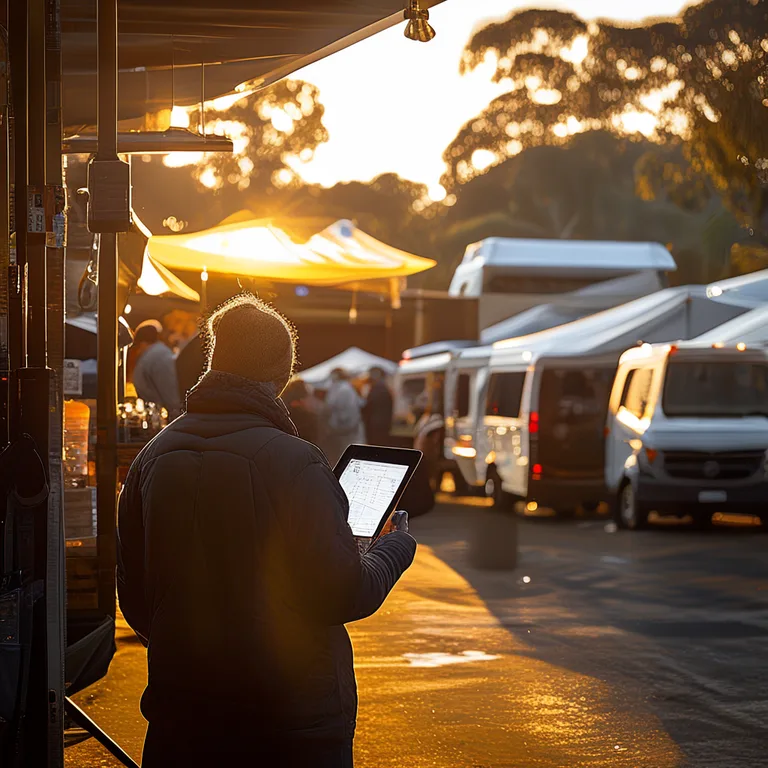
Bump-in is chaos if you let it be. Vendors arrive at different times, some have the wrong site, some cannot find their allocation, and everyone wants to ask you a question at once. A digital check-in process fixes most of this. Vendors scan a QR code on arrival, confirm their site, and you see who is on site in real time. Evntle QR Check-In and Evntle Vendor Check-In handle this without paper lists.
Site planning that drives sales
Where you put each stall affects how much they sell. Food vendors should be spread out to avoid competing queues blocking each other. Craft stalls benefit from being near food, because people browse while they eat. Entrances and exits should funnel traffic past as many stalls as possible. Evntle Site Planning lets you map all of this digitally and share it with vendors before the event, so everyone knows where they are going.
Incident management on the day
Things go wrong at events. A vendor has a power failure. A customer slips. A stall runs out of stock and needs to redirect customers. Having a system to log, assign, and resolve these issues keeps small problems from becoming big ones. Evntle Event Incident Management gives you a mobile-friendly way to record what happened, who is handling it, and when it was resolved. That record also protects you if there is a dispute later.
Analytics, Reporting, and Growing Sales
The final piece of the payments puzzle is what you do with the data afterwards. Every transaction tells you something. Which vendors sold the most? What time of day was busiest? Which payment method dominated? What was the average transaction value?
Most organisers never see this data because it is scattered across terminals, bank accounts, and cash tins. When you run payments through a connected system, the reporting comes automatically. Evntle Analytics & Insights gives you live revenue dashboards, top-selling items, peak hour heatmaps, and end-of-day summaries.
What to measure after every event
- Total vendor sales (where POS data is available)
- Average transaction value per vendor
- Peak trading hours and slow periods
- Payment method split — card vs cash vs QR
- Vendor attendance and no-show rate
- Attendee numbers and repeat visit rate
- Incident count and resolution time
Use this data to make better decisions. If a vendor consistently underperforms, talk to them about their site or their product mix. If a particular time slot is dead, consider adjusting your event hours. If card payments dominate, stop worrying about cash logistics.
"You cannot improve what you do not measure. The organisers who grow are the ones who review their numbers after every event."
— Evntle event analytics guide
Share a simple sales summary with your vendors after each event. It builds trust, helps them plan stock, and makes them more likely to rebook. Vendors who feel informed stay loyal.
Frequently Asked Questions
Q: Can market stalls accept contactless payments in Australia?
A: Yes. Any Australian business with an ABN can get an EFTPOS terminal or mobile card reader from providers like Zeller, Square, or Tyro. You do not need a permanent retail premises. Contactless payments work anywhere with mobile coverage, and most systems have offline mode for areas with patchy signal.
Q: How much do I pay in transaction fees for a market stall POS?
A: Expect 1.4% to 2.0% per transaction for card payments in Australia. Zeller is typically the cheapest for high-volume food vendors. Square charges a flat 1.6%. Some providers also charge a monthly terminal fee, so compare total cost, not just the rate.
Q: What is the best way to collect stall fees from vendors?
A: Collect payment as part of the application or approval process. Make it a condition of securing a site. Use a system that tracks who has paid, who is pending, and who has cancelled. This removes the need for manual follow-up and reduces no-shows.
Q: Do food vendors need insurance to trade at an Australian market?
A: Yes. Public liability insurance is standard, usually with a minimum of $10 million cover. Food vendors should also have product liability insurance. Organisers should collect certificates of currency during the application process and check expiry dates before every event.
Q: How do I handle a vendor who does not show up on event day?
A: Have a clear no-show policy in your terms. Most organisers forfeit the stall fee if the vendor does not arrive by a set time without notice. Keep a waitlist of approved vendors who can fill the site at short notice. A vendor waitlist system makes this fast and fair.
Q: Can I run a cashless market in Australia?
A: Yes, and many already do. Cashless markets are common at food festivals and night markets. The main risk is excluding customers who prefer cash, but that group is shrinking fast. If you go cashless, make sure every vendor has a reliable card reader and a backup device.
Event payments in Australia do not have to be complicated. Set up a mobile POS with contactless acceptance, make stall fees part of the application process, collect compliance documents upfront, and review your data after every event. That is the formula that keeps vendors paid, keeps organisers sane, and keeps customers coming back. If you want to see how it works in practice, Evntle Event Commerce Software brings payments, vendor management, and reporting into one platform built for Australian markets.
More from Evntle

AI SEO Agent vs Traditional SEO Agency for Events
AI SEO agent vs traditional SEO agency for events: cost, speed and results compared. Find the right fit for your market — read the guide now.
AI SEO Agent for Small Business: Event Growth Guide
Discover how an AI SEO agent for small business helps Australian event organisers rank higher, sell more and stress less. Book your Evntle demo today.

AI Marketing Automation Software for Aussie Events
AI marketing automation software for Australian event organisers. Fill stalls, sell tickets, automate vendor comms. Sign up free with Evntle today.

AI Content Automation That Ranks in Google and AI Search
Ai content automation that ranks in google and ai search — Learn how AI content automation ranks in Google & AI search for events Learn more today.
📋 Embed this feed on your website:
<script src="https://maylalabs.com/api/embed?api_key=mayla_site_f1cb1e95fff884263b19125c9f830c929bc45b4d&limit=5" defer></script>