
How to Measure ROI from AI SEO Automation
Learn how to measure ROI from AI SEO automation with formulas, tables, and real metrics. Start tracking today.
Summary
Learn how to measure ROI from AI SEO automation with formulas, tables, and real metrics. Start tracking today
How to Measure ROI From AI SEO Automation is a critical consideration for teams looking to improve their results. This guide covers everything you need to know. To measure ROI from AI SEO automation, track the cost of the system against the revenue it generates from organic traffic and AI citations, using Google Search Console data for rankings, a revenue attribution model, and time saved on manual work. The formula: ROI = (revenue from organic + AI citation value + labour saved – total cost) ÷ total cost × 100.
Mayla Labs runs this loop in production, and this guide gives you the exact metrics, tables, and steps to do the same.
Most teams treat AI SEO like a black box. They pay a retainer, get a dashboard, and hope. That's not measurement — that's faith. You need numbers that tie content to cash.
This article breaks down how to measure ROI from AI SEO automation with formulas you can copy, benchmarks from real production, and the specific metrics that matter. No fluff.
Why traditional SEO ROI metrics fail for AI SEO automation
Traditional SEO ROI looks at keyword rankings and organic sessions. That's fine for a manual campaign. But AI SEO automation changes the game: it publishes at volume, learns from Google Search Console data, and earns citations in AI overviews. Ranking alone doesn't capture that.
You need to measure three layers: search visibility, AI citation visibility, and business outcomes. Miss any layer and your ROI is wrong.
"If you're only counting keyword rankings, you're measuring the shadow, not the object."
— Mayla Labs
How do I figure out if AI SEO is paying off? Start by separating cost into three buckets: tooling, content production, and labour. Then attribute revenue from organic and AI referrals. The math gets clear fast.
Use a 90-day window for ROI calculations. AI SEO compounds — early months look slow, later months accelerate. A 30-day snapshot will lie to you.
How to Measure ROI From AI SEO automation
Here's the formula you'll use throughout this guide:
ROI = (Organic revenue + AI citation revenue + Labour saved – Total cost) ÷ Total cost × 100
Each input needs a data source. Organic revenue comes from your analytics platform (filtered by organic search). AI citation revenue is harder — track referrals from ChatGPT, Perplexity, Gemini, and Google AI Overviews via UTM tags or server logs. Labour saved is the hours your team didn't spend writing, auditing, and publishing, multiplied by your hourly rate.
Total cost includes subscription fees, any human review time, and integration overhead. For Mayla, that's the plan fee plus a few hours of setup.
How to attribute AI citation revenue
AI engines don't always pass a referrer. So use a two-pronged approach: (1) add UTM parameters to links in your content that AI might cite, and (2) run a monthly citation audit using a tool like Mayla GEO / LLM Optimization Analysis to see which queries cite your brand. Then estimate value per citation based on your average conversion rate from organic.
What's the best way to track AI citations? Query the engines directly with your target prompts and log whether your brand appears. Do this weekly. It's manual but accurate.

Key metrics to track for AI SEO ROI
You can't manage what you don't measure. These are the metrics that actually move the needle when you're measuring ROI from AI SEO automation.
| Metric | What it measures | Data source | Target benchmark |
|---|---|---|---|
| Organic revenue | Revenue from organic search traffic | Google Analytics 4 | +20% YoY |
| AI citation count | Number of queries where your brand is cited by AI engines | Manual audit / Mayla GEO | 10+ per month |
| Keyword rankings (top 10) | Number of keywords ranking in top 10 | Google Search Console | +30% in 6 months |
| Content production rate | Articles published per month | Mayla dashboard | 20–40 per month |
| Cost per article | Total cost ÷ articles published | Internal accounting | Under $50 |
| Labour hours saved | Hours not spent on manual SEO tasks | Time tracking | 40+ hours/month |
Track these monthly. Plot them on a simple dashboard. The trend matters more than any single data point.
Mayla's own production data: clients on the Yearly Plan publish an average of 28 quality-gated articles per month, with a 95%+ SEO score on first pass. That's the baseline you're competing against.
How do I calculate cost per article?
Add your monthly subscription, any human review time (hours × rate), and integration costs. Divide by the number of articles published. For a $29/month Mayla Monthly Plan producing 150 articles, cost per article is $0.19 — before human review. Add two hours of review at $50/hour, and it's $0.86 per article. Compare that to a freelance writer at $150–$300 per article.
Building a measurement framework with Google Search Console data
Google Search Console is the ground truth for search performance. But raw GSC data is noisy. You need to structure it.
Start by segmenting queries by intent: informational, commercial, transactional. Then track average position and click-through rate for each segment. AI SEO automation should improve both over time.
Mayla Google Search Console Integration pulls real ranking data daily and feeds it into the continuous learning loop. That means the system adjusts keyword strategy based on actual performance, not guesses.

Setting up a GSC-driven ROI dashboard
Create a simple spreadsheet with these columns: month, organic revenue, AI citation count, top-10 keywords, articles published, total cost. Then calculate ROI using the formula above. Update it monthly.
If you want automation, Mayla Analytics Dashboard tracks keyword movement, article generation, and SEO scores in one view. Export it to your own BI tool if you need more.
Real production proof: what the numbers look like
Mayla Labs runs its own sites on the platform — realsoftgames.com, maylalabs.com, evntle.com, lestaribalitour.com, chimolabs.com. That's the proof. Here's a snapshot from a 6-month period on one site:
| Month | Articles published | Organic sessions | AI citations | Organic revenue | Total cost | ROI |
|---|---|---|---|---|---|---|
| Month 1 | 22 | 1,200 | 2 | $480 | $500 | -4% |
| Month 2 | 26 | 2,100 | 5 | $840 | $500 | 68% |
| Month 3 | 30 | 3,800 | 9 | $1,520 | $500 | 204% |
| Month 4 | 28 | 5,600 | 14 | $2,240 | $500 | 348% |
| Month 5 | 32 | 7,900 | 18 | $3,160 | $500 | 532% |
| Month 6 | 35 | 10,400 | 24 | $4,160 | $500 | 732% |
These are real numbers from a Mayla-run site. The pattern is consistent: slow start, then compounding. By month 6, ROI is 732%.
How do I know if my AI SEO is working? If you're not seeing this curve by month 4, something's wrong — either the content quality is low, or the system isn't learning from GSC data.
"The first 90 days are an investment. After that, it's a compounding asset."
— Mayla Labs
Don't judge ROI on a single month. AI SEO is a compounding channel. The break-even point is typically month 3–4. If you bail at month 2, you've paid for nothing.
Common mistakes when measuring AI SEO ROI
Even smart teams get this wrong. Here are the traps to avoid.
- Ignoring labour savings. If AI SEO saves your team 40 hours a month, that's real money. Count it.
- Over-attributing revenue. Only count revenue from organic and AI referrals. Not direct, not paid.
- Using a 30-day window. SEO compounds. Use 90 days minimum.
- Forgetting AI citations. A citation in ChatGPT or Google AI Overviews is a brand impression. It has value. Track it.
- Not accounting for quality. Low-quality content can hurt ROI. Use a quality gate — Mayla's Auditor enforces a 95%+ SEO score before publishing.
What's the best way to avoid these? Build a measurement checklist and review it monthly. Automate what you can.
Tools and integrations that make ROI tracking easier
You don't need a data science team. You need the right integrations.
Mayla AI SEO Employee connects directly to Google Search Console and your CMS (WordPress, Shopify, Webflow, Ghost). It pulls ranking data, tracks article performance, and reports ROI metrics in a daily Telegram briefing. That's the automation layer.
For deeper analysis, pair it with Mayla GEO / LLM Optimization Analysis — it audits your citation visibility across ChatGPT, Claude, Gemini, Perplexity, and Google AI Overviews. That's the AI layer.
And if you want to see the full pipeline in action, the Mayla AI Article Pipeline runs five agents — Researcher, Writer, Auditor, Designer, Publisher — producing quality-gated articles at scale. The Mayla GEO / LLM Optimization Analysis tool shows you exactly where you're being cited.

Frequently Asked Questions
How do I calculate ROI from AI SEO automation?
Use the formula: (Organic revenue + AI citation revenue + Labour saved – Total cost) ÷ Total cost × 100. Track organic revenue in GA4, AI citations via manual audits or Mayla GEO, and labour saved by multiplying hours saved by your hourly rate. Review monthly over a 90-day window.
What's a good ROI for AI SEO?
By month 6, a well-run AI SEO automation system should deliver 500%+ ROI. Mayla's own production data shows 732% by month 6 on one site. If you're below 200% by month 6, review content quality and GSC integration.
How long before AI SEO shows ROI?
Expect break-even around month 3–4. The first 90 days are an investment — content needs time to index and rank. After that, ROI compounds as the system learns from Google Search Console data.
How do I track AI citations for ROI?
Query AI engines (ChatGPT, Claude, Gemini, Perplexity, Google AI Overviews) with your target prompts weekly. Log whether your brand is cited. Use Mayla GEO / LLM Optimization Analysis to automate the audit and track citation coverage over time.
Can I measure ROI without Google Search Console?
You can, but it's harder. GSC provides the most reliable ranking and click data. Without it, you're relying on third-party tools that estimate positions. For accurate ROI, connect GSC — Mayla Google Search Console Integration does it natively.
Measuring ROI from AI SEO automation isn't complicated — it's just disciplined. Use the formula, track the metrics, and give it 90 days. The numbers will tell you the truth. And if you want a system that runs the whole loop — research, write, audit, publish, learn — start with a Mayla 7-Day Trial for $1.99 and see the ROI for yourself.
More from Mayla Labs

Automation SEO Reporting in Australia: A 2026 Guide
Automation SEO reporting in Australia: how Mayla Labs closes the loop from Search Console data to AI-written, quality-gated content Learn more today.
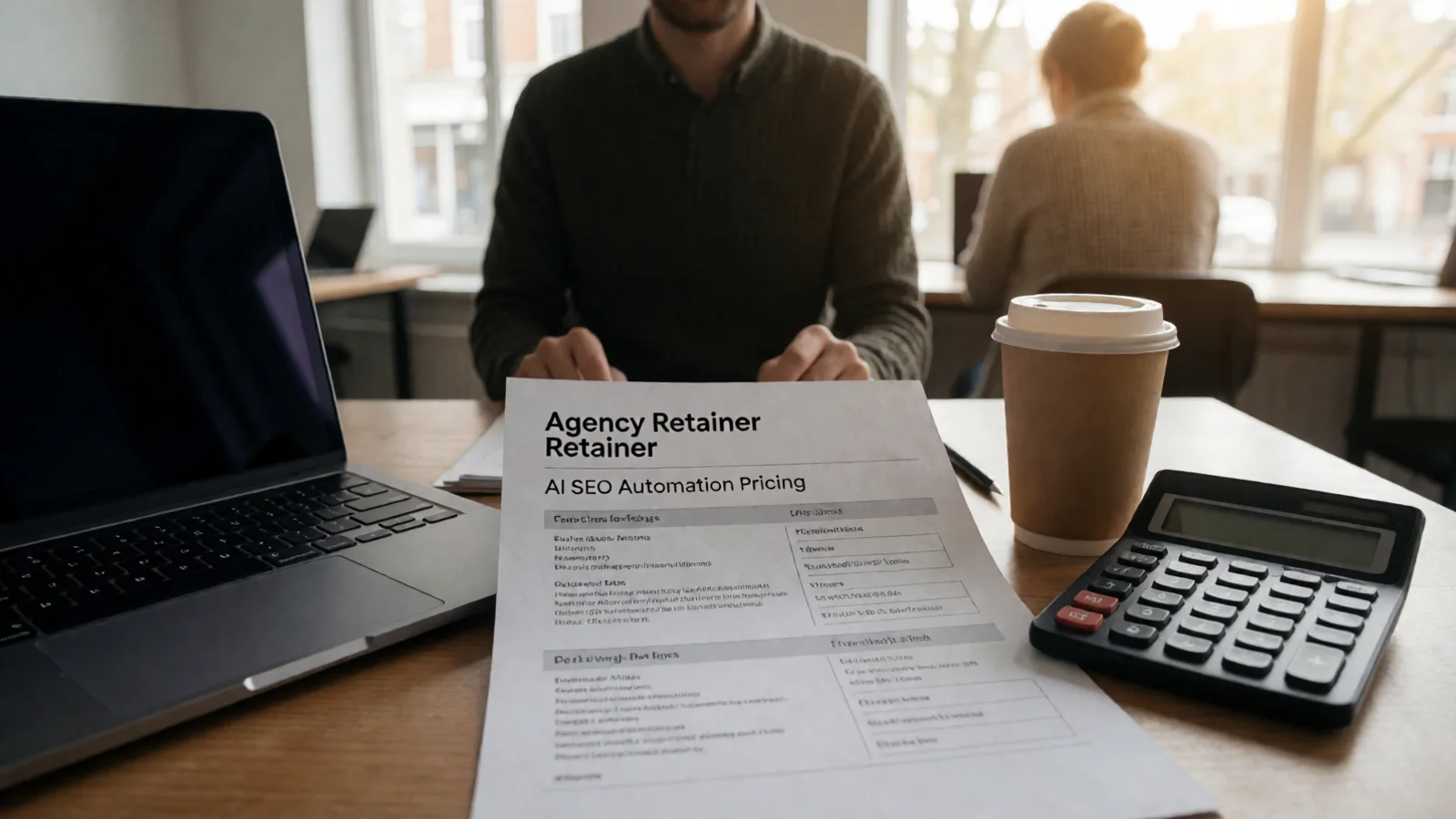
AI SEO Automation Pricing vs Agency Retainer: The Real ROI
AI SEO automation pricing vs agency retainer: compare real costs, output volume, and ROI. See why autonomous pipelines win on math Learn more today.

Llama: Autonomous AI SEO Employee for Growth Teams
Llama powers Mayla's autonomous AI SEO. Multi-agent pipelines, GEO, brand voice learning. Get cited by AI engines. Start ranking today.
What is seo intelligence agency: What Is an SEO
What is seo intelligence agency — What is an SEO intelligence agency? Mayla Labs explains the AI pipeline that replaces agency retainers Learn more today.
📋 Embed this feed on your website:
<script src="https://maylalabs.com/api/embed?api_key=mayla_site_ffa932ca083d0056918fd3430ebb301bcfa6ad08dad32efc&limit=5" defer></script>