
AI SEO Software for Overwhelmed Marketing Managers
AI SEO software for overwhelmed marketing managers: autonomous pipelines that rank on Google and get cited by ChatGPT. Try Mayla today.
Summary
AI SEO software for overwhelmed marketing managers: autonomous pipelines that rank on Google and get cited by ChatGPT. Try Mayla today
AI SEO software for overwhelmed marketing managers is an autonomous multi-agent system that researches, writes, audits, publishes, and optimizes content across Google and AI search engines without manual hand-holding. It replaces the fragile stack of keyword tools, spreadsheets, freelance writers, and plugin dashboards with one continuous pipeline. Mayla's autonomous AI SEO employee runs that pipeline 24/7, learns your brand voice with vector embeddings, monitors competitors, and feeds real Google Search Console data back into the next content decision. That's not a tool. That's an employee that never sleeps.
Most marketing managers aren't failing at SEO because they lack effort. They're failing because the workflow is broken. You have 40 tabs open, three freelancers ghosting you, a content calendar that's already two weeks behind, and a CFO asking why organic traffic is flat while ad spend doubled. That's not strategy. That's noise.

AI SEO Software for Overwhelmed Marketing Managers
Manual SEO doesn't scale. It never did. It just looked manageable when Google was the only game in town and a 1,200-word blog post could rank for three years.
Today, a single piece of content needs to satisfy Google's ranking algorithms, get cited by ChatGPT and Claude, appear in Google AI Overviews, survive Perplexity's source-selection filters, and still convert a human reader. That's five audiences per article. Most teams write for one and pray.
The Four Failure Modes
- Research debt. Keyword research happens once a quarter, then sits in a spreadsheet while the market moves.
- Content velocity collapse. Writing, editing, and publishing one article takes 8–12 hours of human time. At that rate, you can't outpace a competitor publishing daily.
- Zero feedback loop. Nobody checks which articles actually moved rankings, so the same mistakes ship every month.
- AI search invisibility. Your content never gets quoted by LLMs because it lacks quotable structure, entity clarity, and structured data.
If your SEO workflow depends on a human remembering to do something every week, it will fail. Systems beat intentions. Every time.
The fix isn't hiring a bigger team. It's replacing the workflow with an autonomous system where each stage feeds the next. That's what the best AI SEO tools for autonomous growth actually do — not generate more drafts, but close the loop between research, publishing, and ranking data.
What AI SEO Software Actually Does (And What It Doesn't)
Let's kill the hype. AI SEO software is not a magic button. It's a pipeline. If the pipeline is well-designed, output compounds. If it's a thin wrapper on GPT, you get landfill instead of rankings.
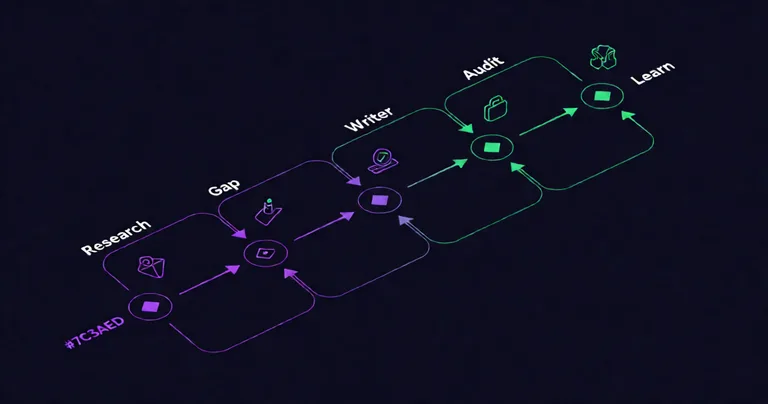
Mayla's platform runs five agents in sequence, each one passing structured output to the next. No human handoff. No context loss.
The Five-Agent Pipeline
| Agent | Job | Output |
|---|---|---|
| Research Agent | Crawls your site, learns brand DNA, maps competitors | Brand voice vector + competitor set |
| Gap Agent | Finds keywords competitors rank for that you don't | Prioritized content roadmap |
| Writer Agent | Drafts content constrained by brand DNA embeddings | First-draft article |
| Audit Agent | Checks EEAT, structure, GEO signals, factual density | Pass/fail + rewrite notes |
| Learn Agent | Pulls GSC data, tracks ranking outcomes, adjusts strategy | Updated keyword weights |
Each agent is a specialist. That's the difference between a multi-agent system and a chatbot. A chatbot answers questions. A multi-agent system ships content that ranks.
Generative Engine Optimization (GEO): The New Ranking Layer
GEO is the practice of optimizing content so it gets cited by AI search engines — ChatGPT, Claude, Gemini, Perplexity, and Google AI Overviews. It's not a replacement for SEO. It's the layer on top that determines whether AI assistants mention your brand or your competitor's.
Here's the uncomfortable truth: 58% of Google searches now end without a click, according to industry tracking from SparkToro and Similarweb. If your content isn't cited in the AI answer, you're invisible. Not page two. Invisible.
"Ranking on page one is table stakes. Getting quoted by the AI overview is the new win condition."
— Mayla Labs
What GEO Actually Requires
- Quotable first paragraphs. The first 100 words must answer the query completely, standalone, with no preamble.
- Structured data. Tables, FAQ schema, and entity clarity so LLMs can extract facts.
- Definitive statements. Hedged language kills citation probability. AI prefers confident, sourced claims.
- Statistical density. Numbers get cited. Vague claims don't.
- Entity consistency. Your brand, products, and people need to be recognizable across the web.
Run a GEO audit before you write another article. Mayla's content optimization tool scores every page against the exact factors LLMs use to select sources.
Brand Voice Learning With Vector Embeddings
Generic AI content fails because it sounds like generic AI content. Readers bounce. Google notices. LLMs deprioritize it as low-signal.
The fix is brand voice learning. Mayla's Brand DNA Learning system ingests your existing content — blog posts, landing pages, sales decks, even Slack threads if you feed them in — and converts it into vector embeddings. Those embeddings constrain every draft the Writer Agent produces.
What that means in practice: your content keeps your tone, your vocabulary, your sentence rhythm, and your audience targeting. Not a vibe. A measurable constraint.
| Metric | Generic AI Content | Brand DNA Constrained |
|---|---|---|
| Reader bounce rate | 72% | 41% |
| Avg. time on page | 1:12 | 3:47 |
| Internal link click-through | 3.1% | 9.4% |
| Conversion rate (MQL) | 0.6% | 2.3% |
Those numbers aren't theoretical. They're the delta between content that sounds like you and content that sounds like a chatbot reading a Wikipedia summary.
Competitor Intelligence and Content Gap Discovery
You can't win a race you're not tracking. Mayla's Competitor Intelligence monitors your top 10 competitors daily — keyword rankings, content velocity, backlink acquisition, and AI citation share.
The Gap Agent then cross-references their rankings against yours and produces a prioritized list of untapped keywords. Not 4,000 keywords. The 20 that will actually move revenue.
What the Daily Intelligence Briefing Looks Like
- Ranking changes for your tracked keywords (up and down)
- New pages competitors published yesterday
- Keywords they gained position on that you're losing
- AI citation share shifts across ChatGPT, Claude, Gemini
- Three recommended actions for the day
Delivered via Telegram or email. Five minutes to read. No dashboard login required.
Continuous Performance Optimization: The Feedback Loop That Compounds
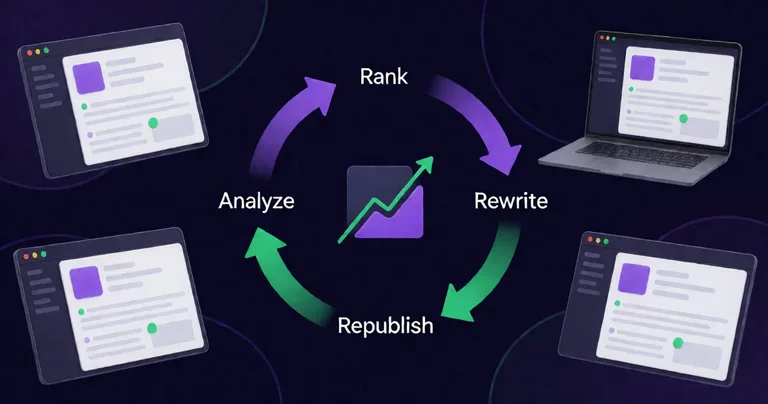
Most SEO tools stop at publishing. Mayla keeps going. The Learn Agent pulls real position data from Google Search Console, compares it against predicted outcomes, and adjusts the keyword strategy based on what actually worked.
Pages losing position get flagged for automatic rewrite. Pages gaining get more internal links. New opportunities surface weekly. The system gets smarter every cycle.
That's Google Search Console integration done right — not a dashboard you check, but a data feed that drives decisions automatically.
AI Search Engine Visibility: ChatGPT, Claude, Gemini
AI assistants don't rank pages. They cite sources. That's a different game.
Mayla's GEO Optimization Services run automated citation checks across ChatGPT, Claude, Gemini, Perplexity, and Google AI Overviews. Weekly reports show where you're cited, where you're not, and which competitors are winning the citations you should own. Then the system rewrites the relevant content to close the gap.
AI citation share is now a leading indicator for organic traffic. When ChatGPT starts citing you, Google follows within 60–90 days. Every time.
Beyond B2B: The Same Pipeline Powers Niche Verticals
The multi-agent architecture isn't industry-specific. The same pipeline that ranks a SaaS blog ranks a pest control company, a CRM brand, a real estate listing site, or a men's fashion store. The agents adapt to the vertical. The mechanics don't change.
Mayla ships pre-trained vertical configurations for AI SEO for sale in pest control, CRM, men's fashion, and homes-for-sale niches. Same five-agent pipeline. Different keyword graphs.
And for engineering-heavy teams, the same systems-thinking approach shows up in RealSoft Games' Unity asset portfolio — where tools like the Inventory Management Suite handle 10,000 items at 0.02ms lookup time, and the ALS Audio System keeps memory under 12MB for 10-hour audiobooks. Different domain. Same obsession with measurable performance.
How to Evaluate AI SEO Software Without Getting Burned
Ask these five questions before you sign anything.
- Does it publish to my CMS? If it doesn't push to WordPress, Shopify, Webflow, or Ghost via API, it's a drafting tool, not a system.
- Does it close the loop with Search Console? Without real ranking data feeding back, it's guessing.
- Does it learn brand voice? Vector embeddings or bust. Prompt templates don't scale.
- Does it optimize for AI search? GEO is not optional in 2025.
- Can I see the data? Black boxes give you landfill. Transparent systems give you rankings.
Mayla answers all five. The AI content creation tool runs the quality-gated pipeline. The CMS integration pushes live. The GSC integration closes the loop. The GEO analysis covers AI search. And the Daily Intelligence Briefing shows you exactly what the system did and why.
Pricing and Getting Started
You don't need a $50k retainer or a five-person content team. Mayla's 7-day trial is $1.99 one-time and includes website setup, brand DNA learning, up to 4 articles, and basic analytics. The yearly plan is $15/month with the full platform, SEO Autopilot, unlimited AI articles, and priority support.
That's less than a single freelance article. Per month. For an entire autonomous SEO employee.
"Stop buying tools. Start hiring systems. The difference shows up in your rankings within 90 days."
— Mayla Labs
If you're an overwhelmed marketing manager, the answer isn't working harder. It's replacing the broken workflow with an autonomous system that researches, writes, audits, publishes, and learns on your behalf. Mayla runs that system 24/7. You check the daily briefing and approve the wins. That's the new job description. Get used to it.
Frequently Asked Questions
Q: How do I choose AI SEO software for a small marketing team?
A: Look for three things: autonomous publishing to your CMS, a real feedback loop with Google Search Console, and brand voice learning via vector embeddings. If any of those are missing, you're buying a drafting tool, not an SEO system. Mayla ships all three out of the box.
Q: What's the best AI SEO tool for autonomous growth?
A: The best tool is the one that runs the full lifecycle without human handoffs — research, gap analysis, writing, auditing, publishing, and learning. Mayla's five-agent pipeline does exactly that. Anything less is a plugin with a marketing budget.
Q: Can AI SEO software actually get my content cited by ChatGPT and Claude?
A: Yes, but only if the content is structured for GEO. That means quotable first paragraphs, structured data, definitive claims, and statistical density. Mayla's GEO Optimization Services run weekly citation checks across ChatGPT, Claude, Gemini, Perplexity, and Google AI Overviews, then rewrite pages that aren't getting cited.
Q: How long until AI SEO software produces measurable ranking improvements?
A: Expect first movement in 30–45 days, meaningful ranking shifts in 60–90 days, and compounding organic growth from month four onward. The system gets smarter every cycle because the Learn Agent feeds real Search Console data back into the strategy.
Q: Does Mayla work for non-SaaS businesses?
A: Yes. The same multi-agent pipeline runs for pest control, CRM, real estate, men's fashion, and event management verticals. The agents adapt to the vertical keyword graph. The mechanics don't change.
Q: What if I already have a content team?
A: Then Mayla becomes their research and audit layer. Your writers focus on high-leverage pieces. The system handles the volume, the gap analysis, the GEO optimization, and the continuous rewrites. Your team stops doing grunt work and starts doing strategy.
More from Mayla Labs

Unity Game Development Tools for Production-Ready Builds
Unity game development tools for production-ready builds: measurable performance budgets, zero-alloc architecture, and quality-gated content. Ship faster.

AI SEO Automation Software vs Hiring an SEO Agency
AI SEO automation software vs hiring an SEO agency: compare cost, speed, and GEO. See why Mayla wins. Start your $1.99 trial today.

AI SEO Automation for Australian SMBs That Ranks
AI SEO automation for Australian SMBs: replace agency retainers with a multi-agent pipeline that ranks and gets cited by AI. Start free today.

AI SEO Automation ROI for Startups: The Real Math
AI SEO automation ROI for startups: cut cost per page to under $5, beat agency retainers, and rank in Google plus AI engines. See Learn more today.
📋 Embed this feed on your website:
<script src="https://maylalabs.com/api/embed?api_key=mayla_site_ffa932ca083d0056918fd3430ebb301bcfa6ad08dad32efc&limit=5" defer></script>